
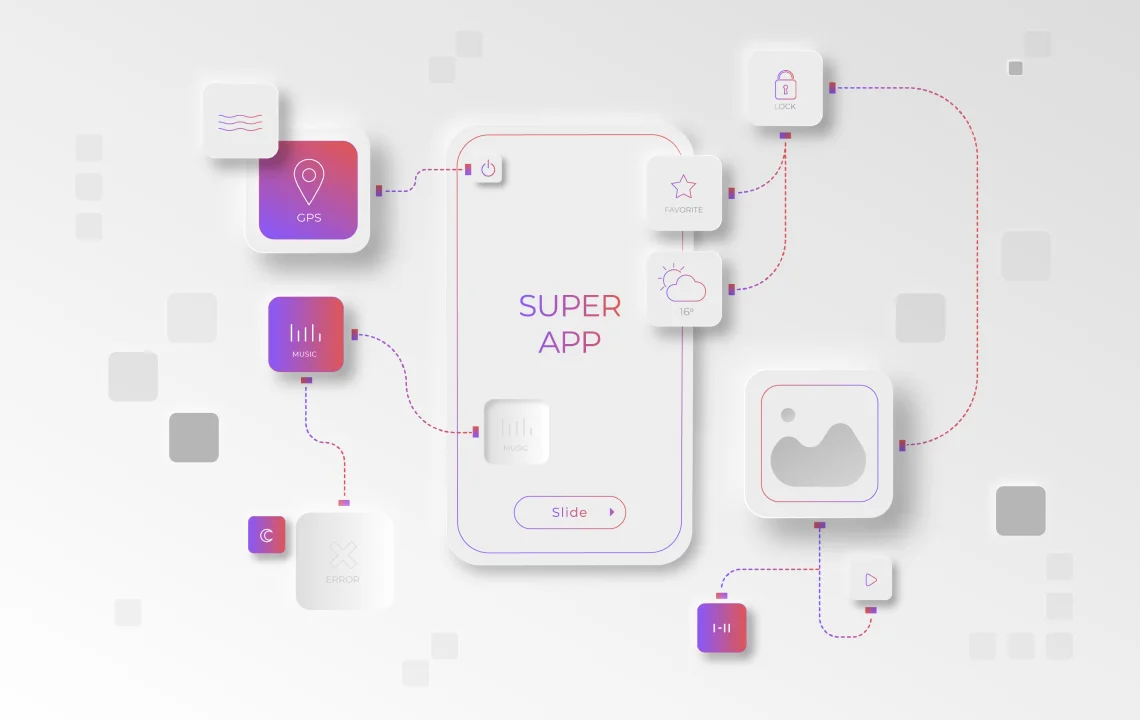
Super Apps Architecture refers to the design and technical foundation of a single mobile application that integrates multiple services into one unified platform. Instead of requiring users to install and manage several separate apps, a super app delivers functionalities such as payments, shopping, messaging, booking, entertainment, and on-demand services within a single interface. This approach simplifies the user experience and increases engagement by centralizing everyday digital needs.
At the heart of super app architecture is a modular and composable design. Each service within the super app functions as an independent module or mini-app. These modules can be developed, tested, deployed, and updated separately, allowing teams to work in parallel and release features faster without impacting the entire application. This modularity is essential for managing complexity at scale.
Microservices architecture plays a critical role in enabling super apps. Backend systems are divided into small, independent services, each responsible for a specific business capability such as payments, user management, orders, or notifications. This separation ensures scalability, fault isolation, and flexibility. If one service experiences an issue, the rest of the platform continues to function smoothly, minimizing disruption for users.
Super apps rely heavily on API gateways to manage communication between the frontend, backend services, and third-party integrations. API gateways handle routing, authentication, rate limiting, and load balancing while enforcing security policies. This centralized control layer ensures efficient data flow and protects internal services from unauthorized access or excessive traffic.
Performance optimization is one of the biggest challenges in super app development. Since multiple services coexist within a single application, efficient resource management is critical. Techniques such as lazy loading, feature-based navigation, code splitting, and on-demand module initialization help maintain smooth performance and fast load times, even as the app grows in complexity.
Strong authentication and identity management systems are essential in super apps. A unified user profile and single sign-on experience allow users to access all services seamlessly. At the same time, role-based access control, data isolation, and encryption ensure that security and privacy are maintained across different modules and services.
Scalability is a major advantage of super apps. These platforms are designed to support millions of users by distributing workloads across microservices and leveraging cloud-native infrastructure. Auto-scaling, caching, and distributed databases enable super apps to handle high traffic volumes while maintaining reliability and performance.
Real-world super apps demonstrate the effectiveness of this architecture by combining services such as digital payments, travel booking, food delivery, ride-hailing, and communication. Their underlying architecture allows rapid feature expansion, easy integration of third-party services, and continuous innovation without disrupting existing users.
In conclusion, Super Apps Architecture enables the creation of scalable, flexible, and user-centric platforms that deliver multiple services through one powerful application. By combining modular design, microservices, API gateways, and cloud-native scalability, super apps represent a modern approach to building comprehensive digital ecosystems within a single mobile experience.
At the heart of super app architecture is a modular and composable design. Each service within the super app functions as an independent module or mini-app. These modules can be developed, tested, deployed, and updated separately, allowing teams to work in parallel and release features faster without impacting the entire application. This modularity is essential for managing complexity at scale.
Microservices architecture plays a critical role in enabling super apps. Backend systems are divided into small, independent services, each responsible for a specific business capability such as payments, user management, orders, or notifications. This separation ensures scalability, fault isolation, and flexibility. If one service experiences an issue, the rest of the platform continues to function smoothly, minimizing disruption for users.
Super apps rely heavily on API gateways to manage communication between the frontend, backend services, and third-party integrations. API gateways handle routing, authentication, rate limiting, and load balancing while enforcing security policies. This centralized control layer ensures efficient data flow and protects internal services from unauthorized access or excessive traffic.
Performance optimization is one of the biggest challenges in super app development. Since multiple services coexist within a single application, efficient resource management is critical. Techniques such as lazy loading, feature-based navigation, code splitting, and on-demand module initialization help maintain smooth performance and fast load times, even as the app grows in complexity.
Strong authentication and identity management systems are essential in super apps. A unified user profile and single sign-on experience allow users to access all services seamlessly. At the same time, role-based access control, data isolation, and encryption ensure that security and privacy are maintained across different modules and services.
Scalability is a major advantage of super apps. These platforms are designed to support millions of users by distributing workloads across microservices and leveraging cloud-native infrastructure. Auto-scaling, caching, and distributed databases enable super apps to handle high traffic volumes while maintaining reliability and performance.
Real-world super apps demonstrate the effectiveness of this architecture by combining services such as digital payments, travel booking, food delivery, ride-hailing, and communication. Their underlying architecture allows rapid feature expansion, easy integration of third-party services, and continuous innovation without disrupting existing users.
In conclusion, Super Apps Architecture enables the creation of scalable, flexible, and user-centric platforms that deliver multiple services through one powerful application. By combining modular design, microservices, API gateways, and cloud-native scalability, super apps represent a modern approach to building comprehensive digital ecosystems within a single mobile experience.