
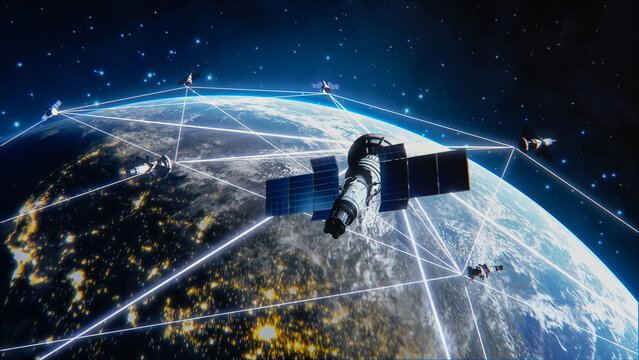
Satellite internet is transforming global communication by delivering high-speed connectivity directly from space. With new low-earth-orbit (LEO) satellite networks like Starlink, OneWeb, and Project Kuiper, high-performance broadband is now reaching remote and underserved regions where traditional fiber infrastructure is impossible or too expensive to build. This course explores how satellite internet works, its advancements, and its role in future digital access.
Students begin with the basics of satellite communication — including satellite orbits, ground stations, frequency bands, and signal transmission. They learn the difference between GEO (Geostationary), MEO (Medium Earth Orbit), and LEO systems and how their distance from Earth impacts latency, coverage, and bandwidth. Understanding these fundamentals helps explain why modern LEO satellites enable faster and more stable internet connectivity.
The course highlights major innovation in phased-array antennas and inter-satellite laser communication. These technologies allow satellites to connect directly with each other and dynamically aim signals toward moving ground receivers. This supports uninterrupted connections even in vehicles, ships, and airplanes — creating truly global mobile internet.
Geo-political and social perspectives are also discussed. Satellite internet can improve access to education, telemedicine, e-commerce, emergency services, and digital identity in rural and disaster-struck areas. It plays a key role in bridging the digital divide, giving every human the opportunity to participate in the global digital economy.
Learners will also examine environmental and regulatory challenges, including space debris, light pollution, and frequency spectrum rights. Governments and space organizations are creating strict guidelines to avoid collisions and interference as the number of satellites rapidly increases in orbit.
Affordability remains a major factor in adoption. Students analyze the cost of user terminals, subscription pricing, and scalability of satellite networks as more competitors enter the market. Case studies show how lower-cost solutions and national subsidies are driving widespread adoption in many developing countries.
Security plays a crucial role in satellite connectivity. The course covers data protection, encrypted communication, cyber-attack prevention in space infrastructure, and national security concerns related to cross-border satellite services. Learners explore how secure networking protocols ensure safe communication from Earth to orbit.
Business and industry growth opportunities are also addressed. Satellite internet is enabling innovations in smart agriculture, remote mining, maritime operations, energy fields, and autonomous vehicles. High-speed space-based connectivity unlocks new commercial models for global enterprises.
By the end of this course, students will understand how satellite internet is shaping the future of worldwide communication. They will be able to evaluate its advantages, limitations, and global importance — preparing them to contribute to technology solutions that make internet access universal, equitable, and future-ready.
Students begin with the basics of satellite communication — including satellite orbits, ground stations, frequency bands, and signal transmission. They learn the difference between GEO (Geostationary), MEO (Medium Earth Orbit), and LEO systems and how their distance from Earth impacts latency, coverage, and bandwidth. Understanding these fundamentals helps explain why modern LEO satellites enable faster and more stable internet connectivity.
The course highlights major innovation in phased-array antennas and inter-satellite laser communication. These technologies allow satellites to connect directly with each other and dynamically aim signals toward moving ground receivers. This supports uninterrupted connections even in vehicles, ships, and airplanes — creating truly global mobile internet.
Geo-political and social perspectives are also discussed. Satellite internet can improve access to education, telemedicine, e-commerce, emergency services, and digital identity in rural and disaster-struck areas. It plays a key role in bridging the digital divide, giving every human the opportunity to participate in the global digital economy.
Learners will also examine environmental and regulatory challenges, including space debris, light pollution, and frequency spectrum rights. Governments and space organizations are creating strict guidelines to avoid collisions and interference as the number of satellites rapidly increases in orbit.
Affordability remains a major factor in adoption. Students analyze the cost of user terminals, subscription pricing, and scalability of satellite networks as more competitors enter the market. Case studies show how lower-cost solutions and national subsidies are driving widespread adoption in many developing countries.
Security plays a crucial role in satellite connectivity. The course covers data protection, encrypted communication, cyber-attack prevention in space infrastructure, and national security concerns related to cross-border satellite services. Learners explore how secure networking protocols ensure safe communication from Earth to orbit.
Business and industry growth opportunities are also addressed. Satellite internet is enabling innovations in smart agriculture, remote mining, maritime operations, energy fields, and autonomous vehicles. High-speed space-based connectivity unlocks new commercial models for global enterprises.
By the end of this course, students will understand how satellite internet is shaping the future of worldwide communication. They will be able to evaluate its advantages, limitations, and global importance — preparing them to contribute to technology solutions that make internet access universal, equitable, and future-ready.