
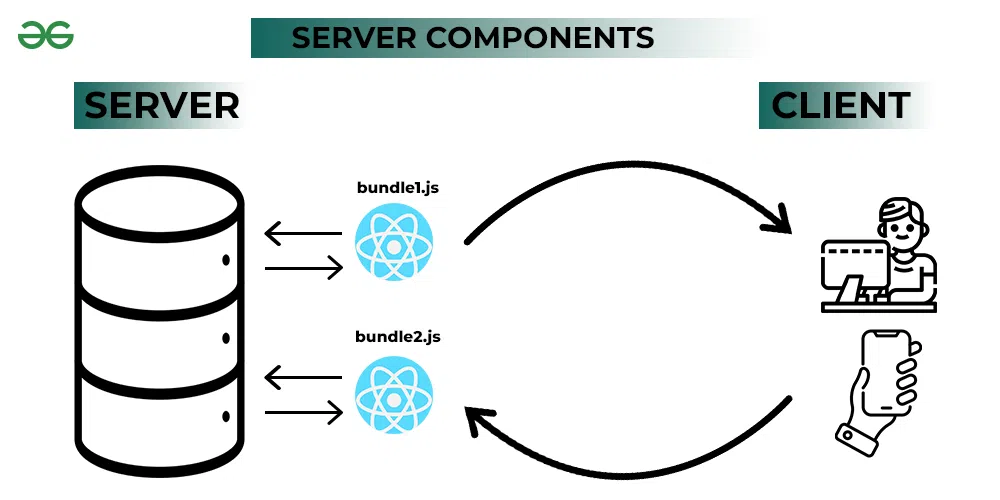
React Server Components (RSCs) represent one of the most significant evolution steps in the React ecosystem since the introduction of hooks. They fundamentally shift how React applications are built, optimized, and delivered. Traditionally, React ran entirely in the browser—fetching data, rendering components, and hydrating UI—all on the client side. This approach created unnecessary JavaScript bundles, slow initial loads, and performance bottlenecks. React Server Components solve these challenges by allowing developers to run components on the server instead of the browser. The server renders UI elements, processes data, and sends a lightweight serialized version of the component tree to the client. As a result, apps load faster, use less JavaScript, and become far more scalable. In a world where performance directly impacts user engagement and business success, RSCs mark a paradigm shift in modern web development.
One of the biggest advantages of React Server Components is zero client-side JavaScript overhead. Server Components run entirely on the server and never ship JavaScript to the browser. This stands in contrast to traditional client components, where every interactive feature required JavaScript bundles that increase load times. With RSCs, pure UI components—like product listings, dashboards, content sections, or static layouts—can be processed server-side. This means heavy data fetching, filtering, sorting, and business logic operate on the server, where computation is more reliable and efficient. The browser receives only the final output in a highly optimized format. This results in lower bundle sizes, reduced network payload, improved Time-to-Interactive (TTI), and smoother performance on low-end devices.
React Server Components also reshape how data fetching works. In traditional client-rendered React, data fetching required multiple steps—network calls from the browser, rendering placeholders, and rehydration once data arrived. With RSCs, data fetching occurs directly on the server, close to the database or API, eliminating latency and unnecessary round trips. Developers can query databases, call APIs, and securely use server-only dependencies inside RSCs without exposing secret keys or sensitive logic to the client. This architecture reduces complexity, improves security, and creates more predictable data flows. When combined with frameworks like Next.js App Router, developers get a deeply integrated data-fetching system that feels natural, intuitive, and extremely efficient.
Another powerful feature of RSCs is their role in enabling streaming and partial hydration. Traditional SSR (Server-Side Rendering) delivered HTML to the browser but still required large hydration bundles to activate interactivity. RSCs introduce a streaming architecture where components can be progressively sent to the client as they resolve. This allows users to see and interact with content much faster. While interactive components (Client Components) still require hydration, RSCs remove the need to hydrate non-interactive parts of the UI entirely. The result is a hybrid model—server-rendered content with client-side interactivity only where needed. This granular approach allows developers to optimize performance at a component level, unlocking experiences much closer to native apps.
The introduction of React Server Components also changes how developers structure applications. Instead of choosing between “server or client rendering” at the page level, developers now decide it at the component level. Server Components can contain other Server Components and Client Components, while Client Components can contain only Client Components. This clear boundary encourages cleaner architecture, separating interactive UI logic from backend logic. UIs become more modular, maintainable, and reusable. This also improves developer experience, as code is more predictable and free from many of the complexities found in full client-side rendering. By thinking in terms of “client where needed, server everywhere else,” engineers can build lean, highly optimized applications that scale easily.
Security benefits also emerge naturally from the RSC model. Since Server Components never run in the browser, they can safely use private environment variables, secrets, database connections, and server-only dependencies. Sensitive logic stays on the server where it is fully protected. This reduces attack surfaces and eliminates risks associated with exposing API keys or backend logic. Furthermore, because RSCs require less JavaScript, the browser has a smaller execution surface, which reduces potential vulnerabilities. When combined with strict package boundaries and framework-level safeguards, React Server Components offer a more secure foundation for building modern applications.
React Server Components shine especially when integrated with Next.js 13+ and its App Router. Next.js provides a unified runtime that handles server rendering, client hydration, streaming, caching, and routing out of the box. With features like automatic caching, React Suspense integration, and parallel data loading, RSCs achieve their full potential. This combination gives developers capabilities like instant page loads, cached server responses, layout-level streaming, and near-zero JavaScript for static sections. The App Router architecture aligns perfectly with the philosophy of RSCs, marking the official transition of Next.js into a full-stack framework. This synergy is why most modern React applications are now shifting toward server-first architectures.
Looking forward, the future of React is unquestionably server-first. As devices diversify, networks fluctuate, and user expectations continue to rise, lightweight and efficient applications are becoming essential. RSCs pave the way for even more advanced optimizations, including AI-driven rendering heuristics, smarter caching layers, and deeper integration with edge computing. Developers will build applications that can dynamically decide what runs on the client, server, or edge depending on user context. This flexibility marks a new era for web development—one focused on performance, modularity, and intelligent resource allocation. React Server Components are not just an improvement; they are the foundation of the next generation of web architecture.
In conclusion, React Server Components represent a groundbreaking advancement that redefines how React applications are built and delivered. By shifting computation to the server, reducing JavaScript in the browser, improving data-fetching efficiency, and enabling streaming architectures, RSCs bring unprecedented performance and scalability. They simplify development, increase security, and create smoother experiences for users. As frameworks like Next.js continue to evolve around RSC principles, the web ecosystem moves firmly toward a server-first future. For developers, embracing React Server Components means building faster, cleaner, and more powerful applications ready for the demands of the modern web.
One of the biggest advantages of React Server Components is zero client-side JavaScript overhead. Server Components run entirely on the server and never ship JavaScript to the browser. This stands in contrast to traditional client components, where every interactive feature required JavaScript bundles that increase load times. With RSCs, pure UI components—like product listings, dashboards, content sections, or static layouts—can be processed server-side. This means heavy data fetching, filtering, sorting, and business logic operate on the server, where computation is more reliable and efficient. The browser receives only the final output in a highly optimized format. This results in lower bundle sizes, reduced network payload, improved Time-to-Interactive (TTI), and smoother performance on low-end devices.
React Server Components also reshape how data fetching works. In traditional client-rendered React, data fetching required multiple steps—network calls from the browser, rendering placeholders, and rehydration once data arrived. With RSCs, data fetching occurs directly on the server, close to the database or API, eliminating latency and unnecessary round trips. Developers can query databases, call APIs, and securely use server-only dependencies inside RSCs without exposing secret keys or sensitive logic to the client. This architecture reduces complexity, improves security, and creates more predictable data flows. When combined with frameworks like Next.js App Router, developers get a deeply integrated data-fetching system that feels natural, intuitive, and extremely efficient.
Another powerful feature of RSCs is their role in enabling streaming and partial hydration. Traditional SSR (Server-Side Rendering) delivered HTML to the browser but still required large hydration bundles to activate interactivity. RSCs introduce a streaming architecture where components can be progressively sent to the client as they resolve. This allows users to see and interact with content much faster. While interactive components (Client Components) still require hydration, RSCs remove the need to hydrate non-interactive parts of the UI entirely. The result is a hybrid model—server-rendered content with client-side interactivity only where needed. This granular approach allows developers to optimize performance at a component level, unlocking experiences much closer to native apps.
The introduction of React Server Components also changes how developers structure applications. Instead of choosing between “server or client rendering” at the page level, developers now decide it at the component level. Server Components can contain other Server Components and Client Components, while Client Components can contain only Client Components. This clear boundary encourages cleaner architecture, separating interactive UI logic from backend logic. UIs become more modular, maintainable, and reusable. This also improves developer experience, as code is more predictable and free from many of the complexities found in full client-side rendering. By thinking in terms of “client where needed, server everywhere else,” engineers can build lean, highly optimized applications that scale easily.
Security benefits also emerge naturally from the RSC model. Since Server Components never run in the browser, they can safely use private environment variables, secrets, database connections, and server-only dependencies. Sensitive logic stays on the server where it is fully protected. This reduces attack surfaces and eliminates risks associated with exposing API keys or backend logic. Furthermore, because RSCs require less JavaScript, the browser has a smaller execution surface, which reduces potential vulnerabilities. When combined with strict package boundaries and framework-level safeguards, React Server Components offer a more secure foundation for building modern applications.
React Server Components shine especially when integrated with Next.js 13+ and its App Router. Next.js provides a unified runtime that handles server rendering, client hydration, streaming, caching, and routing out of the box. With features like automatic caching, React Suspense integration, and parallel data loading, RSCs achieve their full potential. This combination gives developers capabilities like instant page loads, cached server responses, layout-level streaming, and near-zero JavaScript for static sections. The App Router architecture aligns perfectly with the philosophy of RSCs, marking the official transition of Next.js into a full-stack framework. This synergy is why most modern React applications are now shifting toward server-first architectures.
Looking forward, the future of React is unquestionably server-first. As devices diversify, networks fluctuate, and user expectations continue to rise, lightweight and efficient applications are becoming essential. RSCs pave the way for even more advanced optimizations, including AI-driven rendering heuristics, smarter caching layers, and deeper integration with edge computing. Developers will build applications that can dynamically decide what runs on the client, server, or edge depending on user context. This flexibility marks a new era for web development—one focused on performance, modularity, and intelligent resource allocation. React Server Components are not just an improvement; they are the foundation of the next generation of web architecture.
In conclusion, React Server Components represent a groundbreaking advancement that redefines how React applications are built and delivered. By shifting computation to the server, reducing JavaScript in the browser, improving data-fetching efficiency, and enabling streaming architectures, RSCs bring unprecedented performance and scalability. They simplify development, increase security, and create smoother experiences for users. As frameworks like Next.js continue to evolve around RSC principles, the web ecosystem moves firmly toward a server-first future. For developers, embracing React Server Components means building faster, cleaner, and more powerful applications ready for the demands of the modern web.