
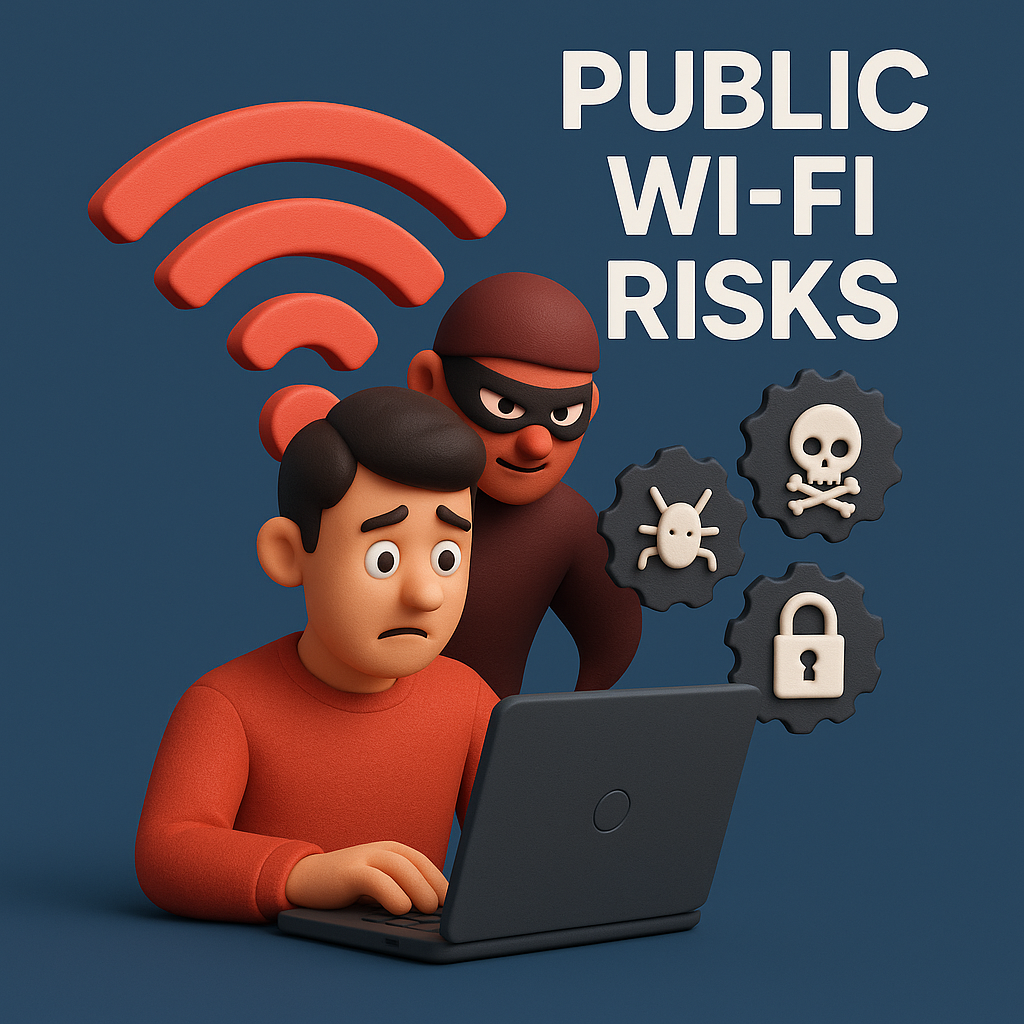
Public Wi-Fi has become a daily convenience, available in cafes, airports, hotels, libraries, malls, waiting rooms, and even public transport. People rely on it to save mobile data, work remotely, or quickly check emails and messages. But behind this convenience lies a major cybersecurity threat. Public Wi-Fi networks are usually open, unencrypted, and poorly configured, making them a playground for hackers. Attackers can intercept traffic, inject malicious code, impersonate networks, steal login details, or even hijack user sessions. Many users falsely assume that simple browsing is safe, but everything from email accounts to banking sessions becomes vulnerable. Understanding the risks of public Wi-Fi is the first step toward building safer online habits.
Public Wi-Fi risks originate from the basic nature of open networks. Since passwords (if any) are shared with everyone, attackers can easily join the same network. Many public networks lack encryption, meaning data packets move in plain text. Attackers use tools like Wireshark or packet sniffers to capture unencrypted traffic and analyze it. Even when websites use HTTPS, poorly configured hotspots may force downgrade attacks or redirect users to insecure versions of websites. Man-in-the-middle (MITM) attacks become extremely easy in these environments because hackers position themselves between the user and the internet, silently intercepting every request. With these techniques, attackers can gather emails, passwords, browsing history, and private communications.
One of the most dangerous threats on public networks is the Evil Twin attack. Here, a hacker sets up a fake Wi-Fi hotspot with a name similar to a legitimate one like “Cafe_WiFi”, “Airport_FreeNet”, or “Starbucks_Guest”. Users naturally connect to the stronger or more convenient signal without verifying authenticity. Once connected, everything the user views, types, or receives passes through the attacker’s system. The hacker can capture login credentials, steal session cookies, and inject malware into websites. Because users rarely check the network certificates or legitimacy of public hotspots, evil twin attacks are among the easiest and most effective Wi-Fi threats.
Public Wi-Fi often exposes users to packet sniffing, where attackers capture network traffic to analyze the data flowing across a network. Even though modern apps use encryption, not all services follow strict security rules. Many websites still load mixed content, send metadata in plain text, or expose session identifiers. Attackers can view unencrypted search queries, locations, visited URLs, app requests, device type, and sometimes authentication tokens. With deep packet inspection tools, attackers may reconstruct entire browsing sessions, read chat messages sent through insecure platforms, or identify vulnerabilities in apps. The user might think they are simply checking social media, but their device may silently leak personal information that can be collected and exploited later.
Public Wi-Fi hotspots sometimes become a source of malware distribution. Hackers inject malicious JavaScript into unencrypted traffic or use fake captive portals (login pages) that ask users to “verify identity,” “install a security update,” or “download an app” before granting internet access. These downloads are often trojans, spyware, or adware. Attackers may also push redirects that lead users to phishing websites mimicking banks, email providers, or e-commerce platforms. Since people trust public networks at face value, they unknowingly install harmful apps or enter sensitive information into fake websites. A single malicious file downloaded on public Wi-Fi can compromise a device long after the user has left the hotspot.
Even when users connect to legitimate websites, attackers can hijack sessions through techniques like sidejacking, where stolen session cookies allow hackers to impersonate the user without needing a password. For example, if the user logs into a social media account, the attacker can steal that session token and access the account immediately. Session hijacking becomes easy on public networks that lack encryption or proper isolation. Attackers can access private accounts, post messages, read conversations, reset passwords, or extract personal data. The victim might remain unaware until unusual activity appears, and by then, the hacker may already have full account control.
One of the biggest mistakes users make is performing sensitive activities on public Wi-Fi. Online banking, UPI transactions, shopping, and work-related logins become extremely risky because attackers target financial data. Even though banking apps use encryption, attackers can still exploit vulnerabilities like DNS spoofing, forcing the device to connect to fraudulent servers. They may replace legitimate payment pages with fake ones or capture OTPs, card details, and login credentials. Public Wi-Fi is an unreliable environment for any financial transaction, and even a small mistake can lead to identity theft or monetary loss. For business users, connecting to public Wi-Fi can expose confidential documents, emails, internal dashboards, and corporate credentials.
Despite the risks, people continue to use public Wi-Fi because it is convenient. Fortunately, several measures can significantly reduce exposure. Always avoid accessing financial, banking, or confidential accounts on public networks. Use VPNs to encrypt your traffic and prevent MITM attacks. Enable HTTPS-only mode in browsers to prevent downgrade attacks. Turn off automatic Wi-Fi connection on your phone. Disable file sharing, Bluetooth, AirDrop, and hotspot features. Prefer mobile data or personal hotspots for secure tasks. Use updated antivirus and firewall protection. For extra security, clear cookies and close sensitive apps after using public Wi-Fi. Understanding these practices empowers users to stay safe without giving up the convenience of free internet access.
Public Wi-Fi offers convenience but introduces significant cybersecurity risks because it exposes user data to attackers. From evil twin attacks to malware injections, session hijacking, and data interception, cybercriminals take advantage of unsecured networks to steal personal and financial information. Users must stay alert and adopt safe browsing habits when using public hotspots. Using VPNs, avoiding sensitive tasks, and verifying Wi-Fi authenticity can drastically reduce the risk. With awareness and the right precautions, users can enjoy the benefits of public Wi-Fi without falling victim to cyber threats. In cybersecurity, knowledge and caution are the most powerful tools for protecting yourself online.
Public Wi-Fi risks originate from the basic nature of open networks. Since passwords (if any) are shared with everyone, attackers can easily join the same network. Many public networks lack encryption, meaning data packets move in plain text. Attackers use tools like Wireshark or packet sniffers to capture unencrypted traffic and analyze it. Even when websites use HTTPS, poorly configured hotspots may force downgrade attacks or redirect users to insecure versions of websites. Man-in-the-middle (MITM) attacks become extremely easy in these environments because hackers position themselves between the user and the internet, silently intercepting every request. With these techniques, attackers can gather emails, passwords, browsing history, and private communications.
One of the most dangerous threats on public networks is the Evil Twin attack. Here, a hacker sets up a fake Wi-Fi hotspot with a name similar to a legitimate one like “Cafe_WiFi”, “Airport_FreeNet”, or “Starbucks_Guest”. Users naturally connect to the stronger or more convenient signal without verifying authenticity. Once connected, everything the user views, types, or receives passes through the attacker’s system. The hacker can capture login credentials, steal session cookies, and inject malware into websites. Because users rarely check the network certificates or legitimacy of public hotspots, evil twin attacks are among the easiest and most effective Wi-Fi threats.
Public Wi-Fi often exposes users to packet sniffing, where attackers capture network traffic to analyze the data flowing across a network. Even though modern apps use encryption, not all services follow strict security rules. Many websites still load mixed content, send metadata in plain text, or expose session identifiers. Attackers can view unencrypted search queries, locations, visited URLs, app requests, device type, and sometimes authentication tokens. With deep packet inspection tools, attackers may reconstruct entire browsing sessions, read chat messages sent through insecure platforms, or identify vulnerabilities in apps. The user might think they are simply checking social media, but their device may silently leak personal information that can be collected and exploited later.
Public Wi-Fi hotspots sometimes become a source of malware distribution. Hackers inject malicious JavaScript into unencrypted traffic or use fake captive portals (login pages) that ask users to “verify identity,” “install a security update,” or “download an app” before granting internet access. These downloads are often trojans, spyware, or adware. Attackers may also push redirects that lead users to phishing websites mimicking banks, email providers, or e-commerce platforms. Since people trust public networks at face value, they unknowingly install harmful apps or enter sensitive information into fake websites. A single malicious file downloaded on public Wi-Fi can compromise a device long after the user has left the hotspot.
Even when users connect to legitimate websites, attackers can hijack sessions through techniques like sidejacking, where stolen session cookies allow hackers to impersonate the user without needing a password. For example, if the user logs into a social media account, the attacker can steal that session token and access the account immediately. Session hijacking becomes easy on public networks that lack encryption or proper isolation. Attackers can access private accounts, post messages, read conversations, reset passwords, or extract personal data. The victim might remain unaware until unusual activity appears, and by then, the hacker may already have full account control.
One of the biggest mistakes users make is performing sensitive activities on public Wi-Fi. Online banking, UPI transactions, shopping, and work-related logins become extremely risky because attackers target financial data. Even though banking apps use encryption, attackers can still exploit vulnerabilities like DNS spoofing, forcing the device to connect to fraudulent servers. They may replace legitimate payment pages with fake ones or capture OTPs, card details, and login credentials. Public Wi-Fi is an unreliable environment for any financial transaction, and even a small mistake can lead to identity theft or monetary loss. For business users, connecting to public Wi-Fi can expose confidential documents, emails, internal dashboards, and corporate credentials.
Despite the risks, people continue to use public Wi-Fi because it is convenient. Fortunately, several measures can significantly reduce exposure. Always avoid accessing financial, banking, or confidential accounts on public networks. Use VPNs to encrypt your traffic and prevent MITM attacks. Enable HTTPS-only mode in browsers to prevent downgrade attacks. Turn off automatic Wi-Fi connection on your phone. Disable file sharing, Bluetooth, AirDrop, and hotspot features. Prefer mobile data or personal hotspots for secure tasks. Use updated antivirus and firewall protection. For extra security, clear cookies and close sensitive apps after using public Wi-Fi. Understanding these practices empowers users to stay safe without giving up the convenience of free internet access.
Public Wi-Fi offers convenience but introduces significant cybersecurity risks because it exposes user data to attackers. From evil twin attacks to malware injections, session hijacking, and data interception, cybercriminals take advantage of unsecured networks to steal personal and financial information. Users must stay alert and adopt safe browsing habits when using public hotspots. Using VPNs, avoiding sensitive tasks, and verifying Wi-Fi authenticity can drastically reduce the risk. With awareness and the right precautions, users can enjoy the benefits of public Wi-Fi without falling victim to cyber threats. In cybersecurity, knowledge and caution are the most powerful tools for protecting yourself online.