
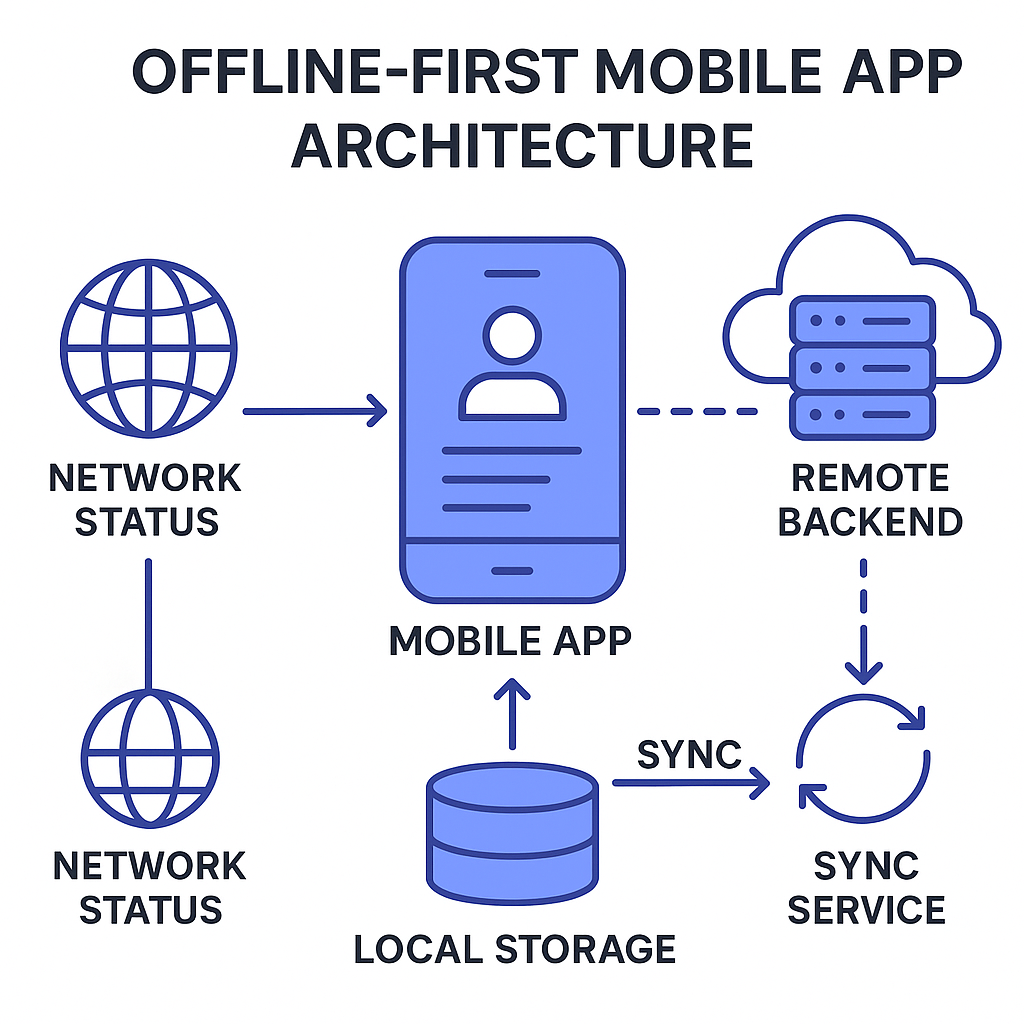
Offline-first mobile app architecture is a modern development approach designed to ensure that applications function smoothly even without an active internet connection. Instead of depending entirely on live server responses, offline-first apps prioritize local storage as the primary data source and sync with the server only when connectivity is available. This model has become essential because users often experience unstable or intermittent networks, especially in rural areas, during travel, or in low-signal environments. The offline-first approach enhances user experience by allowing the app to remain fully functional, responsive, and reliable regardless of connectivity conditions. The concept revolves around storing essential data—such as user profiles, cached screens, forms, images, and app state—locally using technologies like SQLite, Room Database, Hive DB, Secure Storage, Shared Preferences, IndexedDB, or local JSON storage. When the internet reconnects, the app synchronizes any changes with the backend using background sync APIs, queues, delta updates, conflict resolution logic, and timestamps. This architecture is widely used in critical applications such as e-commerce, healthcare, fintech, logistics, ed-tech, note-taking apps, and productivity tools. Offline-first isn’t just a feature—it’s a design philosophy that delivers reliability, speed, and user trust in all situations.
Implementing offline-first architecture requires multiple layers working together seamlessly. The core architecture includes a local database layer, data synchronization layer, network detection layer, and UI state management layer. When a user makes changes offline—such as adding items to a cart, filling a form, creating notes, or updating tasks—these interactions are stored locally first. A synchronization service runs in the background, detecting when an internet connection is restored and syncing the changes with the remote server using batch updates, queued jobs, or background workers. Technologies like WorkManager (Android), BackgroundTasks API (iOS), Firebase Sync, GraphQL Offline Link, Redux Offline, and service workers in PWAs play a major role. To prevent data corruption, the architecture must include conflict resolution strategies, such as “last write wins,” timestamps, versioning, or user-confirmed merges. Additionally, the app must handle cache invalidation, detect partial sync failures, and retry uploads automatically. Developers often adopt patterns such as Repository Pattern, Clean Architecture, or MVVM combined with caching strategies like “read-through cache” or “cache-then-network.” Tools such as Realm, Couchbase Lite, WatermelonDB, and Firebase Firestore provide built-in offline capabilities, making development easier. The goal is to ensure that users can navigate through screens, view cached content, interact with the UI, and perform essential operations without interruption, while keeping the UI consistent and responsive.
Offline-first mobile app architecture offers numerous benefits including high reliability, reduced latency, improved performance, better user experience, and broader accessibility. Apps load faster because they read from local storage rather than waiting for server responses. This approach is especially beneficial for users in low-network regions and helps businesses increase retention, reduce app abandonment rates, and maintain trust. However, implementing offline-first architecture also comes with challenges such as managing complex sync logic, handling large datasets, designing efficient conflict resolution, securing locally stored data, and avoiding excessive storage usage. Developers must also consider encryption, database indexing, and background job scheduling to ensure both security and performance. The future of offline-first architecture is growing rapidly as more apps adopt hybrid sync engines, AI-assisted caching, edge computing, and advanced serverless backends. Technologies like GraphQL subscriptions, distributed data systems, and real-time conflict resolution will make offline-first apps even more powerful. In conclusion, offline-first mobile app architecture is no longer optional—it is becoming a requirement for modern, scalable, user-friendly applications. By designing apps that perform smoothly both online and offline, developers can deliver seamless experiences that meet user expectations and stand strong in real-world connectivity conditions.
Implementing offline-first architecture requires multiple layers working together seamlessly. The core architecture includes a local database layer, data synchronization layer, network detection layer, and UI state management layer. When a user makes changes offline—such as adding items to a cart, filling a form, creating notes, or updating tasks—these interactions are stored locally first. A synchronization service runs in the background, detecting when an internet connection is restored and syncing the changes with the remote server using batch updates, queued jobs, or background workers. Technologies like WorkManager (Android), BackgroundTasks API (iOS), Firebase Sync, GraphQL Offline Link, Redux Offline, and service workers in PWAs play a major role. To prevent data corruption, the architecture must include conflict resolution strategies, such as “last write wins,” timestamps, versioning, or user-confirmed merges. Additionally, the app must handle cache invalidation, detect partial sync failures, and retry uploads automatically. Developers often adopt patterns such as Repository Pattern, Clean Architecture, or MVVM combined with caching strategies like “read-through cache” or “cache-then-network.” Tools such as Realm, Couchbase Lite, WatermelonDB, and Firebase Firestore provide built-in offline capabilities, making development easier. The goal is to ensure that users can navigate through screens, view cached content, interact with the UI, and perform essential operations without interruption, while keeping the UI consistent and responsive.
Offline-first mobile app architecture offers numerous benefits including high reliability, reduced latency, improved performance, better user experience, and broader accessibility. Apps load faster because they read from local storage rather than waiting for server responses. This approach is especially beneficial for users in low-network regions and helps businesses increase retention, reduce app abandonment rates, and maintain trust. However, implementing offline-first architecture also comes with challenges such as managing complex sync logic, handling large datasets, designing efficient conflict resolution, securing locally stored data, and avoiding excessive storage usage. Developers must also consider encryption, database indexing, and background job scheduling to ensure both security and performance. The future of offline-first architecture is growing rapidly as more apps adopt hybrid sync engines, AI-assisted caching, edge computing, and advanced serverless backends. Technologies like GraphQL subscriptions, distributed data systems, and real-time conflict resolution will make offline-first apps even more powerful. In conclusion, offline-first mobile app architecture is no longer optional—it is becoming a requirement for modern, scalable, user-friendly applications. By designing apps that perform smoothly both online and offline, developers can deliver seamless experiences that meet user expectations and stand strong in real-world connectivity conditions.