
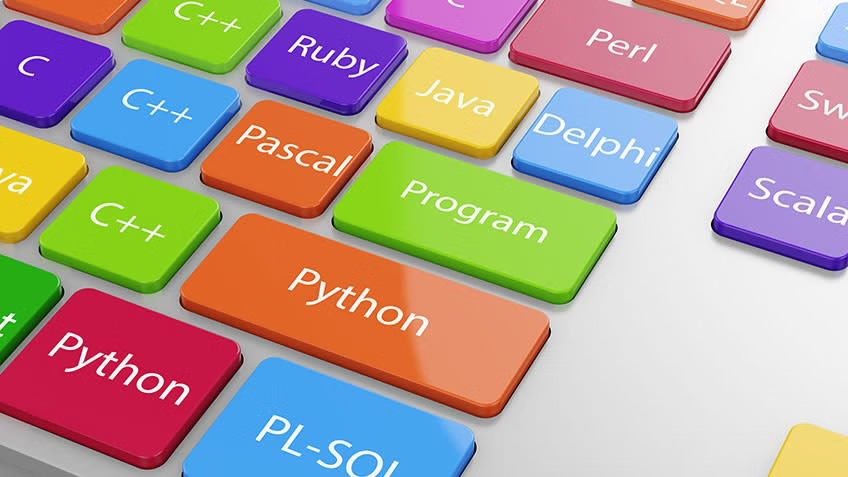
Programming languages are the foundation of software development, enabling developers to communicate instructions to computers. Modern programming languages focus on performance, safety, scalability, and developer productivity. Python, TypeScript, Rust, Go, and Kotlin are widely used today due to their versatility and strong ecosystem support.
Python is known for its simplicity and readability, making it ideal for beginners and professionals alike. It is widely used in data science, artificial intelligence, automation, and web development. Python’s extensive libraries and frameworks allow rapid application development and experimentation.
TypeScript builds on JavaScript by adding static typing and better tooling support. It helps developers write more reliable and maintainable code, especially for large-scale web applications. TypeScript is commonly used in frontend frameworks and enterprise-level projects.
Rust focuses on performance and memory safety without requiring garbage collection. It prevents common bugs such as null pointer dereferencing and data races. Rust is popular in system programming, embedded systems, and performance-critical applications.
Go, also known as Golang, is designed for simplicity and efficiency in distributed systems. It offers fast compilation, built-in concurrency support, and strong performance. Go is widely used in cloud services, microservices, and backend development.
Kotlin is a modern language designed to improve developer productivity while maintaining full compatibility with Java. It is officially supported for Android development and is also used in backend and cross-platform applications. Kotlin reduces boilerplate code and improves code safety.
Each of these languages serves different use cases and development needs. Choosing the right language depends on project requirements, performance goals, and team expertise. Many modern applications use multiple languages to achieve optimal results.
As technology evolves, programming languages continue to adapt. Improvements in tooling, performance, and security ensure these languages remain relevant. Developers benefit from strong communities and continuous innovation.
In conclusion, Python, TypeScript, Rust, Go, and Kotlin represent the future of modern software development. Mastering these languages helps developers build efficient, secure, and scalable applications across various domains.
Python is known for its simplicity and readability, making it ideal for beginners and professionals alike. It is widely used in data science, artificial intelligence, automation, and web development. Python’s extensive libraries and frameworks allow rapid application development and experimentation.
TypeScript builds on JavaScript by adding static typing and better tooling support. It helps developers write more reliable and maintainable code, especially for large-scale web applications. TypeScript is commonly used in frontend frameworks and enterprise-level projects.
Rust focuses on performance and memory safety without requiring garbage collection. It prevents common bugs such as null pointer dereferencing and data races. Rust is popular in system programming, embedded systems, and performance-critical applications.
Go, also known as Golang, is designed for simplicity and efficiency in distributed systems. It offers fast compilation, built-in concurrency support, and strong performance. Go is widely used in cloud services, microservices, and backend development.
Kotlin is a modern language designed to improve developer productivity while maintaining full compatibility with Java. It is officially supported for Android development and is also used in backend and cross-platform applications. Kotlin reduces boilerplate code and improves code safety.
Each of these languages serves different use cases and development needs. Choosing the right language depends on project requirements, performance goals, and team expertise. Many modern applications use multiple languages to achieve optimal results.
As technology evolves, programming languages continue to adapt. Improvements in tooling, performance, and security ensure these languages remain relevant. Developers benefit from strong communities and continuous innovation.
In conclusion, Python, TypeScript, Rust, Go, and Kotlin represent the future of modern software development. Mastering these languages helps developers build efficient, secure, and scalable applications across various domains.