
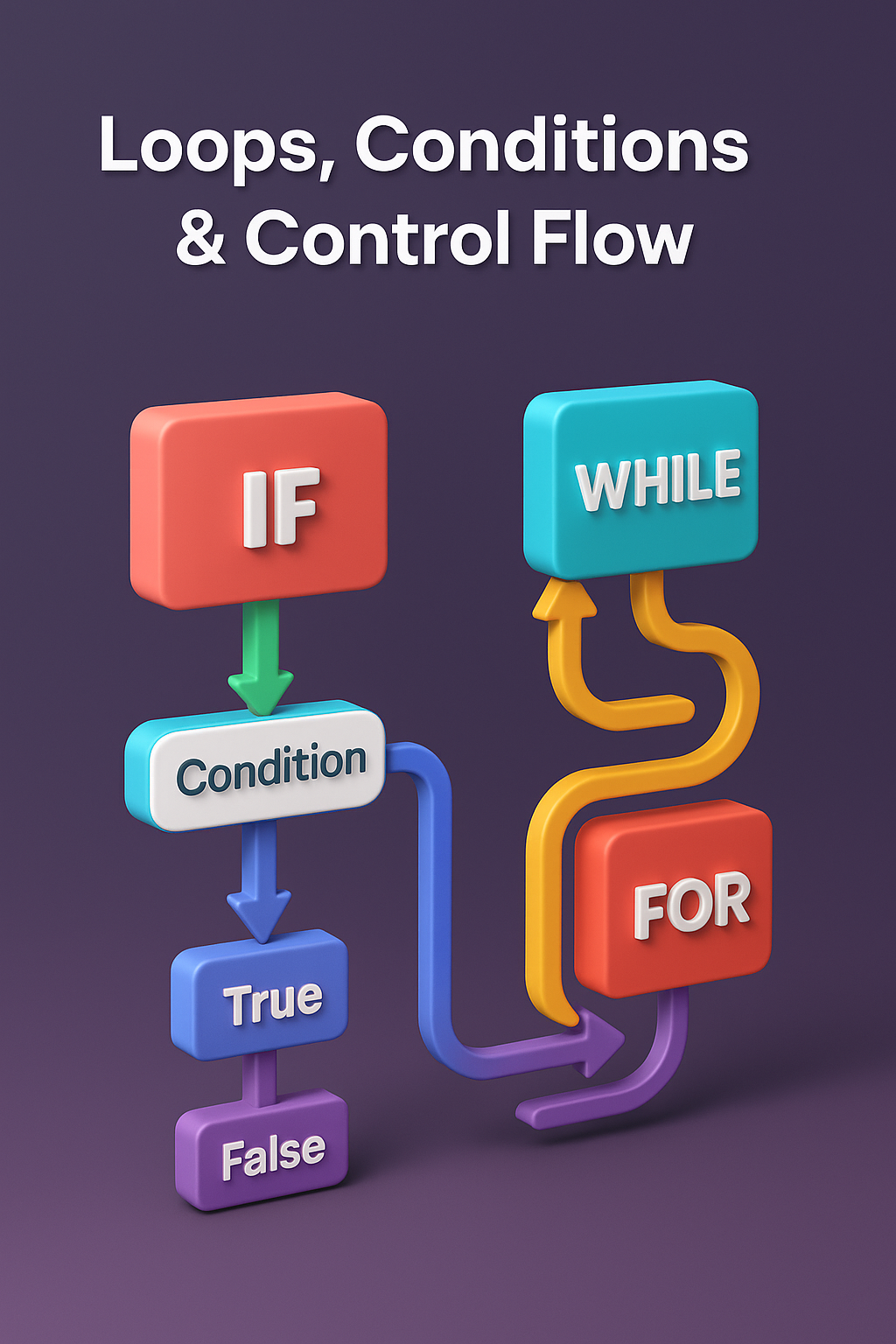
Control flow is the backbone of programming logic, determining how a program executes statements, makes decisions, and repeats operations based on conditions. Every application—whether a calculator, website backend, mobile app, or AI model—depends on well-structured control flow to function correctly. Without it, programs would run line-by-line without the ability to choose different paths or repeat tasks. Control flow enables dynamic behavior, making programs intelligent, responsive, and capable of handling real-world scenarios. Most programming languages implement control flow using three fundamental components: conditions, loops, and branching statements. Together, these constructs allow developers to respond to user input, process data efficiently, and ensure predictable program execution.
Conditional statements form the foundation of decision-making in code. These statements evaluate whether certain conditions are true or false and execute code blocks accordingly. The most common conditional structures include if, else if, and else. They enable programs to respond differently based on the given input. For example, a login system uses conditions to check whether a username and password match stored credentials. Online shopping apps use conditions to determine stock availability. Banking applications use them to validate transactions. More advanced conditions involve logical operators like AND, OR, and NOT, enabling complex decision-making. Conditional logic ensures programs behave correctly, securely, and efficiently under various circumstances.
In real-world software systems, decisions are rarely simple. Nested conditions allow developers to check additional details only if a prior condition is met. For example, verifying that a user is logged in and has admin privileges requires layered conditions. While powerful, nested structures must be used carefully to avoid deep, unreadable blocks known as “pyramid code.” Using switch-case statements for multi-option decisions simplifies code readability and reduces logical complexity. Modern languages such as Python, JavaScript, Java, and Kotlin support pattern matching and enhanced switch expressions that make complex decision-making easier. Clean, structured conditional logic improves maintainability and reduces bugs caused by poorly written branches.
Loops allow programs to repeat tasks efficiently without rewriting code. They are essential when processing lists, running repeated operations, handling large datasets, or automating tasks. The three primary loop types are for loops, while loops, and do-while loops. A for loop is best for running a fixed number of iterations, while a while loop continues until a condition becomes false. Do-while loops execute at least once before checking the condition. Loops eliminate redundancy, reduce code length, and improve performance. Without loops, tasks like reading files, searching large datasets, analyzing logs, or training machine learning models would be inefficient and error-prone.
Most programming languages provide additional control keywords such as break, continue, and sometimes pass. Break immediately terminates a loop when a certain condition is met, while continue skips the remaining statements in the current iteration and moves to the next cycle. These tools provide granular control over how loops behave and are essential when optimizing performance or preventing unnecessary computation. When working with nested loops—such as processing two-dimensional arrays or matrices—managing control flow becomes even more critical. Developers must understand how inner and outer loops interact to avoid logic errors and performance bottlenecks. Efficient loop usage can significantly reduce program execution time.
Loops and conditions are used throughout modern software systems. In web development, loops iterate through database records to render lists of products, comments, or media. In machine learning, loops train models over thousands of epochs. In gaming, conditions determine player movements, collisions, and scoring logic. IoT systems use loops to continuously monitor sensors, and cybersecurity tools use them to analyze logs and detect anomalies. Financial systems use control flow to validate transactions, calculate interest, process payroll, and handle thousands of clients simultaneously. These real-world applications showcase how deeply integrated loops and decision structures are within the digital world.
Efficient control flow is key to building fast, scalable software. Poorly designed loops can degrade performance, especially when dealing with large datasets. Infinite loops—caused by conditions that never become false—can crash applications and freeze systems. Developers must learn to optimize loops by minimizing unnecessary calculations, breaking early when possible, and using appropriate data structures. Similarly, redundant conditions slow down logic and increase cognitive load for future developers. Applying best practices such as refactoring nested conditions, using meaningful variable names, and implementing guard clauses helps produce clean, efficient, and maintainable code. High-performance applications such as trading platforms, real-time analytics engines, and AI systems depend heavily on optimized control flow.
Even with well-structured logic, unexpected conditions may arise—invalid inputs, missing data, network errors, or incorrect configurations. Integrating error handling within loops and conditions prevents crashes and ensures smooth execution. Try-catch blocks, validation checks, and fallback logic allow programs to respond gracefully rather than terminating abruptly. For instance, a file-reading loop must handle cases where the file is missing or corrupted. Network-related loops must manage timeouts and retries. Proper error handling not only improves user experience but also enhances application reliability. Integrating logging inside control flow structures further helps diagnose issues efficiently, especially in large distributed systems.
As programming languages evolve, control flow constructs are becoming more expressive and concise. Functional programming paradigms introduce alternatives to loops such as map, filter, and reduce, promoting a more declarative style. Pattern matching in modern languages simplifies complex conditional logic. Asynchronous loops in JavaScript, Python, and Rust enable non-blocking execution, crucial for APIs and real-time applications. AI-driven tools and compilers increasingly optimize control flow automatically, helping developers write cleaner, faster code. Despite new advancements, the fundamental principles of loops, conditions, and control flow will remain essential. They will continue to be the building blocks of all programming logic across future technologies.
Conditional statements form the foundation of decision-making in code. These statements evaluate whether certain conditions are true or false and execute code blocks accordingly. The most common conditional structures include if, else if, and else. They enable programs to respond differently based on the given input. For example, a login system uses conditions to check whether a username and password match stored credentials. Online shopping apps use conditions to determine stock availability. Banking applications use them to validate transactions. More advanced conditions involve logical operators like AND, OR, and NOT, enabling complex decision-making. Conditional logic ensures programs behave correctly, securely, and efficiently under various circumstances.
In real-world software systems, decisions are rarely simple. Nested conditions allow developers to check additional details only if a prior condition is met. For example, verifying that a user is logged in and has admin privileges requires layered conditions. While powerful, nested structures must be used carefully to avoid deep, unreadable blocks known as “pyramid code.” Using switch-case statements for multi-option decisions simplifies code readability and reduces logical complexity. Modern languages such as Python, JavaScript, Java, and Kotlin support pattern matching and enhanced switch expressions that make complex decision-making easier. Clean, structured conditional logic improves maintainability and reduces bugs caused by poorly written branches.
Loops allow programs to repeat tasks efficiently without rewriting code. They are essential when processing lists, running repeated operations, handling large datasets, or automating tasks. The three primary loop types are for loops, while loops, and do-while loops. A for loop is best for running a fixed number of iterations, while a while loop continues until a condition becomes false. Do-while loops execute at least once before checking the condition. Loops eliminate redundancy, reduce code length, and improve performance. Without loops, tasks like reading files, searching large datasets, analyzing logs, or training machine learning models would be inefficient and error-prone.
Most programming languages provide additional control keywords such as break, continue, and sometimes pass. Break immediately terminates a loop when a certain condition is met, while continue skips the remaining statements in the current iteration and moves to the next cycle. These tools provide granular control over how loops behave and are essential when optimizing performance or preventing unnecessary computation. When working with nested loops—such as processing two-dimensional arrays or matrices—managing control flow becomes even more critical. Developers must understand how inner and outer loops interact to avoid logic errors and performance bottlenecks. Efficient loop usage can significantly reduce program execution time.
Loops and conditions are used throughout modern software systems. In web development, loops iterate through database records to render lists of products, comments, or media. In machine learning, loops train models over thousands of epochs. In gaming, conditions determine player movements, collisions, and scoring logic. IoT systems use loops to continuously monitor sensors, and cybersecurity tools use them to analyze logs and detect anomalies. Financial systems use control flow to validate transactions, calculate interest, process payroll, and handle thousands of clients simultaneously. These real-world applications showcase how deeply integrated loops and decision structures are within the digital world.
Efficient control flow is key to building fast, scalable software. Poorly designed loops can degrade performance, especially when dealing with large datasets. Infinite loops—caused by conditions that never become false—can crash applications and freeze systems. Developers must learn to optimize loops by minimizing unnecessary calculations, breaking early when possible, and using appropriate data structures. Similarly, redundant conditions slow down logic and increase cognitive load for future developers. Applying best practices such as refactoring nested conditions, using meaningful variable names, and implementing guard clauses helps produce clean, efficient, and maintainable code. High-performance applications such as trading platforms, real-time analytics engines, and AI systems depend heavily on optimized control flow.
Even with well-structured logic, unexpected conditions may arise—invalid inputs, missing data, network errors, or incorrect configurations. Integrating error handling within loops and conditions prevents crashes and ensures smooth execution. Try-catch blocks, validation checks, and fallback logic allow programs to respond gracefully rather than terminating abruptly. For instance, a file-reading loop must handle cases where the file is missing or corrupted. Network-related loops must manage timeouts and retries. Proper error handling not only improves user experience but also enhances application reliability. Integrating logging inside control flow structures further helps diagnose issues efficiently, especially in large distributed systems.
As programming languages evolve, control flow constructs are becoming more expressive and concise. Functional programming paradigms introduce alternatives to loops such as map, filter, and reduce, promoting a more declarative style. Pattern matching in modern languages simplifies complex conditional logic. Asynchronous loops in JavaScript, Python, and Rust enable non-blocking execution, crucial for APIs and real-time applications. AI-driven tools and compilers increasingly optimize control flow automatically, helping developers write cleaner, faster code. Despite new advancements, the fundamental principles of loops, conditions, and control flow will remain essential. They will continue to be the building blocks of all programming logic across future technologies.