
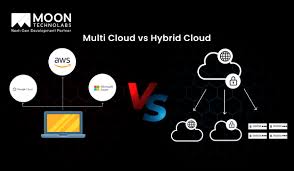
Cloud computing has transformed the way businesses build, deploy, and scale applications. As organizations move toward digital transformation, they increasingly require flexible, secure, and cost-effective cloud infrastructures. Two advanced cloud strategies that have become popular are Hybrid Cloud and Multi-Cloud Architecture. While both approaches involve using multiple computing environments, they differ significantly in purpose, structure, and business impact. A Hybrid Cloud combines on-premise infrastructure with public cloud services, offering a balance between control and scalability. It is ideal for companies with sensitive data, legacy systems, or compliance needs. On the other hand, Multi-Cloud Architecture uses multiple public cloud providers—such as AWS, Azure, and Google Cloud—without relying on a single vendor. This approach enhances redundancy, performance, and cost optimization while reducing the risk of vendor lock-in. As organizations adopt artificial intelligence, big data analytics, IoT applications, and global platforms, the demand for hybrid and multi-cloud models continues to grow. Both architectures bring unique strengths and challenges, shaping how modern businesses operate. Understanding their differences helps companies design cloud strategies that align with long-term goals, data policies, and performance requirements.
Hybrid Cloud architecture integrates on-premise data centers with public cloud environments, creating a unified ecosystem where data and applications move seamlessly between both infrastructures. Companies typically use on-premise systems for sensitive workloads—like financial records, healthcare data, or regulated operations—while leveraging public clouds for scalable workloads, development environments, or data analytics. Hybrid setups are enabled through VPNs, dedicated cloud connections, container orchestration (Kubernetes), and cloud management tools that unify security policies, workload scheduling, and resource monitoring.
The main advantage of Hybrid Cloud is flexibility. Businesses can choose where to store data, how to distribute workloads, and which environment to use for specific tasks. This hybrid model also improves security since critical data remains in-house while leveraging cloud scalability when necessary. Hybrid Cloud is cost-efficient because companies only scale on the public cloud during peak demand instead of investing in expensive hardware. It also supports disaster recovery, enabling seamless failover between on-premise systems and the cloud. Use cases include financial institutions maintaining private servers for transactions, hospitals storing patient data on secure in-house servers, and enterprises using public cloud platforms for development and testing. Hybrid Cloud is ideal for organizations modernizing legacy systems while keeping tight control over sensitive or regulated data.
Multi-Cloud Architecture involves using two or more public cloud providers simultaneously—such as AWS, Google Cloud, Azure, IBM Cloud, or Oracle Cloud. Instead of depending on a single cloud vendor, organizations distribute workloads across multiple clouds to improve redundancy, avoid dependency, and optimize performance. For example, a company may use Google Cloud for AI capabilities, AWS for scalable compute resources, and Azure for enterprise tools. Workloads are strategically assigned based on each cloud provider’s strengths.
One of the biggest advantages of Multi-Cloud is vendor independence. Businesses are not locked into one provider’s pricing, limitations, or service outages. By spreading workloads across multiple platforms, organizations minimize downtime and increase availability. Multi-cloud strategies also improve performance by deploying applications closer to global users through region-specific cloud zones. Cost optimization is another benefit—companies can compare pricing across providers and choose the most cost-effective service for each use case. Multi-Cloud is widely used in industries like e-commerce, streaming, SaaS platforms, gaming, and global enterprises that require high uptime. However, managing multiple cloud platforms can be complex without strong governance, security policies, and monitoring tools. Multi-cloud requires skilled teams who can handle interoperability, networking, cost management, and cross-platform integrations. Despite the challenges, Multi-Cloud is highly effective for companies wanting maximum scalability, business continuity, and competitive advantage.
While both Hybrid and Multi-Cloud architectures offer flexibility, resilience, and scalability, they serve different business needs. Hybrid Cloud focuses on integrating on-premise infrastructure with the cloud, making it ideal for industries with strict compliance, legacy systems, or sensitive data that cannot be fully migrated. Multi-Cloud, in contrast, focuses on leveraging multiple cloud providers, ensuring vendor independence and diversifying capabilities. Hybrid Cloud simplifies security by keeping critical data private, whereas Multi-Cloud enhances availability by distributing workloads globally.
Both architectures come with challenges. Hybrid Cloud requires advanced networking, strong security management, and continuous synchronization between systems. Multi-Cloud suffers from complexity in managing multiple dashboards, tools, pricing models, and compliance policies. Companies must evaluate their technical maturity, business goals, data sensitivity, and regulatory requirements before choosing a model. The future of cloud computing is expected to combine both—Hybrid Multi-Cloud systems where companies use private infrastructure, local data centers, and multiple public cloud providers simultaneously. This approach offers the best of both worlds: control, scalability, global reach, and resilience. As cloud technology evolves with AI-driven automation, edge computing, and containerization, organizations must build flexible cloud strategies that support innovation and long-term growth.
Hybrid Cloud architecture integrates on-premise data centers with public cloud environments, creating a unified ecosystem where data and applications move seamlessly between both infrastructures. Companies typically use on-premise systems for sensitive workloads—like financial records, healthcare data, or regulated operations—while leveraging public clouds for scalable workloads, development environments, or data analytics. Hybrid setups are enabled through VPNs, dedicated cloud connections, container orchestration (Kubernetes), and cloud management tools that unify security policies, workload scheduling, and resource monitoring.
The main advantage of Hybrid Cloud is flexibility. Businesses can choose where to store data, how to distribute workloads, and which environment to use for specific tasks. This hybrid model also improves security since critical data remains in-house while leveraging cloud scalability when necessary. Hybrid Cloud is cost-efficient because companies only scale on the public cloud during peak demand instead of investing in expensive hardware. It also supports disaster recovery, enabling seamless failover between on-premise systems and the cloud. Use cases include financial institutions maintaining private servers for transactions, hospitals storing patient data on secure in-house servers, and enterprises using public cloud platforms for development and testing. Hybrid Cloud is ideal for organizations modernizing legacy systems while keeping tight control over sensitive or regulated data.
Multi-Cloud Architecture involves using two or more public cloud providers simultaneously—such as AWS, Google Cloud, Azure, IBM Cloud, or Oracle Cloud. Instead of depending on a single cloud vendor, organizations distribute workloads across multiple clouds to improve redundancy, avoid dependency, and optimize performance. For example, a company may use Google Cloud for AI capabilities, AWS for scalable compute resources, and Azure for enterprise tools. Workloads are strategically assigned based on each cloud provider’s strengths.
One of the biggest advantages of Multi-Cloud is vendor independence. Businesses are not locked into one provider’s pricing, limitations, or service outages. By spreading workloads across multiple platforms, organizations minimize downtime and increase availability. Multi-cloud strategies also improve performance by deploying applications closer to global users through region-specific cloud zones. Cost optimization is another benefit—companies can compare pricing across providers and choose the most cost-effective service for each use case. Multi-Cloud is widely used in industries like e-commerce, streaming, SaaS platforms, gaming, and global enterprises that require high uptime. However, managing multiple cloud platforms can be complex without strong governance, security policies, and monitoring tools. Multi-cloud requires skilled teams who can handle interoperability, networking, cost management, and cross-platform integrations. Despite the challenges, Multi-Cloud is highly effective for companies wanting maximum scalability, business continuity, and competitive advantage.
While both Hybrid and Multi-Cloud architectures offer flexibility, resilience, and scalability, they serve different business needs. Hybrid Cloud focuses on integrating on-premise infrastructure with the cloud, making it ideal for industries with strict compliance, legacy systems, or sensitive data that cannot be fully migrated. Multi-Cloud, in contrast, focuses on leveraging multiple cloud providers, ensuring vendor independence and diversifying capabilities. Hybrid Cloud simplifies security by keeping critical data private, whereas Multi-Cloud enhances availability by distributing workloads globally.
Both architectures come with challenges. Hybrid Cloud requires advanced networking, strong security management, and continuous synchronization between systems. Multi-Cloud suffers from complexity in managing multiple dashboards, tools, pricing models, and compliance policies. Companies must evaluate their technical maturity, business goals, data sensitivity, and regulatory requirements before choosing a model. The future of cloud computing is expected to combine both—Hybrid Multi-Cloud systems where companies use private infrastructure, local data centers, and multiple public cloud providers simultaneously. This approach offers the best of both worlds: control, scalability, global reach, and resilience. As cloud technology evolves with AI-driven automation, edge computing, and containerization, organizations must build flexible cloud strategies that support innovation and long-term growth.