
Horizontal and vertical scaling are two foundational strategies used to increase the capacity, performance, and reliability of modern web applications. As traffic grows and user demands intensify, web systems must handle more requests without slowing down or failing. Scaling ensures the application remains stable under heavy load. Choosing between horizontal and vertical scaling—or combining both—greatly affects an application's cost, architecture, and long-term flexibility.
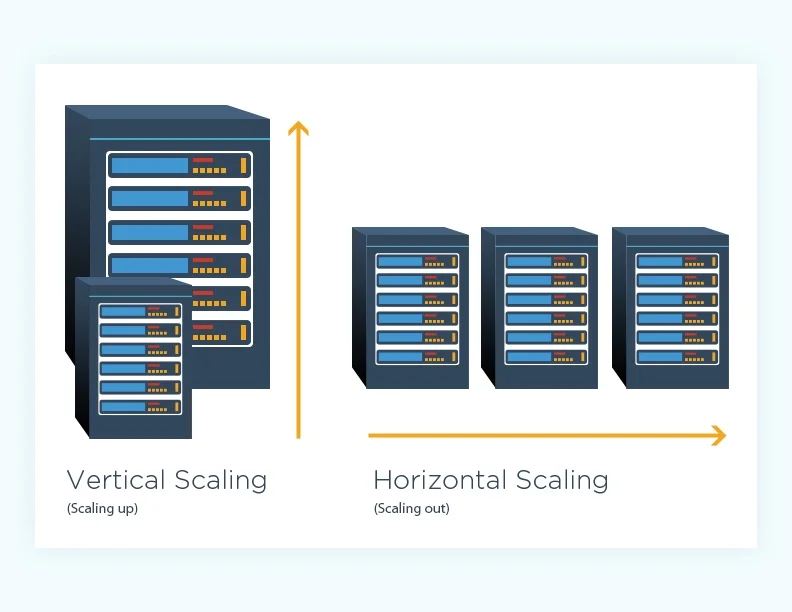
Vertical scaling, often referred to as “scaling up,” involves increasing the power of a single server. This can include adding more CPU cores, increasing RAM, upgrading storage speed, or enhancing network capabilities. Vertical scaling is simple and requires minimal architectural changes, making it attractive for small to medium applications. Developers and system administrators can improve performance quickly by upgrading the hardware or moving to a stronger machine within the cloud environment.
However, vertical scaling has limitations. There is always an upper boundary to how powerful a single server can become. Beyond a certain point, upgrades become extremely expensive and offer diminishing returns. The system also remains a single point of failure—if the machine goes down, the entire application may become unavailable. This makes vertical scaling less suitable for mission-critical, high-traffic platforms that need redundancy and seamless failover.
Horizontal scaling, or “scaling out,” involves adding multiple servers to distribute the workload. Instead of relying on one powerful machine, the application runs across many smaller ones working together. This approach requires load balancers, distributed databases, and architecture designed for concurrency, but it offers far greater flexibility and reliability. By adding more nodes, organizations can match increasing traffic without rebuilding their entire system.
Horizontal scaling is commonly used in modern cloud-native applications, microservices architectures, and large web platforms like e-commerce sites, streaming services, and social networks. It improves fault tolerance because even if one server fails, the system continues running with the remaining nodes. This extraction of workloads across multiple servers also makes it easier to deploy updates, perform maintenance, and optimize performance without downtime.
One challenge of horizontal scaling is architectural complexity. Systems must be designed for statelessness, shared storage, distributed caching, and synchronized databases. Not all applications are built this way out of the box. Teams often need to refactor their backend logic and adopt cloud-friendly patterns. Despite the upfront effort, horizontal scaling promises long-term benefits for applications that expect continuous growth.
Cost is another factor when choosing between these two strategies. Vertical scaling tends to be cheaper and simpler at the early stages of a project, but costs rise rapidly as hardware upgrades become premium. Horizontal scaling, on the other hand, may require more engineering effort initially but provides greater cost efficiency and smoother scalability as the user base expands. Cloud providers also support auto-scaling, making horizontal scaling easier than ever before.
Together, horizontal and vertical scaling provide a complete toolkit for managing application performance. Many real-world systems use a hybrid approach—vertically scaling to a reasonable limit, then adding horizontal servers once the workload demands distribution. This ensures optimal performance while controlling costs and preserving system stability. Understanding these scaling strategies helps developers and architects design resilient, future-proof applications that can handle growth confidently.
Vertical scaling, often referred to as “scaling up,” involves increasing the power of a single server. This can include adding more CPU cores, increasing RAM, upgrading storage speed, or enhancing network capabilities. Vertical scaling is simple and requires minimal architectural changes, making it attractive for small to medium applications. Developers and system administrators can improve performance quickly by upgrading the hardware or moving to a stronger machine within the cloud environment.
However, vertical scaling has limitations. There is always an upper boundary to how powerful a single server can become. Beyond a certain point, upgrades become extremely expensive and offer diminishing returns. The system also remains a single point of failure—if the machine goes down, the entire application may become unavailable. This makes vertical scaling less suitable for mission-critical, high-traffic platforms that need redundancy and seamless failover.
Horizontal scaling, or “scaling out,” involves adding multiple servers to distribute the workload. Instead of relying on one powerful machine, the application runs across many smaller ones working together. This approach requires load balancers, distributed databases, and architecture designed for concurrency, but it offers far greater flexibility and reliability. By adding more nodes, organizations can match increasing traffic without rebuilding their entire system.
Horizontal scaling is commonly used in modern cloud-native applications, microservices architectures, and large web platforms like e-commerce sites, streaming services, and social networks. It improves fault tolerance because even if one server fails, the system continues running with the remaining nodes. This extraction of workloads across multiple servers also makes it easier to deploy updates, perform maintenance, and optimize performance without downtime.
One challenge of horizontal scaling is architectural complexity. Systems must be designed for statelessness, shared storage, distributed caching, and synchronized databases. Not all applications are built this way out of the box. Teams often need to refactor their backend logic and adopt cloud-friendly patterns. Despite the upfront effort, horizontal scaling promises long-term benefits for applications that expect continuous growth.
Cost is another factor when choosing between these two strategies. Vertical scaling tends to be cheaper and simpler at the early stages of a project, but costs rise rapidly as hardware upgrades become premium. Horizontal scaling, on the other hand, may require more engineering effort initially but provides greater cost efficiency and smoother scalability as the user base expands. Cloud providers also support auto-scaling, making horizontal scaling easier than ever before.
Together, horizontal and vertical scaling provide a complete toolkit for managing application performance. Many real-world systems use a hybrid approach—vertically scaling to a reasonable limit, then adding horizontal servers once the workload demands distribution. This ensures optimal performance while controlling costs and preserving system stability. Understanding these scaling strategies helps developers and architects design resilient, future-proof applications that can handle growth confidently.