
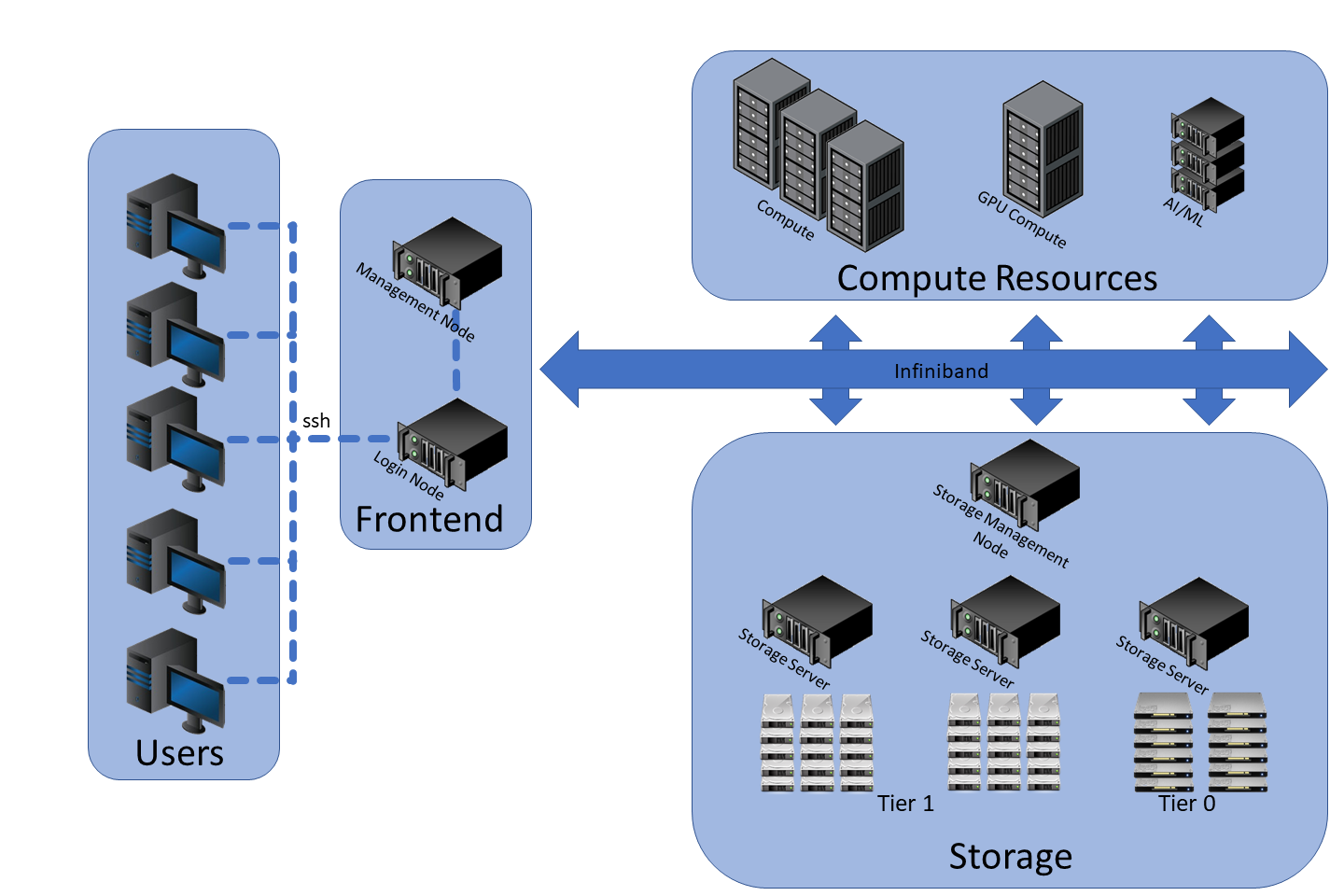
High-Performance Computing (HPC) refers to the use of extremely powerful computing systems—such as supercomputers, clusters, and parallel processors—to solve large, complex, and computation-heavy problems at very high speeds. HPC systems can perform trillions of calculations per second, enabling tasks that ordinary computers cannot handle efficiently. These systems use parallel processing, distributed computing, and high-speed networking to execute multiple operations simultaneously, making them essential for scientific research, engineering simulations, climate modeling, AI training, and real-time big-data processing.
HPC is built around the idea of combining many computing units (CPUs, GPUs, TPUs) in a coordinated cluster to work together on a single task. Instead of processing data sequentially, HPC systems break large problems into smaller parts and process them in parallel. This drastically improves speed, accuracy, and efficiency. Modern supercomputers use thousands of nodes connected through ultra-low-latency networks to deliver maximum performance.
HPC plays a crucial role in fields such as weather forecasting, earthquake simulation, space exploration, nuclear research, cryptanalysis, drug discovery, genetic sequencing, and AI model training. For example, climate scientists use HPC to simulate global weather patterns, while healthcare researchers use it to analyze millions of genetic combinations in minutes. Industries also rely on HPC for financial risk modeling, advanced manufacturing, and autonomous vehicle development.
The architecture of HPC typically includes three components: compute nodes, which perform the actual processing; high-speed interconnects, which allow the nodes to communicate rapidly; and parallel storage systems, which handle massive datasets. To run effectively, HPC systems require specialized software, job schedulers, and optimized algorithms designed for parallel execution.
One of the challenges of HPC is managing heat, power consumption, and cooling requirements. Supercomputers generate enormous heat and require advanced cooling technologies such as liquid cooling or immersion cooling. Additionally, developing algorithms that efficiently scale across thousands of processors is complex.
Advantages
1)Extremely fast computation
2)Handles large scientific and industrial workloads
3)Enables accurate simulations and predictions
4)Boosts innovation in research and engineering
Disadvantages
1)Very high setup and maintenance cost
2)Requires advanced cooling and power systems
3)Complex to program and optimize
4)Needs specialized talent and infrastructure
HPC is built around the idea of combining many computing units (CPUs, GPUs, TPUs) in a coordinated cluster to work together on a single task. Instead of processing data sequentially, HPC systems break large problems into smaller parts and process them in parallel. This drastically improves speed, accuracy, and efficiency. Modern supercomputers use thousands of nodes connected through ultra-low-latency networks to deliver maximum performance.
HPC plays a crucial role in fields such as weather forecasting, earthquake simulation, space exploration, nuclear research, cryptanalysis, drug discovery, genetic sequencing, and AI model training. For example, climate scientists use HPC to simulate global weather patterns, while healthcare researchers use it to analyze millions of genetic combinations in minutes. Industries also rely on HPC for financial risk modeling, advanced manufacturing, and autonomous vehicle development.
The architecture of HPC typically includes three components: compute nodes, which perform the actual processing; high-speed interconnects, which allow the nodes to communicate rapidly; and parallel storage systems, which handle massive datasets. To run effectively, HPC systems require specialized software, job schedulers, and optimized algorithms designed for parallel execution.
One of the challenges of HPC is managing heat, power consumption, and cooling requirements. Supercomputers generate enormous heat and require advanced cooling technologies such as liquid cooling or immersion cooling. Additionally, developing algorithms that efficiently scale across thousands of processors is complex.
Advantages
1)Extremely fast computation
2)Handles large scientific and industrial workloads
3)Enables accurate simulations and predictions
4)Boosts innovation in research and engineering
Disadvantages
1)Very high setup and maintenance cost
2)Requires advanced cooling and power systems
3)Complex to program and optimize
4)Needs specialized talent and infrastructure