
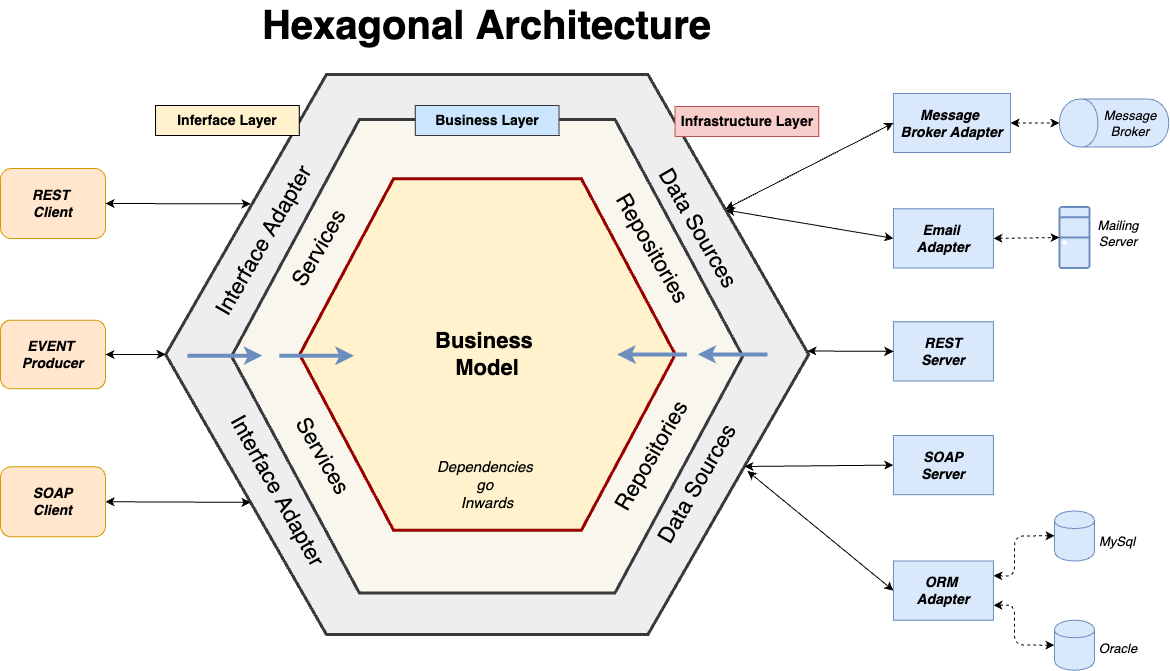
Hexagonal Architecture, also known as the Ports and Adapters Architecture, is a powerful design pattern created to isolate the core business logic of an application from external systems. This architecture emerged as an answer to growing complexity in modern applications, where software often interacts with databases, APIs, user interfaces, messaging systems, and third-party services. In traditional architectures, the business logic easily becomes tightly coupled to these outer systems, making maintenance, testing, and scaling extremely difficult. Hexagonal Architecture solves this by placing the application core at the center, ensuring that business rules remain independent of frameworks, libraries, and external technologies. It allows software to become more modular, flexible, and adaptable to future changes without creating rigid dependencies.
At its heart, Hexagonal Architecture separates the application into two layers: the inner core that contains the domain logic and the outer layer composed of adapters. The inner core includes the essential business rules, domain models, and use cases—these represent the real functionality that the application is supposed to deliver. This core does not know anything about the outside world. It doesn’t know whether the data will come from a MySQL database, a file, an API, or even a mock source used for testing. Its only point of contact with the outside world is through “ports,” which are abstract interfaces defining the required operations. This abstraction ensures that the domain logic remains pure and unaffected by shifting technologies.
The outer layer consists of adapters, which are concrete implementations of those ports. Adapters translate incoming data from external systems into a format that the inner application core understands, and they also convert the core’s output back into a format suitable for external devices or services. These adapters can be user interface components, web controllers, database repositories, messaging queues, or external service integrations. Because adapters depend on ports—not the other way around—they can be replaced or modified without touching the business logic. This creates a highly decoupled architecture where each external dependency becomes a plug-and-play component, enabling developers to change frameworks, databases, or transport layers with minimal effort.
One of the biggest strengths of Hexagonal Architecture is how naturally it supports testing. In traditional layered architectures such as MVC or three-tier systems, unit testing often becomes complicated because domain logic is intertwined with infrastructure code. Developers struggle to test business rules without spinning up databases, running servers, or configuring external dependencies. With Hexagonal Architecture, the domain logic is completely independent, so it can be tested using simple unit tests without any environment setup. Mock implementations of ports make it easy to simulate various conditions, test edge cases, and validate how the domain reacts to expected and unexpected inputs. This drastically reduces test complexity and improves the overall reliability of the software.
Another advantage is long-term maintainability. As applications evolve, requirements change, technologies become outdated, and integrations need upgrades. Traditional architectures often break under such pressure, requiring major rewrites or risky refactoring. Hexagonal Architecture avoids this problem by keeping the domain logic untouched and allowing developers to update only the affected adapters. If the team decides to migrate from REST to GraphQL, from SQL to NoSQL, or from one cloud service to another, they only modify the corresponding adapter without altering the core functionality. This protects the business rules from instability caused by technological churn. In large-scale enterprise systems where longevity is essential, this separation significantly extends the software's lifespan.
Hexagonal Architecture also brings clarity and intention to software design. By forcing a clean separation of concerns, it encourages teams to define explicit domain boundaries. The business layer becomes the heart of the system, expressing the company’s real value and operational rules, while everything else simply supports the domain. This leads to better domain modeling, clearer business workflows, and code that naturally reflects real-world processes. When developers focus on expressing the domain rather than wrestling with frameworks, the result is cleaner and more maintainable code. The architecture promotes principles such as dependency inversion and domain-driven design, making the software resilient to growth and complexity.
In real-world applications, Hexagonal Architecture works exceptionally well with modern software paradigms like microservices. Each microservice can be designed as a standalone hexagon with its own domain logic and dedicated adapters. This creates isolated components that communicate through events or APIs while preserving autonomy. The architecture makes it easier to replace services, scale individual modules, and maintain clear domain boundaries across distributed systems. It also pairs extremely well with DevOps pipelines, enabling teams to deploy updates independently and run comprehensive tests at each layer without interference from external systems. This level of independence is key for systems that require high reliability and rapid iteration.
As software ecosystems continue to grow more complex, Hexagonal Architecture provides stability by avoiding tight coupling between business logic and infrastructure. It enables organizations to adapt quickly to new tools, user interfaces, and deployment environments. Whether the application needs to support mobile clients, web clients, command-line tools, or external partners through APIs, the same domain logic can be reused without modification. This reusability increases efficiency and reduces the risk of inconsistencies across platforms. The architecture’s adaptability also prepares systems for future trends such as serverless computing, cloud-native design, event-driven workflows, and AI-driven automation.
Overall, Hexagonal Architecture is more than a design pattern—it is a philosophy for building software that lasts. It emphasizes clear separation, independence, and modularity. The architecture ensures that business rules remain central, protected from rapid technological changes and external constraints. By using ports and adapters, developers gain the flexibility to integrate new technologies, improve testing efficiency, and evolve the system with confidence. In a world where software requirements shift constantly, Hexagonal Architecture provides a robust, future-proof approach that keeps complexity in check while maintaining clarity, consistency, and high-quality domain design.
At its heart, Hexagonal Architecture separates the application into two layers: the inner core that contains the domain logic and the outer layer composed of adapters. The inner core includes the essential business rules, domain models, and use cases—these represent the real functionality that the application is supposed to deliver. This core does not know anything about the outside world. It doesn’t know whether the data will come from a MySQL database, a file, an API, or even a mock source used for testing. Its only point of contact with the outside world is through “ports,” which are abstract interfaces defining the required operations. This abstraction ensures that the domain logic remains pure and unaffected by shifting technologies.
The outer layer consists of adapters, which are concrete implementations of those ports. Adapters translate incoming data from external systems into a format that the inner application core understands, and they also convert the core’s output back into a format suitable for external devices or services. These adapters can be user interface components, web controllers, database repositories, messaging queues, or external service integrations. Because adapters depend on ports—not the other way around—they can be replaced or modified without touching the business logic. This creates a highly decoupled architecture where each external dependency becomes a plug-and-play component, enabling developers to change frameworks, databases, or transport layers with minimal effort.
One of the biggest strengths of Hexagonal Architecture is how naturally it supports testing. In traditional layered architectures such as MVC or three-tier systems, unit testing often becomes complicated because domain logic is intertwined with infrastructure code. Developers struggle to test business rules without spinning up databases, running servers, or configuring external dependencies. With Hexagonal Architecture, the domain logic is completely independent, so it can be tested using simple unit tests without any environment setup. Mock implementations of ports make it easy to simulate various conditions, test edge cases, and validate how the domain reacts to expected and unexpected inputs. This drastically reduces test complexity and improves the overall reliability of the software.
Another advantage is long-term maintainability. As applications evolve, requirements change, technologies become outdated, and integrations need upgrades. Traditional architectures often break under such pressure, requiring major rewrites or risky refactoring. Hexagonal Architecture avoids this problem by keeping the domain logic untouched and allowing developers to update only the affected adapters. If the team decides to migrate from REST to GraphQL, from SQL to NoSQL, or from one cloud service to another, they only modify the corresponding adapter without altering the core functionality. This protects the business rules from instability caused by technological churn. In large-scale enterprise systems where longevity is essential, this separation significantly extends the software's lifespan.
Hexagonal Architecture also brings clarity and intention to software design. By forcing a clean separation of concerns, it encourages teams to define explicit domain boundaries. The business layer becomes the heart of the system, expressing the company’s real value and operational rules, while everything else simply supports the domain. This leads to better domain modeling, clearer business workflows, and code that naturally reflects real-world processes. When developers focus on expressing the domain rather than wrestling with frameworks, the result is cleaner and more maintainable code. The architecture promotes principles such as dependency inversion and domain-driven design, making the software resilient to growth and complexity.
In real-world applications, Hexagonal Architecture works exceptionally well with modern software paradigms like microservices. Each microservice can be designed as a standalone hexagon with its own domain logic and dedicated adapters. This creates isolated components that communicate through events or APIs while preserving autonomy. The architecture makes it easier to replace services, scale individual modules, and maintain clear domain boundaries across distributed systems. It also pairs extremely well with DevOps pipelines, enabling teams to deploy updates independently and run comprehensive tests at each layer without interference from external systems. This level of independence is key for systems that require high reliability and rapid iteration.
As software ecosystems continue to grow more complex, Hexagonal Architecture provides stability by avoiding tight coupling between business logic and infrastructure. It enables organizations to adapt quickly to new tools, user interfaces, and deployment environments. Whether the application needs to support mobile clients, web clients, command-line tools, or external partners through APIs, the same domain logic can be reused without modification. This reusability increases efficiency and reduces the risk of inconsistencies across platforms. The architecture’s adaptability also prepares systems for future trends such as serverless computing, cloud-native design, event-driven workflows, and AI-driven automation.
Overall, Hexagonal Architecture is more than a design pattern—it is a philosophy for building software that lasts. It emphasizes clear separation, independence, and modularity. The architecture ensures that business rules remain central, protected from rapid technological changes and external constraints. By using ports and adapters, developers gain the flexibility to integrate new technologies, improve testing efficiency, and evolve the system with confidence. In a world where software requirements shift constantly, Hexagonal Architecture provides a robust, future-proof approach that keeps complexity in check while maintaining clarity, consistency, and high-quality domain design.