
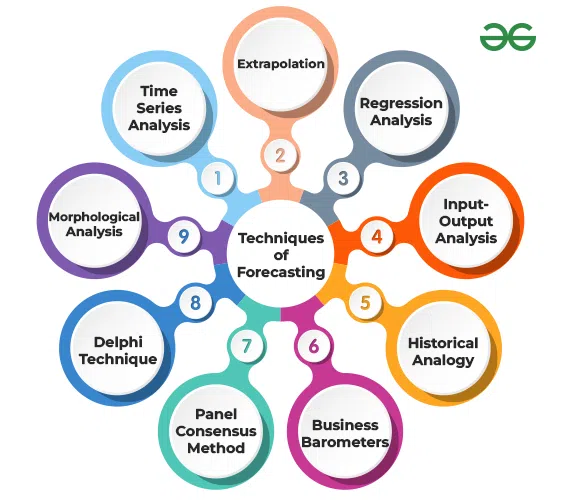
Forecasting techniques are essential tools in data science and analytics used to predict future values based on historical data. Whether estimating next month’s sales, forecasting weather patterns, predicting stock market trends, or estimating production needs, forecasting allows organizations to plan ahead with confidence. These techniques transform past observations into actionable insights by identifying patterns, seasonality, and trends. Forecasting is valuable across industries—retail uses it to manage inventory, finance uses it for portfolio strategy, healthcare uses it to predict patient flow, and transportation uses it to estimate traffic congestion. At the heart of forecasting lies the concept of time series analysis, which studies data points ordered over time and uses them to model future outcomes.
A fundamental step in forecasting involves understanding the components of time series data. Most real-world time series contain elements such as trend, seasonality, cyclic patterns, and random noise. Trends refer to long-term upward or downward movement. Seasonality captures periodic fluctuations due to seasons, months, days, or other recurring intervals. Cycles represent long-term fluctuations that occur irregularly, often influenced by economic or social factors. Finally, random noise consists of unpredictable variations that cannot be explained by any known pattern. Identifying these components helps analysts choose the right forecasting technique, as different models handle these elements differently.
One of the simplest yet effective forecasting methods is the moving average and exponential smoothing family of techniques. Moving averages smooth out data by calculating the average of consecutive data points, making it easier to detect trends. Simple exponential smoothing gives more weight to recent data, making forecasts more responsive to recent changes. Advanced variations like Holt’s Linear Trend Method incorporate trend components, while Holt-Winters Exponential Smoothing handles both trend and seasonality. These smoothing techniques are easy to implement, computationally efficient, and widely used in environments where quick, real-time forecasting is needed.
Regression-based forecasting techniques extend traditional regression to time-series data by identifying relationships between variables. Linear regression can be used when a clear linear trend exists, while multiple regression incorporates several predictors that influence the target variable. For example, energy consumption may depend on temperature, day of the week, and economic activity. Regression analysis helps explain the cause-and-effect relationship and can be combined with time-based features such as lag variables, rolling averages, or time indices. Although regression models are simple, they provide strong interpretability, making them suitable for business scenarios where explanations matter as much as results.
The ARIMA family of models is one of the most widely used forecasting approaches for time series data. ARIMA stands for AutoRegressive Integrated Moving Average, and it combines autoregression (AR), differencing (I), and moving averages (MA) to handle various types of non-seasonal time series patterns. Seasonal ARIMA (SARIMA) extends ARIMA by capturing seasonal components, making it highly effective for data with monthly or quarterly cycles. These models require parameter tuning and diagnostic checks based on autocorrelation and partial autocorrelation plots. When configured correctly, ARIMA/SARIMA models provide highly accurate forecasts and have been the backbone of time series analysis for decades.
Machine learning techniques have increasingly transformed forecasting by allowing models to learn complex relationships beyond linear patterns. Algorithms like Random Forest, Gradient Boosting (XGBoost, LightGBM, CatBoost), and Support Vector Regression (SVR) can handle nonlinear patterns, interactions, and large feature sets. Machine learning models are particularly strong when dealing with multiple external variables, such as pricing, promotions, weather, or social media trends, which traditional time series methods may struggle to incorporate. However, machine learning models often lack interpretability and require feature engineering to extract time-dependent features like lags, rolling windows, and seasonal indicators.
Deep learning has opened new possibilities in forecasting, especially for complex time series involving high-dimensional data, sequential dependencies, or long-term patterns. Recurrent Neural Networks (RNNs), particularly LSTM (Long Short-Term Memory) and GRU models, are designed to capture long-term dependencies in sequential data. These models handle noisy, nonlinear sequences far better than traditional methods. More recently, transformer models—originally developed for natural language processing—have shown exceptional performance in time series forecasting by learning long-range relationships, multi-step predictions, and seasonal structures. Although deep learning requires large datasets and significant computational power, it delivers remarkable accuracy in many modern forecasting applications.
Forecasting also involves evaluating model performance using error metrics such as Mean Absolute Error (MAE), Root Mean Squared Error (RMSE), Mean Absolute Percentage Error (MAPE), and others. These metrics help select the best model for deployment. Cross-validation techniques adapted for time series data, such as rolling-origin evaluation, ensure models are tested realistically by preserving the chronological order of data. Proper evaluation prevents overfitting and improves prediction reliability when the model is used in real-world scenarios. Forecasting is not just about building a model—it’s equally about verifying that the model makes stable, consistent, and dependable predictions.
Effective forecasting requires thoughtful deployment and monitoring. Even the best models degrade over time due to changes in market conditions, consumer behavior, or external events such as pandemics or economic shifts. This concept, known as data drift or concept drift, means that forecasting models must be retrained periodically to stay accurate. Businesses often implement automated pipelines that continuously ingest new data, update forecasts, and evaluate model performance. These pipelines, supported by MLOps frameworks, ensure that forecasting remains dynamic rather than static. When combined with dashboards and visualization tools, forecasting becomes a powerful tool for strategic planning, operational decision-making, and real-time optimization.
Forecasting techniques continue to evolve as technology advances. Hybrid models that combine statistical methods with machine learning or deep learning are becoming popular because they capture both trend-based predictability and complex nonlinear behavior. Cloud platforms provide scalable infrastructure for real-time forecasting, while automated tools simplify model selection and tuning. Regardless of the approach, forecasting remains essential for turning historical data into foresight. Whether used for financial planning, demand prediction, risk assessment, or supply-chain optimization, forecasting empowers organizations to stay ahead by making informed decisions grounded in data-driven predictions.
A fundamental step in forecasting involves understanding the components of time series data. Most real-world time series contain elements such as trend, seasonality, cyclic patterns, and random noise. Trends refer to long-term upward or downward movement. Seasonality captures periodic fluctuations due to seasons, months, days, or other recurring intervals. Cycles represent long-term fluctuations that occur irregularly, often influenced by economic or social factors. Finally, random noise consists of unpredictable variations that cannot be explained by any known pattern. Identifying these components helps analysts choose the right forecasting technique, as different models handle these elements differently.
One of the simplest yet effective forecasting methods is the moving average and exponential smoothing family of techniques. Moving averages smooth out data by calculating the average of consecutive data points, making it easier to detect trends. Simple exponential smoothing gives more weight to recent data, making forecasts more responsive to recent changes. Advanced variations like Holt’s Linear Trend Method incorporate trend components, while Holt-Winters Exponential Smoothing handles both trend and seasonality. These smoothing techniques are easy to implement, computationally efficient, and widely used in environments where quick, real-time forecasting is needed.
Regression-based forecasting techniques extend traditional regression to time-series data by identifying relationships between variables. Linear regression can be used when a clear linear trend exists, while multiple regression incorporates several predictors that influence the target variable. For example, energy consumption may depend on temperature, day of the week, and economic activity. Regression analysis helps explain the cause-and-effect relationship and can be combined with time-based features such as lag variables, rolling averages, or time indices. Although regression models are simple, they provide strong interpretability, making them suitable for business scenarios where explanations matter as much as results.
The ARIMA family of models is one of the most widely used forecasting approaches for time series data. ARIMA stands for AutoRegressive Integrated Moving Average, and it combines autoregression (AR), differencing (I), and moving averages (MA) to handle various types of non-seasonal time series patterns. Seasonal ARIMA (SARIMA) extends ARIMA by capturing seasonal components, making it highly effective for data with monthly or quarterly cycles. These models require parameter tuning and diagnostic checks based on autocorrelation and partial autocorrelation plots. When configured correctly, ARIMA/SARIMA models provide highly accurate forecasts and have been the backbone of time series analysis for decades.
Machine learning techniques have increasingly transformed forecasting by allowing models to learn complex relationships beyond linear patterns. Algorithms like Random Forest, Gradient Boosting (XGBoost, LightGBM, CatBoost), and Support Vector Regression (SVR) can handle nonlinear patterns, interactions, and large feature sets. Machine learning models are particularly strong when dealing with multiple external variables, such as pricing, promotions, weather, or social media trends, which traditional time series methods may struggle to incorporate. However, machine learning models often lack interpretability and require feature engineering to extract time-dependent features like lags, rolling windows, and seasonal indicators.
Deep learning has opened new possibilities in forecasting, especially for complex time series involving high-dimensional data, sequential dependencies, or long-term patterns. Recurrent Neural Networks (RNNs), particularly LSTM (Long Short-Term Memory) and GRU models, are designed to capture long-term dependencies in sequential data. These models handle noisy, nonlinear sequences far better than traditional methods. More recently, transformer models—originally developed for natural language processing—have shown exceptional performance in time series forecasting by learning long-range relationships, multi-step predictions, and seasonal structures. Although deep learning requires large datasets and significant computational power, it delivers remarkable accuracy in many modern forecasting applications.
Forecasting also involves evaluating model performance using error metrics such as Mean Absolute Error (MAE), Root Mean Squared Error (RMSE), Mean Absolute Percentage Error (MAPE), and others. These metrics help select the best model for deployment. Cross-validation techniques adapted for time series data, such as rolling-origin evaluation, ensure models are tested realistically by preserving the chronological order of data. Proper evaluation prevents overfitting and improves prediction reliability when the model is used in real-world scenarios. Forecasting is not just about building a model—it’s equally about verifying that the model makes stable, consistent, and dependable predictions.
Effective forecasting requires thoughtful deployment and monitoring. Even the best models degrade over time due to changes in market conditions, consumer behavior, or external events such as pandemics or economic shifts. This concept, known as data drift or concept drift, means that forecasting models must be retrained periodically to stay accurate. Businesses often implement automated pipelines that continuously ingest new data, update forecasts, and evaluate model performance. These pipelines, supported by MLOps frameworks, ensure that forecasting remains dynamic rather than static. When combined with dashboards and visualization tools, forecasting becomes a powerful tool for strategic planning, operational decision-making, and real-time optimization.
Forecasting techniques continue to evolve as technology advances. Hybrid models that combine statistical methods with machine learning or deep learning are becoming popular because they capture both trend-based predictability and complex nonlinear behavior. Cloud platforms provide scalable infrastructure for real-time forecasting, while automated tools simplify model selection and tuning. Regardless of the approach, forecasting remains essential for turning historical data into foresight. Whether used for financial planning, demand prediction, risk assessment, or supply-chain optimization, forecasting empowers organizations to stay ahead by making informed decisions grounded in data-driven predictions.