
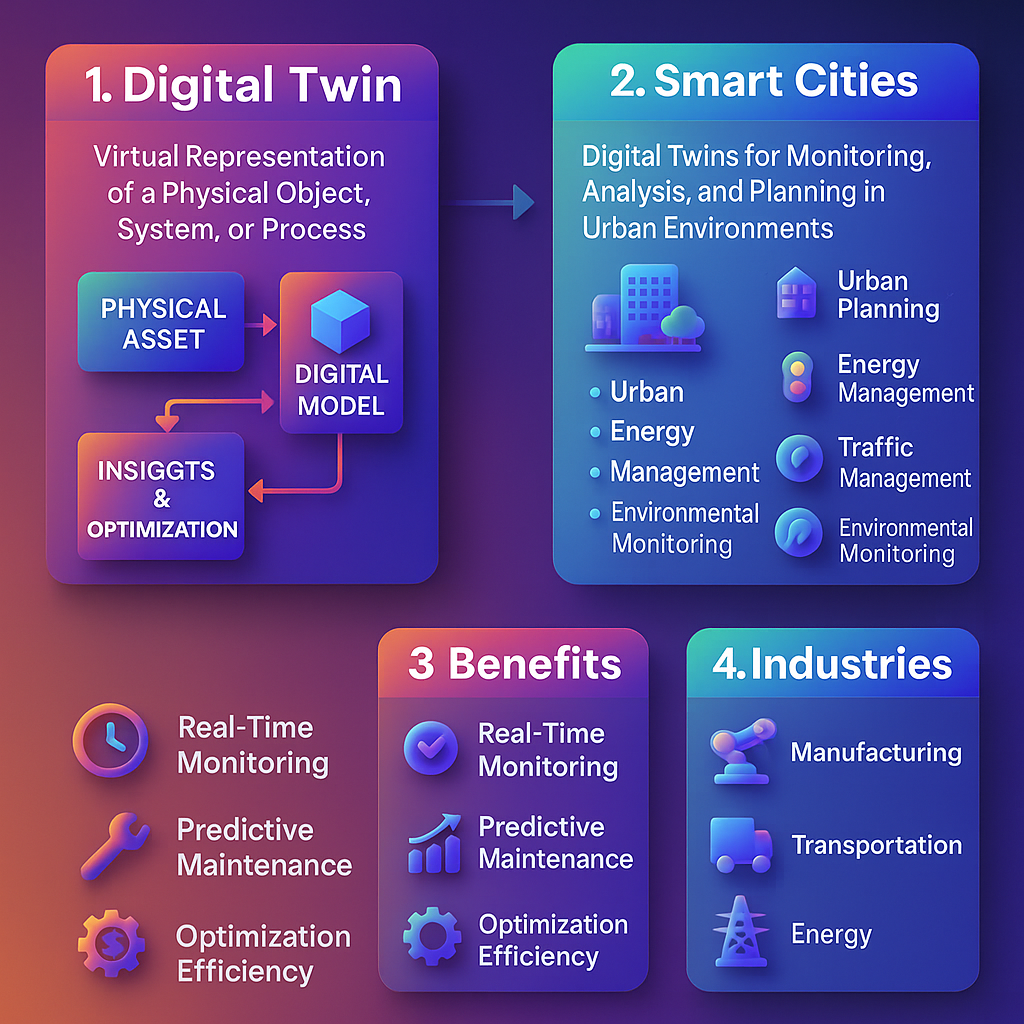
Digital Twins have rapidly emerged as one of the most transformative technologies shaping the future of smart cities and industrial operations. A digital twin is a dynamic, real-time virtual representation of a physical asset, system, or environment. Unlike traditional simulations, digital twins continuously update using live data from sensors, IoT devices, cloud systems, and AI models. This allows the digital replica to mirror the behavior, performance, and condition of the real-world object, enabling advanced monitoring, prediction, optimization, and automation. Today, digital twins are not just tools—they form the digital foundation for smart cities, industrial factories, utilities, transportation networks, and urban planning.
The concept has existed for decades in aerospace and manufacturing, but only in the last few years—because of IoT, AI, 5G, edge computing, and cloud platforms—has the technology become scalable enough for real-time city-level and industry-wide applications. Digital twins are now used to simulate buildings, energy grids, water systems, traffic management, industrial robots, supply chains, and even entire city districts. By analyzing real-time and historical data, digital twins allow organizations to make smarter decisions, reduce operational costs, improve sustainability, and enhance citizen experiences. They provide a “single source of truth” for physical infrastructure, combining engineering, data science, and digital modeling into a unified system.
The Core Components of Digital Twin Technology
Digital twins rely on multiple interconnected technologies. The physical asset is connected to sensor networks and IoT devices, which gather real-time operational data. This data flows through secure networks—often enhanced by 5G or fiber connectivity—to cloud and edge systems. AI algorithms then process data to detect patterns, generate predictions, and simulate future behaviors. Visualization tools—3D models, dashboards, augmented reality—allow users to interact with the digital replica. Finally, control systems send optimized instructions back to the physical environment. This constant loop of sensing, transmitting, analyzing, and acting enables dynamic optimization of physical systems.
Three levels of digital twins exist: component twins, which simulate one part of a machine; system twins, which simulate entire machines or buildings; and city-scale twins, which model entire urban regions. As systems expand, the value grows exponentially. A digital twin becomes not just a model but a living organism that learns, adapts, and evolves continuously.
Digital Twins in Smart Cities
Smart cities use digital twins to improve urban planning, optimize resource use, enhance citizen services, and manage complex infrastructure networks. City-scale twins integrate data from buildings, utilities, transportation systems, traffic cameras, environmental sensors, satellite imagery, and citizen feedback platforms. Urban planners can simulate population growth, energy demand, rainfall patterns, pollution levels, traffic congestion, and emergency response scenarios. For example, a twin may predict how a newly constructed highway will affect traffic patterns or how a change in bus routes will affect average commute time.
Transportation is one of the biggest beneficiaries. Digital twins simulate real-time congestion, analyze traffic flow, and optimize routing for buses, trucks, and public transport. Combined with AI, twins can suggest the best traffic light timings, emergency vehicle routes, or accident management responses. Smart cities like Singapore, Dubai, and Shanghai already operate city-level digital twins that connect roads, public transit, utilities, government services, and energy systems.
Energy and utility management is another major application. A digital twin of an energy grid helps predict outages, balance demand, manage renewable energy input, and reduce carbon emissions. Water distribution twins detect leaks, predict consumption, and optimize pressure levels to avoid pipeline failures. Waste management systems use digital twins to optimize route planning and resource allocation. Environmental modeling is enhanced with real-time air quality monitoring, noise mapping, heat island analysis, and disaster predictions.
Building management is also transformed. Smart buildings equipped with sensors on HVAC systems, lighting, elevators, and security infrastructure can simulate energy usage, occupant movement, and maintenance needs. Digital twins enable predictive maintenance—fixing issues before they occur—which saves millions in operational costs.
Digital Twins in Industry & Manufacturing
Industries leverage digital twins for operational efficiency, predictive maintenance, product lifecycle management, and factory automation. In manufacturing, machines, assembly lines, robots, and entire production plants have digital replicas. These twins help engineers simulate performance, detect failures before downtime occurs, and optimize production parameters. Predictive maintenance powered by digital twins reduces breakdowns, minimizes downtime, and extends the lifespan of equipment.
Digital twins also support real-time quality control. By analyzing sensor data and machine behavior, twins identify deviations that may lead to defective products. Factories use twins to optimize workflows, reduce waste, and improve throughput. Entire supply chains now use digital twins to simulate logistics, inventory levels, transportation delays, and storage conditions.
Industrial automation integrates digital twins with robotics. A robotic arm’s digital twin allows engineers to test motion sequences, optimize performance, and detect safety issues before they occur in real machines. Companies like Siemens, GE, Tesla, and Bosch use digital twins extensively in production.
Benefits of Digital Twins
Digital twins provide a long list of benefits:
• Real-time monitoring improves awareness of system performance.
• Predictive analytics reduce failures and increase reliability.
• Simulation & modeling allow safe testing before real deployment.
• Operational efficiency increases productivity and reduces waste.
• Data-driven decision-making enhances planning and investments.
• Sustainability improves energy use and reduces emissions.
• Citizen experience improves in smart cities through optimized services.
• Cost savings occur from reduced downtime, efficient planning, and automation.
Challenges in Digital Twin Adoption
There are challenges such as high implementation costs, data security risks, interoperability issues, and lack of skilled professionals. Digital twins require enormous computational power, high-quality data, and strong cybersecurity protections. Integrating thousands of sensors, IoT devices, cloud platforms, and legacy systems is complex. Data privacy regulations also impact certain applications. However, rapid advancements in AI, IoT, and cloud systems are reducing barriers.
The Future of Digital Twins
The next era involves autonomous digital twins—systems that not only monitor and predict but also take actions automatically. Combined with AI agents, these twins will autonomously optimize traffic systems, industrial robots, energy grids, and urban utilities. The integration with metaverse, AR/VR, 6G, and quantum computing will elevate digital twins to new levels. Entire nations may soon operate digital replicas for planning infrastructure, agriculture, transportation, and environmental protection.
Digital twins will become the digital backbone of future cities and industries—making environments smarter, safer, more efficient, and highly sustainable. As adoption grows globally, digital twins will evolve into a standard requirement for smart urban development and industrial excellence.
The concept has existed for decades in aerospace and manufacturing, but only in the last few years—because of IoT, AI, 5G, edge computing, and cloud platforms—has the technology become scalable enough for real-time city-level and industry-wide applications. Digital twins are now used to simulate buildings, energy grids, water systems, traffic management, industrial robots, supply chains, and even entire city districts. By analyzing real-time and historical data, digital twins allow organizations to make smarter decisions, reduce operational costs, improve sustainability, and enhance citizen experiences. They provide a “single source of truth” for physical infrastructure, combining engineering, data science, and digital modeling into a unified system.
The Core Components of Digital Twin Technology
Digital twins rely on multiple interconnected technologies. The physical asset is connected to sensor networks and IoT devices, which gather real-time operational data. This data flows through secure networks—often enhanced by 5G or fiber connectivity—to cloud and edge systems. AI algorithms then process data to detect patterns, generate predictions, and simulate future behaviors. Visualization tools—3D models, dashboards, augmented reality—allow users to interact with the digital replica. Finally, control systems send optimized instructions back to the physical environment. This constant loop of sensing, transmitting, analyzing, and acting enables dynamic optimization of physical systems.
Three levels of digital twins exist: component twins, which simulate one part of a machine; system twins, which simulate entire machines or buildings; and city-scale twins, which model entire urban regions. As systems expand, the value grows exponentially. A digital twin becomes not just a model but a living organism that learns, adapts, and evolves continuously.
Digital Twins in Smart Cities
Smart cities use digital twins to improve urban planning, optimize resource use, enhance citizen services, and manage complex infrastructure networks. City-scale twins integrate data from buildings, utilities, transportation systems, traffic cameras, environmental sensors, satellite imagery, and citizen feedback platforms. Urban planners can simulate population growth, energy demand, rainfall patterns, pollution levels, traffic congestion, and emergency response scenarios. For example, a twin may predict how a newly constructed highway will affect traffic patterns or how a change in bus routes will affect average commute time.
Transportation is one of the biggest beneficiaries. Digital twins simulate real-time congestion, analyze traffic flow, and optimize routing for buses, trucks, and public transport. Combined with AI, twins can suggest the best traffic light timings, emergency vehicle routes, or accident management responses. Smart cities like Singapore, Dubai, and Shanghai already operate city-level digital twins that connect roads, public transit, utilities, government services, and energy systems.
Energy and utility management is another major application. A digital twin of an energy grid helps predict outages, balance demand, manage renewable energy input, and reduce carbon emissions. Water distribution twins detect leaks, predict consumption, and optimize pressure levels to avoid pipeline failures. Waste management systems use digital twins to optimize route planning and resource allocation. Environmental modeling is enhanced with real-time air quality monitoring, noise mapping, heat island analysis, and disaster predictions.
Building management is also transformed. Smart buildings equipped with sensors on HVAC systems, lighting, elevators, and security infrastructure can simulate energy usage, occupant movement, and maintenance needs. Digital twins enable predictive maintenance—fixing issues before they occur—which saves millions in operational costs.
Digital Twins in Industry & Manufacturing
Industries leverage digital twins for operational efficiency, predictive maintenance, product lifecycle management, and factory automation. In manufacturing, machines, assembly lines, robots, and entire production plants have digital replicas. These twins help engineers simulate performance, detect failures before downtime occurs, and optimize production parameters. Predictive maintenance powered by digital twins reduces breakdowns, minimizes downtime, and extends the lifespan of equipment.
Digital twins also support real-time quality control. By analyzing sensor data and machine behavior, twins identify deviations that may lead to defective products. Factories use twins to optimize workflows, reduce waste, and improve throughput. Entire supply chains now use digital twins to simulate logistics, inventory levels, transportation delays, and storage conditions.
Industrial automation integrates digital twins with robotics. A robotic arm’s digital twin allows engineers to test motion sequences, optimize performance, and detect safety issues before they occur in real machines. Companies like Siemens, GE, Tesla, and Bosch use digital twins extensively in production.
Benefits of Digital Twins
Digital twins provide a long list of benefits:
• Real-time monitoring improves awareness of system performance.
• Predictive analytics reduce failures and increase reliability.
• Simulation & modeling allow safe testing before real deployment.
• Operational efficiency increases productivity and reduces waste.
• Data-driven decision-making enhances planning and investments.
• Sustainability improves energy use and reduces emissions.
• Citizen experience improves in smart cities through optimized services.
• Cost savings occur from reduced downtime, efficient planning, and automation.
Challenges in Digital Twin Adoption
There are challenges such as high implementation costs, data security risks, interoperability issues, and lack of skilled professionals. Digital twins require enormous computational power, high-quality data, and strong cybersecurity protections. Integrating thousands of sensors, IoT devices, cloud platforms, and legacy systems is complex. Data privacy regulations also impact certain applications. However, rapid advancements in AI, IoT, and cloud systems are reducing barriers.
The Future of Digital Twins
The next era involves autonomous digital twins—systems that not only monitor and predict but also take actions automatically. Combined with AI agents, these twins will autonomously optimize traffic systems, industrial robots, energy grids, and urban utilities. The integration with metaverse, AR/VR, 6G, and quantum computing will elevate digital twins to new levels. Entire nations may soon operate digital replicas for planning infrastructure, agriculture, transportation, and environmental protection.
Digital twins will become the digital backbone of future cities and industries—making environments smarter, safer, more efficient, and highly sustainable. As adoption grows globally, digital twins will evolve into a standard requirement for smart urban development and industrial excellence.