
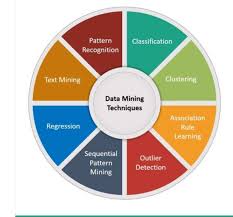
Data mining is one of the most powerful processes used in the data science and analytics world to extract meaningful patterns, knowledge, and insights from massive datasets. It combines statistics, machine learning, database systems, and artificial intelligence to identify hidden trends that businesses can use to make better decisions. In today’s digital ecosystem, organizations collect enormous volumes of structured and unstructured data from websites, apps, transactions, sensors, social media, and IoT devices. Without data mining, this raw data remains unused and offers no value. Data mining applies systematic techniques to detect correlations, clusters, anomalies, relationships, and predictive patterns. Some of the most important data mining techniques include classification, which assigns data into predefined categories using algorithms like decision trees, random forests, SVM, and neural networks; clustering, which groups similar data points without predefined labels using algorithms such as K-means and DBSCAN; regression, used to predict numeric values such as sales, pricing, or demand; association rule learning, which finds meaningful relationships among items, commonly used in market basket analysis; anomaly detection, which identifies unusual patterns, fraud, or abnormal user behavior; dimensionality reduction, which simplifies large datasets using techniques like PCA; and text mining, which extracts patterns from written content. These techniques help businesses forecast trends, personalize user experiences, detect fraud, optimize marketing, and improve operations. The essence of data mining lies in transforming raw, complex, and high-volume data into actionable intelligence.
To perform data mining effectively, professionals rely on a wide range of specialized tools and platforms. Each tool offers unique capabilities such as modeling, automation, interactive visualization, or large-scale processing. Some of the most widely used tools include RapidMiner, an end-to-end platform offering drag-and-drop workflows; WEKA, popular for academic research and machine learning experimentation; KNIME, an open-source tool for analytics pipelines; Orange, known for visual modeling; and SPSS Modeler, used extensively in enterprise predictive analytics. For large-scale data mining, tools such as Apache Hadoop, Apache Spark, Hive, and Pig play a major role, especially when processing big data across distributed environments. Python-based libraries—Scikit-learn, NumPy, Pandas, TensorFlow, and PyTorch—are widely adopted for coding-based data mining. Database-driven mining uses tools like SQL Server Analysis Services (SSAS), Oracle Data Mining, and MySQL ML extensions. Cloud-based platforms such as Azure Machine Learning, Google BigQuery ML, AWS SageMaker, and Databricks allow teams to scale data mining operations seamlessly with built-in automation and large computing power. Industries rely on data mining for a wide range of applications: banking uses it for fraud detection, retail uses it for inventory planning and customer behavior prediction, healthcare applies it for disease prediction and diagnosis analysis, telecom uses it to reduce churn, and marketing teams use it to segment users and personalize campaigns. A typical data mining workflow includes data collection, cleaning, preprocessing, feature engineering, model selection, pattern discovery, evaluation, and deployment. Each step is crucial for obtaining reliable insights. Businesses that master data mining benefit from higher efficiency, enhanced customer experience, reduced risk, and data-driven decision-making.
The future of data mining is evolving rapidly with advancements in artificial intelligence, automation, real-time analytics, and cloud integration. Techniques like deep learning, reinforcement learning, graph analytics, and automated machine learning (AutoML) are pushing the boundaries of what data mining can achieve. Real-time mining of streaming data from IoT devices, social feeds, sensors, and network logs allows organizations to respond instantly to changes—whether predicting equipment failure, monitoring cybersecurity threats, or optimizing traffic systems. Explainable AI (XAI) is becoming essential to ensure that the insights generated from data mining are interpretable, transparent, and ethical. Data mining tools are also shifting toward low-code and no-code platforms, making analytics accessible not only to data scientists but also to business professionals. The importance of data mining will continue to grow as companies depend increasingly on data to make decisions, improve efficiency, and gain competitive advantage. In conclusion, data mining techniques and tools form the backbone of modern analytics. They turn vast amounts of raw data into meaningful insights that drive strategic decisions, innovation, customer satisfaction, and business growth. Whether used in finance, healthcare, e-commerce, telecom, logistics, or cybersecurity, data mining empowers organizations to understand patterns, reduce risks, and make smarter, data-driven choices. As technology advances, the integration of automation, AI, and real-time processing will make data mining even more powerful, accessible, and essential for future-ready businesses.
To perform data mining effectively, professionals rely on a wide range of specialized tools and platforms. Each tool offers unique capabilities such as modeling, automation, interactive visualization, or large-scale processing. Some of the most widely used tools include RapidMiner, an end-to-end platform offering drag-and-drop workflows; WEKA, popular for academic research and machine learning experimentation; KNIME, an open-source tool for analytics pipelines; Orange, known for visual modeling; and SPSS Modeler, used extensively in enterprise predictive analytics. For large-scale data mining, tools such as Apache Hadoop, Apache Spark, Hive, and Pig play a major role, especially when processing big data across distributed environments. Python-based libraries—Scikit-learn, NumPy, Pandas, TensorFlow, and PyTorch—are widely adopted for coding-based data mining. Database-driven mining uses tools like SQL Server Analysis Services (SSAS), Oracle Data Mining, and MySQL ML extensions. Cloud-based platforms such as Azure Machine Learning, Google BigQuery ML, AWS SageMaker, and Databricks allow teams to scale data mining operations seamlessly with built-in automation and large computing power. Industries rely on data mining for a wide range of applications: banking uses it for fraud detection, retail uses it for inventory planning and customer behavior prediction, healthcare applies it for disease prediction and diagnosis analysis, telecom uses it to reduce churn, and marketing teams use it to segment users and personalize campaigns. A typical data mining workflow includes data collection, cleaning, preprocessing, feature engineering, model selection, pattern discovery, evaluation, and deployment. Each step is crucial for obtaining reliable insights. Businesses that master data mining benefit from higher efficiency, enhanced customer experience, reduced risk, and data-driven decision-making.
The future of data mining is evolving rapidly with advancements in artificial intelligence, automation, real-time analytics, and cloud integration. Techniques like deep learning, reinforcement learning, graph analytics, and automated machine learning (AutoML) are pushing the boundaries of what data mining can achieve. Real-time mining of streaming data from IoT devices, social feeds, sensors, and network logs allows organizations to respond instantly to changes—whether predicting equipment failure, monitoring cybersecurity threats, or optimizing traffic systems. Explainable AI (XAI) is becoming essential to ensure that the insights generated from data mining are interpretable, transparent, and ethical. Data mining tools are also shifting toward low-code and no-code platforms, making analytics accessible not only to data scientists but also to business professionals. The importance of data mining will continue to grow as companies depend increasingly on data to make decisions, improve efficiency, and gain competitive advantage. In conclusion, data mining techniques and tools form the backbone of modern analytics. They turn vast amounts of raw data into meaningful insights that drive strategic decisions, innovation, customer satisfaction, and business growth. Whether used in finance, healthcare, e-commerce, telecom, logistics, or cybersecurity, data mining empowers organizations to understand patterns, reduce risks, and make smarter, data-driven choices. As technology advances, the integration of automation, AI, and real-time processing will make data mining even more powerful, accessible, and essential for future-ready businesses.