
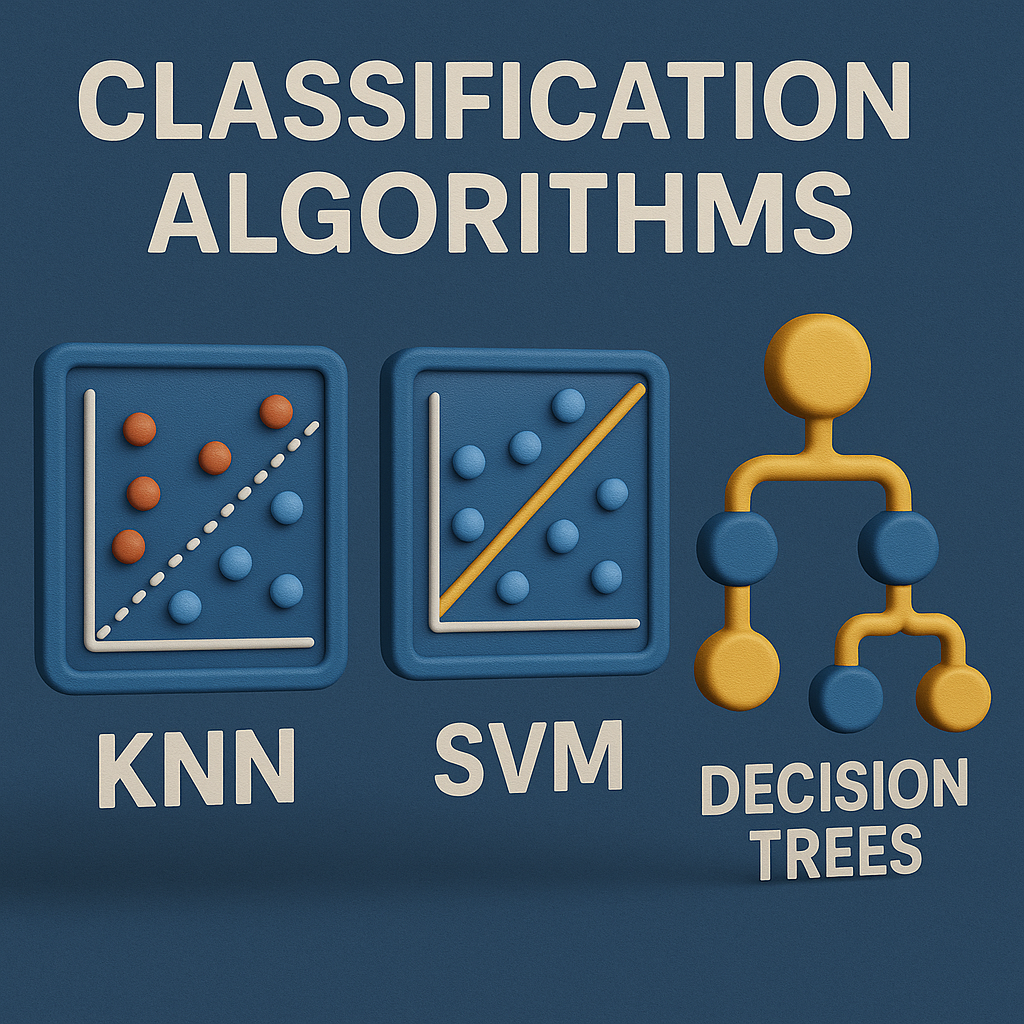
Classification is one of the most fundamental tasks in machine learning. It involves assigning labels or categories to input data based on learned patterns. Email spam detection, disease prediction, customer segmentation, handwriting recognition, and sentiment analysis all rely on classification algorithms. Among the most widely used and intuitive classification models are K-Nearest Neighbors (KNN), Support Vector Machines (SVM), and Decision Trees. Although they solve the same type of problem—classifying data—they work in very different ways, each offering unique strengths and practical applications. Understanding these algorithms forms the foundation for mastering machine learning.
The K-Nearest Neighbors (KNN) algorithm is one of the simplest yet surprisingly powerful classification techniques. It works based on similarity: to classify a new data point, KNN looks at the 'k' closest known data points in the training dataset and assigns the label most common among them. Instead of learning a mathematical model, KNN simply stores the dataset and performs classification during prediction time. This makes KNN a “lazy learning” algorithm. It is ideal for pattern-based problems like recommendation systems, image classification with small datasets, and simple clustering-based applications. However, because KNN calculates distances for every prediction, it can become slow for very large datasets and sensitive to noisy data or irrelevant features.
In contrast, the Support Vector Machine (SVM) is a more advanced and mathematically grounded algorithm used for high-accuracy classification. SVM works by finding the best separating boundary—called a hyperplane—that divides data points of different classes. The goal of SVM is to maximize the margin between classes so the model gains strong generalization ability and avoids overfitting. One of the biggest strengths of SVM is the kernel trick, which allows it to classify even highly non-linear data by projecting it into higher-dimensional space. This makes SVM ideal for tasks like text categorization, handwriting recognition, bioinformatics, and situations where data is complex and not linearly separable. While SVM delivers high accuracy, it requires tuning and can be computationally expensive for extremely large datasets.
Decision Trees offer a very different classification approach. They classify data by asking a series of questions—almost like a flowchart—until a final decision is reached. Each internal node represents a condition on a feature, each branch represents an outcome, and each leaf node represents a class label. Decision trees are intuitive, easy to visualize, and work well with both numerical and categorical data. They can capture non-linear relationships and interactions that simpler linear models struggle with. However, decision trees are prone to overfitting, especially when deep or trained on noisy data. Techniques such as pruning, limiting depth, or using ensemble methods like Random Forests significantly improve their performance.
While KNN, SVM, and Decision Trees are powerful individually, they serve different kinds of problems. KNN performs well when data is small and patterns rely on proximity, while SVM excels when boundaries between classes are complex and require sophisticated separation. Decision Trees are best when interpretability is critical, such as in financial risk assessment or healthcare diagnostics. Understanding these differences helps data scientists choose the right algorithm for the right scenario. In many real-world systems, data scientists test multiple algorithms and compare accuracy, precision, recall, F1-score, and computational efficiency before selecting the final model.
Another important aspect of classification is data preprocessing, which directly affects the performance of all three algorithms. KNN requires features to be scaled because it relies on distance calculations. SVM benefits from normalization and often requires well-structured data without many outliers. Decision Trees do not require feature scaling, but they are sensitive to noisy or correlated attributes. Feature engineering—selecting the right inputs, encoding categorical variables, handling missing values, and performing dimensionality reduction—can dramatically improve accuracy, reduce training time, and prevent overfitting.
These algorithms also differ in terms of computational cost. KNN is simple to implement but slow during prediction, especially for large datasets, because it calculates distance for each new sample. SVM may require heavy computation during training, especially with non-linear kernels. Decision Trees train quickly but can be unstable unless carefully tuned. Choosing between them often depends on dataset size, dimensionality, and available computational resources. In time-critical environments like online recommendation systems, KNN may be too slow, whereas SVM or Decision Trees might deliver faster, more reliable predictions.
Despite their differences, KNN, SVM, and Decision Trees remain essential tools in machine learning because they form the foundation of more complex techniques. Algorithms like Random Forest, XGBoost, and Gradient Boosting Machines build upon decision trees. Support Vector Machines influence modern deep learning models with margin-based loss functions. KNN inspires similarity-based learning techniques used in computer vision and recommendation engines. Learning these three algorithms not only builds strong ML fundamentals but also prepares you for advanced techniques across statistical learning, neural networks, and AI-driven applications.
In conclusion, classification algorithms such as KNN, SVM, and Decision Trees play a key role in modern machine learning. They provide clear, practical approaches to modeling patterns in data, offering different strengths for different use cases. Whether you're building a medical diagnosis model, designing spam filters, predicting customer churn, or handling natural language tasks, a strong understanding of these algorithms will guide you toward better accuracy, optimal performance, and more robust solutions. Mastering the basics of classification sets a solid foundation for every aspiring AI/ML developer and opens the door to deeper exploration of advanced machine learning techniques.
The K-Nearest Neighbors (KNN) algorithm is one of the simplest yet surprisingly powerful classification techniques. It works based on similarity: to classify a new data point, KNN looks at the 'k' closest known data points in the training dataset and assigns the label most common among them. Instead of learning a mathematical model, KNN simply stores the dataset and performs classification during prediction time. This makes KNN a “lazy learning” algorithm. It is ideal for pattern-based problems like recommendation systems, image classification with small datasets, and simple clustering-based applications. However, because KNN calculates distances for every prediction, it can become slow for very large datasets and sensitive to noisy data or irrelevant features.
In contrast, the Support Vector Machine (SVM) is a more advanced and mathematically grounded algorithm used for high-accuracy classification. SVM works by finding the best separating boundary—called a hyperplane—that divides data points of different classes. The goal of SVM is to maximize the margin between classes so the model gains strong generalization ability and avoids overfitting. One of the biggest strengths of SVM is the kernel trick, which allows it to classify even highly non-linear data by projecting it into higher-dimensional space. This makes SVM ideal for tasks like text categorization, handwriting recognition, bioinformatics, and situations where data is complex and not linearly separable. While SVM delivers high accuracy, it requires tuning and can be computationally expensive for extremely large datasets.
Decision Trees offer a very different classification approach. They classify data by asking a series of questions—almost like a flowchart—until a final decision is reached. Each internal node represents a condition on a feature, each branch represents an outcome, and each leaf node represents a class label. Decision trees are intuitive, easy to visualize, and work well with both numerical and categorical data. They can capture non-linear relationships and interactions that simpler linear models struggle with. However, decision trees are prone to overfitting, especially when deep or trained on noisy data. Techniques such as pruning, limiting depth, or using ensemble methods like Random Forests significantly improve their performance.
While KNN, SVM, and Decision Trees are powerful individually, they serve different kinds of problems. KNN performs well when data is small and patterns rely on proximity, while SVM excels when boundaries between classes are complex and require sophisticated separation. Decision Trees are best when interpretability is critical, such as in financial risk assessment or healthcare diagnostics. Understanding these differences helps data scientists choose the right algorithm for the right scenario. In many real-world systems, data scientists test multiple algorithms and compare accuracy, precision, recall, F1-score, and computational efficiency before selecting the final model.
Another important aspect of classification is data preprocessing, which directly affects the performance of all three algorithms. KNN requires features to be scaled because it relies on distance calculations. SVM benefits from normalization and often requires well-structured data without many outliers. Decision Trees do not require feature scaling, but they are sensitive to noisy or correlated attributes. Feature engineering—selecting the right inputs, encoding categorical variables, handling missing values, and performing dimensionality reduction—can dramatically improve accuracy, reduce training time, and prevent overfitting.
These algorithms also differ in terms of computational cost. KNN is simple to implement but slow during prediction, especially for large datasets, because it calculates distance for each new sample. SVM may require heavy computation during training, especially with non-linear kernels. Decision Trees train quickly but can be unstable unless carefully tuned. Choosing between them often depends on dataset size, dimensionality, and available computational resources. In time-critical environments like online recommendation systems, KNN may be too slow, whereas SVM or Decision Trees might deliver faster, more reliable predictions.
Despite their differences, KNN, SVM, and Decision Trees remain essential tools in machine learning because they form the foundation of more complex techniques. Algorithms like Random Forest, XGBoost, and Gradient Boosting Machines build upon decision trees. Support Vector Machines influence modern deep learning models with margin-based loss functions. KNN inspires similarity-based learning techniques used in computer vision and recommendation engines. Learning these three algorithms not only builds strong ML fundamentals but also prepares you for advanced techniques across statistical learning, neural networks, and AI-driven applications.
In conclusion, classification algorithms such as KNN, SVM, and Decision Trees play a key role in modern machine learning. They provide clear, practical approaches to modeling patterns in data, offering different strengths for different use cases. Whether you're building a medical diagnosis model, designing spam filters, predicting customer churn, or handling natural language tasks, a strong understanding of these algorithms will guide you toward better accuracy, optimal performance, and more robust solutions. Mastering the basics of classification sets a solid foundation for every aspiring AI/ML developer and opens the door to deeper exploration of advanced machine learning techniques.