
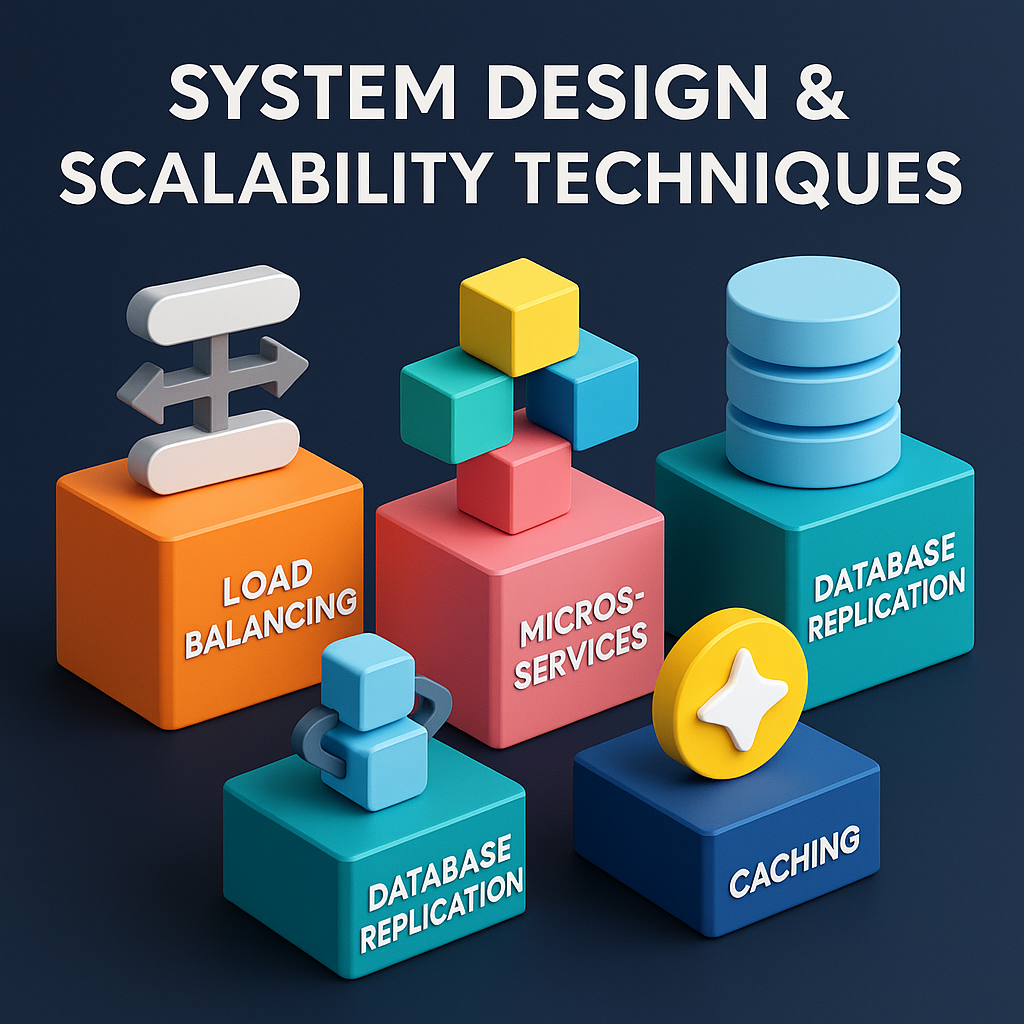
System design is the backbone of large-scale software engineering. It determines how an application behaves under load, how smoothly it handles user growth, how efficiently it processes requests, and how reliably it continues operating even when parts fail. In today’s world, digital systems must support millions of daily users, real-time interactions, global access, high-speed performance, and strict security standards. A poorly designed system collapses under traffic spikes, suffers frequent downtime, and struggles with latency, resulting in user dissatisfaction and lost revenue. Modern businesses—from social networks and streaming platforms to e-commerce, ride-sharing apps, and financial services—depend heavily on scalable and fault-tolerant architectures. System design helps engineers organize components like load balancers, databases, caches, queues, microservices, and distributed systems into a coherent structure that meets performance and reliability goals. With cloud platforms such as AWS, Google Cloud, and Azure, systems can scale globally—but only if architects apply the right strategies such as horizontal scaling, replication, partitioning, caching, asynchronous processing, and redundancy. As digital transformation accelerates, system design is no longer optional; it is a core engineering discipline that ensures long-term stability, efficient resource utilization, high availability, and smooth user experience across all platforms.
Scalability is the ability of a system to grow as demand increases. There are two main types: vertical scaling and horizontal scaling. Vertical scaling (scaling up) means adding more CPU, RAM, or storage to a single server. It is simple and requires minimal architectural changes, making it ideal for early development stages. However, it has strict limits—hardware can only be upgraded so far, and a single server becomes a single point of failure. Horizontal scaling (scaling out) means adding more servers or nodes to distribute the workload. This requires load balancing, data replication, request routing, and distributed coordination, but it provides near-infinite scalability. Horizontal scaling is superior for applications that must support millions of users, global availability, or real-time operations. Large companies like Google, Netflix, Meta, and Amazon rely heavily on horizontal scaling to maintain performance during traffic spikes. Scalability also involves capacity planning, elasticity, and auto-scaling frameworks that add or remove resources based on traffic patterns. To achieve efficient scalability, engineers must reduce bottlenecks, eliminate single points of failure, and adopt loosely coupled architectures where components can scale independently. This is why microservices, container orchestration (Kubernetes), and distributed systems have become foundational pillars of modern system design. They allow small components to scale independently, ensuring efficient resource usage and improved resilience.
A scalable system consists of multiple architectural layers working together. Load balancers distribute incoming traffic across multiple servers to prevent any single server from overloading. Technologies like Nginx, HAProxy, and AWS ELB ensure fairness, failover, and session persistence. Caching reduces database load and improves latency by storing frequently accessed data in memory using tools like Redis, Memcached, CDN caches, and browser caching. Caching strategies such as write-through, write-around, write-back, and TTL-based eviction help balance freshness and speed. Databases are central to scalability. Relational databases provide strong consistency but require sharding or read replicas to handle high loads. NoSQL databases like MongoDB, Cassandra, and DynamoDB scale horizontally with ease. Replication improves read scalability and fault tolerance by distributing copies of data across multiple nodes. Sharding (partitioning) distributes large datasets across multiple servers to reduce bottlenecks. Message queues (Kafka, RabbitMQ, AWS SQS) enable asynchronous processing and decouple services, preventing system overload by smoothing traffic bursts. Microservices architectures further enhance scalability by breaking a large application into independently deployable services, each with its own database and scaling strategy. CDNs accelerate global content delivery, while service discovery tools (Consul, etcd) help services find each other in distributed environments. All these components must be orchestrated carefully to achieve predictable performance under varying loads.
High availability and fault tolerance are essential in system design because system failures are inevitable. Distributed systems allow applications to run across multiple servers, zones, and regions to ensure continuous operation even when components fail. Techniques such as active-passive, active-active clusters, health checks, failover mechanisms, and redundancy protect systems against server crashes, network failures, or data center outages. Replication ensures multiple nodes have identical data, enabling fast recovery and read scalability. Consensus algorithms such as Paxos, Raft, and Zookeeper ensure consistency across distributed nodes. Systems like Cassandra and DynamoDB use quorum-based reads and writes for tunable consistency. Stateless services improve reliability because any instance can process any request without relying on local session data, making horizontal scaling easier. For stateful components, techniques like sticky sessions, session replication, and distributed caches help maintain consistency. Circuit breakers, rate limiting, retry strategies, graceful degradation, and bulkheads prevent cascading failures. Event-driven architectures decouple services and enable resilience by using queues and streaming platforms to handle intermittent spikes. Designing for high availability means assuming that failures will occur and building systems that continue functioning gracefully under those conditions. Global companies use multi-region replication, DNS load balancing, and failover routing to maintain uptime even during catastrophic failures.
Scalability is not only about handling more users—it’s about keeping applications fast. Performance optimization is achieved through multiple strategies: reducing network latency, optimizing queries, introducing caching layers, restructuring data models, and minimizing inter-service communication. Database indexing, query optimization, denormalization, and connection pooling enhance database performance. Content Delivery Networks (CDNs) reduce geographic latency by serving static assets from edge locations close to users. API optimization techniques such as pagination, batching, throttling, and compression reduce payload sizes and speed up responses. Concurrency, parallelism, and asynchronous programming improve backend throughput, especially in I/O-heavy applications. Profiling tools, APM (Application Performance Monitoring) systems like Datadog, New Relic, Prometheus, Grafana, and Elastic Observability allow engineers to track latency, error rates, CPU usage, memory consumption, and bottlenecks across distributed systems. Logging, tracing, and metrics form the three pillars of observability, helping engineers diagnose system failures quickly. Auto-scaling mechanisms dynamically add or remove resources based on CPU, memory, or traffic patterns. Database replicas handle read-heavy workloads, while write-heavy architectures may require sharding or using distributed NoSQL systems. Ultimately, performance optimization is a continuous process involving monitoring, benchmarking, and iterative improvements across all layers of the system.
System design is evolving rapidly with innovations such as serverless computing, microservices evolution, edge computing, and AI-assisted architecture optimization. Serverless platforms (AWS Lambda, Google Cloud Functions, Azure Functions) eliminate server management and scale automatically based on traffic. They are ideal for event-driven workloads, automation, and microservices. Edge computing moves computation closer to the user using edge nodes, reducing latency and improving performance for real-time applications like gaming, IoT, AR/VR, and live streaming. Microservices continue to evolve into micro frontends, service mesh architectures (Istio, Linkerd), and event-driven microservices, enabling better observability, routing, and internal security. AI-driven system design tools analyze traffic patterns, recommend scaling strategies, detect bottlenecks, automate failover, and predict outages before they occur. Container orchestration platforms like Kubernetes have become the standard for deploying and scaling microservices globally. Multi-cloud and hybrid-cloud architectures are becoming more common, allowing companies to distribute workloads across AWS, Azure, GCP, and private cloud environments. The future also brings stronger emphasis on zero-trust security, encryption-by-default, secure APIs, and automated governance. With increasing user expectations, global traffic, and real-time systems, the importance of intelligent, scalable, resilient system design will continue to grow—making it a critical skill for every software engineer, architect, and technical leader.
Scalability is the ability of a system to grow as demand increases. There are two main types: vertical scaling and horizontal scaling. Vertical scaling (scaling up) means adding more CPU, RAM, or storage to a single server. It is simple and requires minimal architectural changes, making it ideal for early development stages. However, it has strict limits—hardware can only be upgraded so far, and a single server becomes a single point of failure. Horizontal scaling (scaling out) means adding more servers or nodes to distribute the workload. This requires load balancing, data replication, request routing, and distributed coordination, but it provides near-infinite scalability. Horizontal scaling is superior for applications that must support millions of users, global availability, or real-time operations. Large companies like Google, Netflix, Meta, and Amazon rely heavily on horizontal scaling to maintain performance during traffic spikes. Scalability also involves capacity planning, elasticity, and auto-scaling frameworks that add or remove resources based on traffic patterns. To achieve efficient scalability, engineers must reduce bottlenecks, eliminate single points of failure, and adopt loosely coupled architectures where components can scale independently. This is why microservices, container orchestration (Kubernetes), and distributed systems have become foundational pillars of modern system design. They allow small components to scale independently, ensuring efficient resource usage and improved resilience.
A scalable system consists of multiple architectural layers working together. Load balancers distribute incoming traffic across multiple servers to prevent any single server from overloading. Technologies like Nginx, HAProxy, and AWS ELB ensure fairness, failover, and session persistence. Caching reduces database load and improves latency by storing frequently accessed data in memory using tools like Redis, Memcached, CDN caches, and browser caching. Caching strategies such as write-through, write-around, write-back, and TTL-based eviction help balance freshness and speed. Databases are central to scalability. Relational databases provide strong consistency but require sharding or read replicas to handle high loads. NoSQL databases like MongoDB, Cassandra, and DynamoDB scale horizontally with ease. Replication improves read scalability and fault tolerance by distributing copies of data across multiple nodes. Sharding (partitioning) distributes large datasets across multiple servers to reduce bottlenecks. Message queues (Kafka, RabbitMQ, AWS SQS) enable asynchronous processing and decouple services, preventing system overload by smoothing traffic bursts. Microservices architectures further enhance scalability by breaking a large application into independently deployable services, each with its own database and scaling strategy. CDNs accelerate global content delivery, while service discovery tools (Consul, etcd) help services find each other in distributed environments. All these components must be orchestrated carefully to achieve predictable performance under varying loads.
High availability and fault tolerance are essential in system design because system failures are inevitable. Distributed systems allow applications to run across multiple servers, zones, and regions to ensure continuous operation even when components fail. Techniques such as active-passive, active-active clusters, health checks, failover mechanisms, and redundancy protect systems against server crashes, network failures, or data center outages. Replication ensures multiple nodes have identical data, enabling fast recovery and read scalability. Consensus algorithms such as Paxos, Raft, and Zookeeper ensure consistency across distributed nodes. Systems like Cassandra and DynamoDB use quorum-based reads and writes for tunable consistency. Stateless services improve reliability because any instance can process any request without relying on local session data, making horizontal scaling easier. For stateful components, techniques like sticky sessions, session replication, and distributed caches help maintain consistency. Circuit breakers, rate limiting, retry strategies, graceful degradation, and bulkheads prevent cascading failures. Event-driven architectures decouple services and enable resilience by using queues and streaming platforms to handle intermittent spikes. Designing for high availability means assuming that failures will occur and building systems that continue functioning gracefully under those conditions. Global companies use multi-region replication, DNS load balancing, and failover routing to maintain uptime even during catastrophic failures.
Scalability is not only about handling more users—it’s about keeping applications fast. Performance optimization is achieved through multiple strategies: reducing network latency, optimizing queries, introducing caching layers, restructuring data models, and minimizing inter-service communication. Database indexing, query optimization, denormalization, and connection pooling enhance database performance. Content Delivery Networks (CDNs) reduce geographic latency by serving static assets from edge locations close to users. API optimization techniques such as pagination, batching, throttling, and compression reduce payload sizes and speed up responses. Concurrency, parallelism, and asynchronous programming improve backend throughput, especially in I/O-heavy applications. Profiling tools, APM (Application Performance Monitoring) systems like Datadog, New Relic, Prometheus, Grafana, and Elastic Observability allow engineers to track latency, error rates, CPU usage, memory consumption, and bottlenecks across distributed systems. Logging, tracing, and metrics form the three pillars of observability, helping engineers diagnose system failures quickly. Auto-scaling mechanisms dynamically add or remove resources based on CPU, memory, or traffic patterns. Database replicas handle read-heavy workloads, while write-heavy architectures may require sharding or using distributed NoSQL systems. Ultimately, performance optimization is a continuous process involving monitoring, benchmarking, and iterative improvements across all layers of the system.
System design is evolving rapidly with innovations such as serverless computing, microservices evolution, edge computing, and AI-assisted architecture optimization. Serverless platforms (AWS Lambda, Google Cloud Functions, Azure Functions) eliminate server management and scale automatically based on traffic. They are ideal for event-driven workloads, automation, and microservices. Edge computing moves computation closer to the user using edge nodes, reducing latency and improving performance for real-time applications like gaming, IoT, AR/VR, and live streaming. Microservices continue to evolve into micro frontends, service mesh architectures (Istio, Linkerd), and event-driven microservices, enabling better observability, routing, and internal security. AI-driven system design tools analyze traffic patterns, recommend scaling strategies, detect bottlenecks, automate failover, and predict outages before they occur. Container orchestration platforms like Kubernetes have become the standard for deploying and scaling microservices globally. Multi-cloud and hybrid-cloud architectures are becoming more common, allowing companies to distribute workloads across AWS, Azure, GCP, and private cloud environments. The future also brings stronger emphasis on zero-trust security, encryption-by-default, secure APIs, and automated governance. With increasing user expectations, global traffic, and real-time systems, the importance of intelligent, scalable, resilient system design will continue to grow—making it a critical skill for every software engineer, architect, and technical leader.