
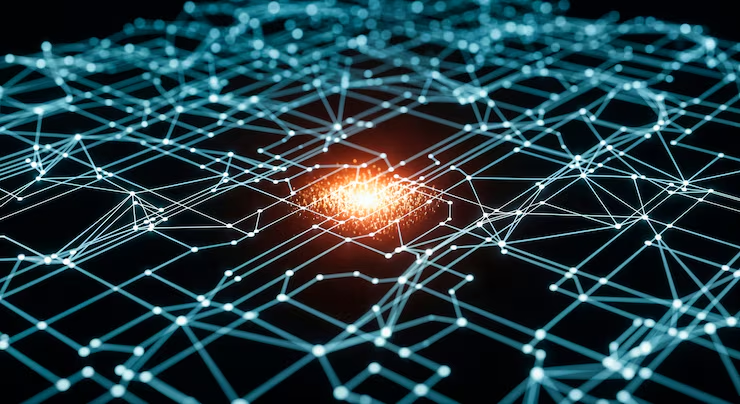
Swarm Intelligence in analytics refers to applying the collective behavior of decentralized, self-organizing natural systems — like ants, bees, birds, or fish — to solve data-driven problems. Inspired by biological swarms, these algorithms use simple agents working together to find optimal solutions without centralized control. This approach provides strong computational power for complex optimization and decision-making tasks in data science.
One of the most widely used swarm-based methods is Particle Swarm Optimization (PSO). It simulates birds flocking to locate the most promising region of a solution space. Each “particle” adjusts its path based on personal experience and nearby particles, making it efficient for optimizing machine learning models, feature selection, and hyperparameter tuning.
Ant Colony Optimization (ACO) was inspired by how ants find the shortest path to food using pheromone trails. In analytics, ACO helps solve combinatorial problems like routing, scheduling, and resource allocation. It is especially useful in logistics and network design, where minimizing travel time or costs is critical for business operations.
Swarm intelligence supports decision-making in uncertain environments. Since agents explore multiple areas simultaneously, these algorithms avoid getting stuck in local optima — a common issue in traditional optimization. This makes them highly effective in high-dimensional analytical problems such as clustering, anomaly detection, and predictive modeling.
Real-time analytics benefit from swarm intelligence as the algorithms can adapt continuously. When new data comes in, swarm-based systems update the solution dynamically rather than recalculating from scratch. This enables fast responses in applications like financial trading, manufacturing processes, and emergency routing.
Swarm robotics is emerging as a practical extension of these concepts. Multiple robots collaborate to inspect environments, collect data, or conduct search-and-rescue operations. Collected insights feed into analytics systems for automated decision-making, reducing human risks and improving operational scalability.
Despite its strengths, swarm intelligence also has challenges. Algorithms may require extensive computation when scaling to very large data sets. Parameter tuning is crucial for achieving convergence, and performance may vary across different problem types. Hybrid approaches combining swarm intelligence with machine learning or evolutionary algorithms are increasingly used to enhance stability and accuracy.
Swarm-based analytics can support sustainability as well. Smart cities use distributed sensor networks guided by swarm coordination to manage traffic, reduce pollution, and optimize energy use. This decentralized approach aligns well with nature-inspired efficiency and environmental adaptability.
In conclusion, swarm intelligence enables smarter, faster, and more resilient analytics by harnessing collective problem-solving abilities found in nature. As AI transitions toward more decentralized and collaborative intelligence, swarm-based techniques will continue to grow in importance — revolutionizing optimization, automation, and real-time decision-making in industries worldwide.
One of the most widely used swarm-based methods is Particle Swarm Optimization (PSO). It simulates birds flocking to locate the most promising region of a solution space. Each “particle” adjusts its path based on personal experience and nearby particles, making it efficient for optimizing machine learning models, feature selection, and hyperparameter tuning.
Ant Colony Optimization (ACO) was inspired by how ants find the shortest path to food using pheromone trails. In analytics, ACO helps solve combinatorial problems like routing, scheduling, and resource allocation. It is especially useful in logistics and network design, where minimizing travel time or costs is critical for business operations.
Swarm intelligence supports decision-making in uncertain environments. Since agents explore multiple areas simultaneously, these algorithms avoid getting stuck in local optima — a common issue in traditional optimization. This makes them highly effective in high-dimensional analytical problems such as clustering, anomaly detection, and predictive modeling.
Real-time analytics benefit from swarm intelligence as the algorithms can adapt continuously. When new data comes in, swarm-based systems update the solution dynamically rather than recalculating from scratch. This enables fast responses in applications like financial trading, manufacturing processes, and emergency routing.
Swarm robotics is emerging as a practical extension of these concepts. Multiple robots collaborate to inspect environments, collect data, or conduct search-and-rescue operations. Collected insights feed into analytics systems for automated decision-making, reducing human risks and improving operational scalability.
Despite its strengths, swarm intelligence also has challenges. Algorithms may require extensive computation when scaling to very large data sets. Parameter tuning is crucial for achieving convergence, and performance may vary across different problem types. Hybrid approaches combining swarm intelligence with machine learning or evolutionary algorithms are increasingly used to enhance stability and accuracy.
Swarm-based analytics can support sustainability as well. Smart cities use distributed sensor networks guided by swarm coordination to manage traffic, reduce pollution, and optimize energy use. This decentralized approach aligns well with nature-inspired efficiency and environmental adaptability.
In conclusion, swarm intelligence enables smarter, faster, and more resilient analytics by harnessing collective problem-solving abilities found in nature. As AI transitions toward more decentralized and collaborative intelligence, swarm-based techniques will continue to grow in importance — revolutionizing optimization, automation, and real-time decision-making in industries worldwide.