
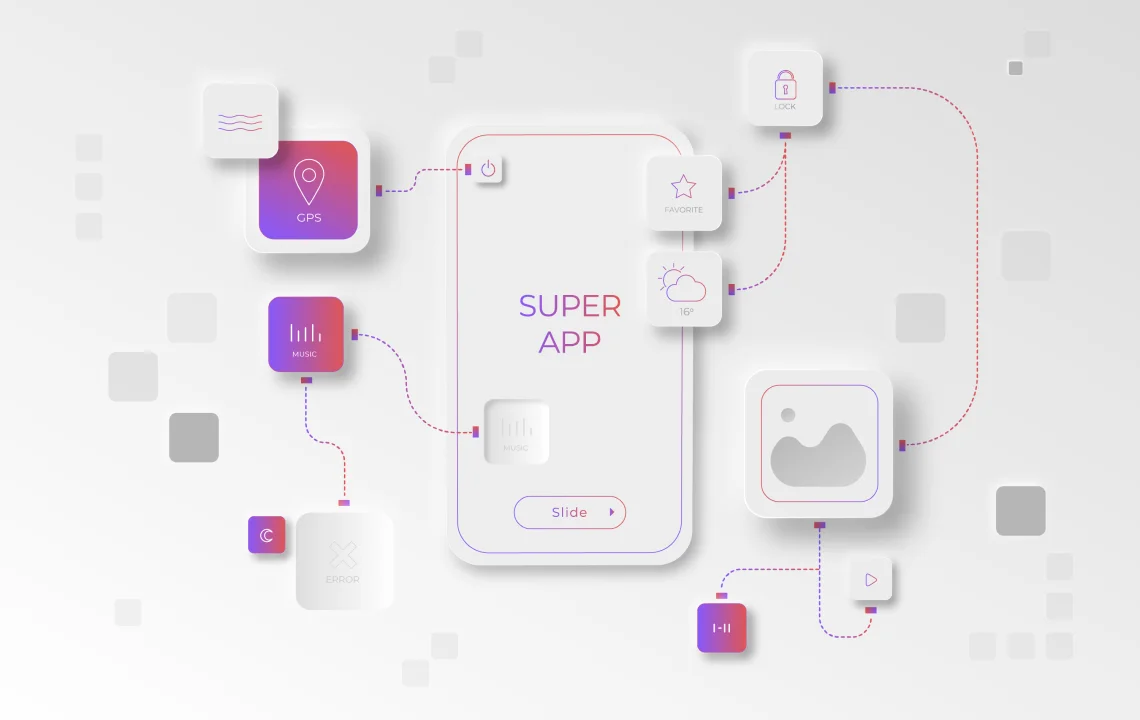
Super App Architecture refers to the structural and technological foundation that enables a single mobile application to host multiple services—such as payments, shopping, ride-hailing, food delivery, messaging, and financial tools—all within one unified ecosystem. Unlike traditional standalone apps, a super app functions as a platform that integrates third-party mini-apps, modules, and microservices, giving users a seamless and centralized digital experience. The architecture must therefore be flexible, scalable, and capable of supporting continuous growth without compromising performance.
At the core of Super App Architecture is the modular microservices approach. Each service—payments, chat, marketplace, wallet, or booking—is developed as an independent microservice that can be deployed, maintained, and scaled separately. This separation minimizes downtime, reduces risk, and allows teams to work in parallel. Microservices communicate through APIs or event-driven messaging systems, enabling efficient service orchestration across the entire platform.
Another major component is the Mini-App Framework, which allows third-party developers to create small applications that run inside the main app. These mini-apps use predefined UI templates, standardized APIs, and secure sandbox environments to ensure consistency and safety. By providing SDKs and API gateways, the super app acts as a host platform, giving external businesses the ability to plug their services into the ecosystem without building separate apps.
A super app heavily relies on API Gateways, which manage all incoming and outgoing communication. The gateway handles routing, authentication, rate limiting, logging, and monitoring. This central layer ensures that each service remains secure, stable, and accessible. The gateway also simplifies integration for mini-apps, allowing them to use platform-level features such as user profiles, wallets, and notifications without duplicating logic.
Because super apps serve millions of users and large volumes of real-time data, scalability and distributed systems are critical. Load balancing, container orchestration tools like Kubernetes, and distributed databases ensure high availability and fault tolerance. Elastic storage and compute architectures allow the app to handle traffic spikes during peak usage—especially for services like payments or food delivery, where reliability is essential.
A unified Identity and Access Management (IAM) system is another key element. Users need single sign-on (SSO) across all mini-apps and integrated services. IAM handles authentication tokens, encryption, user roles, and permissions. This centralized identity layer improves user experience and strengthens security, since sensitive information is managed consistently across the ecosystem.
Super App Architecture also relies heavily on data platforms and analytics pipelines. With so many services interacting, data becomes the backbone of personalization, recommendations, fraud detection, and operational intelligence. Modern super apps use real-time analytics, event streams, user behavior profiling, and AI-powered decision engines to make the experience smarter and more context-aware.
A robust payment infrastructure is typically embedded into the architecture. Digital wallets, UPI integration, bank connections, subscription handling, and transaction security are foundational to most super apps. Since payments are widely used across multiple services, this layer must be highly secure, compliant with regulations, and optimized for speed.
Overall, Super App Architecture represents a complex but powerful system design that brings diverse digital services under one roof. With modular microservices, mini-app frameworks, secure APIs, scalable cloud infrastructure, and intelligent data systems, super apps become digital ecosystems rather than single-purpose applications. This architecture enables rapid expansion, deeper user engagement, and long-term platform growth in an increasingly interconnected mobile-first world.
At the core of Super App Architecture is the modular microservices approach. Each service—payments, chat, marketplace, wallet, or booking—is developed as an independent microservice that can be deployed, maintained, and scaled separately. This separation minimizes downtime, reduces risk, and allows teams to work in parallel. Microservices communicate through APIs or event-driven messaging systems, enabling efficient service orchestration across the entire platform.
Another major component is the Mini-App Framework, which allows third-party developers to create small applications that run inside the main app. These mini-apps use predefined UI templates, standardized APIs, and secure sandbox environments to ensure consistency and safety. By providing SDKs and API gateways, the super app acts as a host platform, giving external businesses the ability to plug their services into the ecosystem without building separate apps.
A super app heavily relies on API Gateways, which manage all incoming and outgoing communication. The gateway handles routing, authentication, rate limiting, logging, and monitoring. This central layer ensures that each service remains secure, stable, and accessible. The gateway also simplifies integration for mini-apps, allowing them to use platform-level features such as user profiles, wallets, and notifications without duplicating logic.
Because super apps serve millions of users and large volumes of real-time data, scalability and distributed systems are critical. Load balancing, container orchestration tools like Kubernetes, and distributed databases ensure high availability and fault tolerance. Elastic storage and compute architectures allow the app to handle traffic spikes during peak usage—especially for services like payments or food delivery, where reliability is essential.
A unified Identity and Access Management (IAM) system is another key element. Users need single sign-on (SSO) across all mini-apps and integrated services. IAM handles authentication tokens, encryption, user roles, and permissions. This centralized identity layer improves user experience and strengthens security, since sensitive information is managed consistently across the ecosystem.
Super App Architecture also relies heavily on data platforms and analytics pipelines. With so many services interacting, data becomes the backbone of personalization, recommendations, fraud detection, and operational intelligence. Modern super apps use real-time analytics, event streams, user behavior profiling, and AI-powered decision engines to make the experience smarter and more context-aware.
A robust payment infrastructure is typically embedded into the architecture. Digital wallets, UPI integration, bank connections, subscription handling, and transaction security are foundational to most super apps. Since payments are widely used across multiple services, this layer must be highly secure, compliant with regulations, and optimized for speed.
Overall, Super App Architecture represents a complex but powerful system design that brings diverse digital services under one roof. With modular microservices, mini-app frameworks, secure APIs, scalable cloud infrastructure, and intelligent data systems, super apps become digital ecosystems rather than single-purpose applications. This architecture enables rapid expansion, deeper user engagement, and long-term platform growth in an increasingly interconnected mobile-first world.