
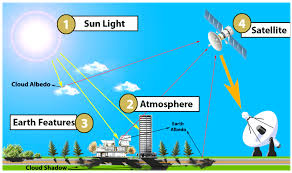
Space cloud computing refers to using satellites in space as nodes for data processing, storage, and communication — rather than sending all data back to Earth for computing. With increasing satellite deployments for Earth observation, navigation, and global connectivity, processing data in orbit saves time, reduces bandwidth usage, and provides services to remote locations where ground infrastructure is limited.
Traditionally, satellites captured massive amounts of data but relied on ground stations for analysis. This caused delays, especially in critical areas like disaster monitoring, military missions, and environmental research. Space-based cloud architecture enables immediate data processing in orbit, providing faster insights and decision-making for time-sensitive scenarios.
Companies like Amazon AWS (Project Kupier), Microsoft Azure Orbital, and partnerships with SpaceX Starlink are pioneering cloud services directly through satellite networks. These services aim to provide low-latency communication, secure transmission, and global coverage — even in oceans, mountains, and remote regions where terrestrial networks cannot reach.
Edge computing in space enables AI models to run aboard satellites. For example, satellites can analyze wildfire patterns, identify ship traffic, or track deforestation instantly using onboard computation. Only processed results are sent to Earth, reducing transmission cost and protecting sensitive information from interception.
Space cloud infrastructure also supports future autonomous systems such as self-navigating spacecraft, interplanetary drones, and Mars colony networks. By enabling real-time analytics without Earth-based delays, space missions gain faster control, safer automation, and efficient resource usage in hostile environments millions of kilometers away.
Cybersecurity is a major challenge in space-based cloud systems. Satellites are vulnerable to signal jamming, spoofing, and cyber intrusions. As these systems expand, strong encryption, zero-trust models, and space-grade monitoring must protect critical communication from threats that could disrupt government, aviation, or financial services.
Latency remains an important consideration. Although space clouds reduce data backhaul to Earth, communication still involves long distances through orbit, especially for high-altitude satellite constellations. Low Earth Orbit (LEO) networks are becoming the preferred choice for near-real-time connectivity thanks to reduced travel time for signals.
Regulatory and orbital management issues also influence deployment. Coordination among countries is necessary to secure communication frequencies, avoid satellite collisions, and justify commercial usage of space resources. Space cloud infrastructure must follow international space laws to prevent conflicts and ensure sustainable development.
In conclusion, space cloud computing marks a huge leap in global digital infrastructure. By bringing cloud capabilities beyond Earth, it unlocks new opportunities in communication, science, defense, and economic growth. As satellite technologies advance and cloud giants expand into space, the boundary between digital services and the space industry continues to disappear — driving us closer to a fully connected planet and future interplanetary networks.
Traditionally, satellites captured massive amounts of data but relied on ground stations for analysis. This caused delays, especially in critical areas like disaster monitoring, military missions, and environmental research. Space-based cloud architecture enables immediate data processing in orbit, providing faster insights and decision-making for time-sensitive scenarios.
Companies like Amazon AWS (Project Kupier), Microsoft Azure Orbital, and partnerships with SpaceX Starlink are pioneering cloud services directly through satellite networks. These services aim to provide low-latency communication, secure transmission, and global coverage — even in oceans, mountains, and remote regions where terrestrial networks cannot reach.
Edge computing in space enables AI models to run aboard satellites. For example, satellites can analyze wildfire patterns, identify ship traffic, or track deforestation instantly using onboard computation. Only processed results are sent to Earth, reducing transmission cost and protecting sensitive information from interception.
Space cloud infrastructure also supports future autonomous systems such as self-navigating spacecraft, interplanetary drones, and Mars colony networks. By enabling real-time analytics without Earth-based delays, space missions gain faster control, safer automation, and efficient resource usage in hostile environments millions of kilometers away.
Cybersecurity is a major challenge in space-based cloud systems. Satellites are vulnerable to signal jamming, spoofing, and cyber intrusions. As these systems expand, strong encryption, zero-trust models, and space-grade monitoring must protect critical communication from threats that could disrupt government, aviation, or financial services.
Latency remains an important consideration. Although space clouds reduce data backhaul to Earth, communication still involves long distances through orbit, especially for high-altitude satellite constellations. Low Earth Orbit (LEO) networks are becoming the preferred choice for near-real-time connectivity thanks to reduced travel time for signals.
Regulatory and orbital management issues also influence deployment. Coordination among countries is necessary to secure communication frequencies, avoid satellite collisions, and justify commercial usage of space resources. Space cloud infrastructure must follow international space laws to prevent conflicts and ensure sustainable development.
In conclusion, space cloud computing marks a huge leap in global digital infrastructure. By bringing cloud capabilities beyond Earth, it unlocks new opportunities in communication, science, defense, and economic growth. As satellite technologies advance and cloud giants expand into space, the boundary between digital services and the space industry continues to disappear — driving us closer to a fully connected planet and future interplanetary networks.