
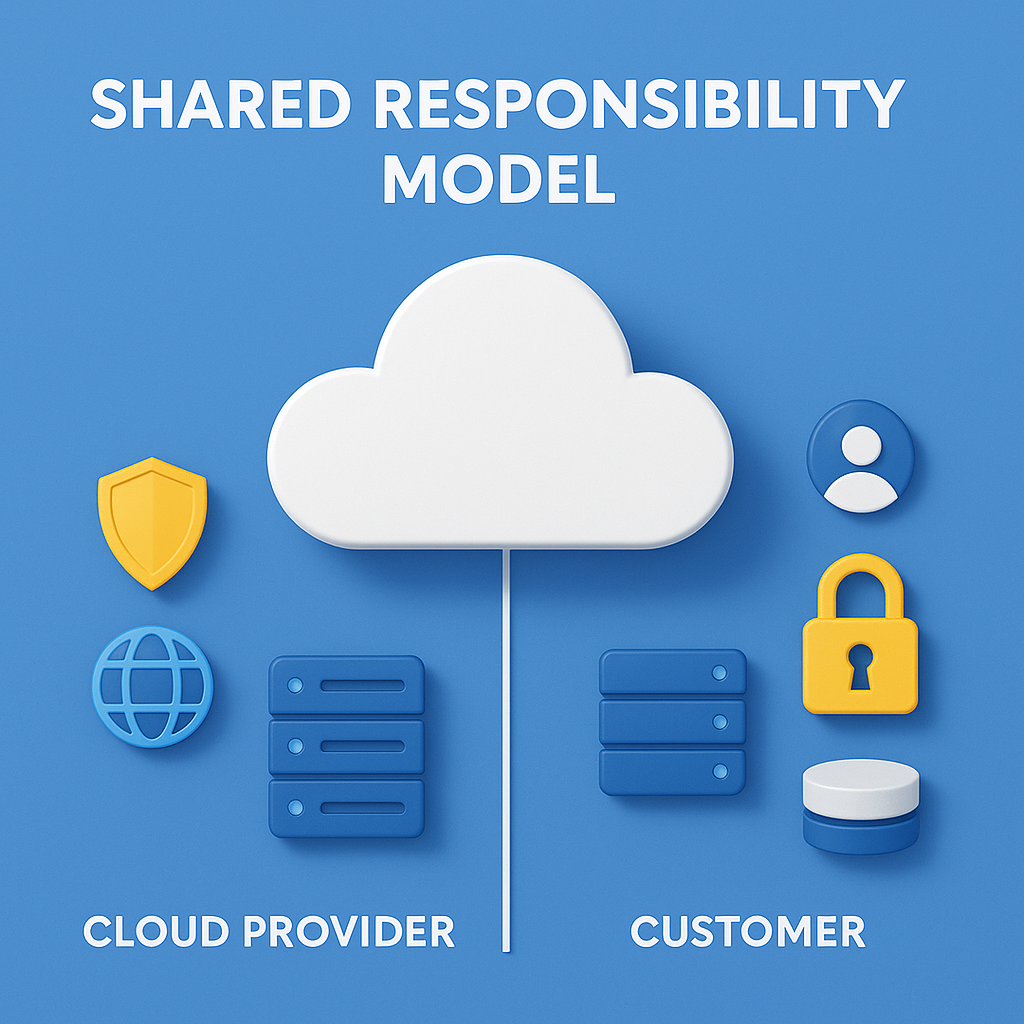
As cloud computing becomes the foundation for modern applications, understanding who is responsible for security is critical. Many beginners assume that cloud providers handle everything, but that is not true. Cloud platforms like AWS, Azure, and Google Cloud follow the Shared Responsibility Model, a security framework that clearly defines which tasks the cloud provider manages and which tasks the customer must control. This model ensures clarity, accountability, and compliance. It helps businesses protect data, meet regulatory requirements, and avoid security breaches caused by configuration mistakes. For beginners stepping into cloud computing, understanding this model is essential for using the cloud safely and effectively.
The Shared Responsibility Model divides security into two major areas: security of the cloud, which is handled by the cloud provider, and security in the cloud, which is handled by the customer. The cloud provider is responsible for protecting the underlying infrastructure such as physical servers, global data centers, networks, storage devices, and virtualization layers. Meanwhile, the customer is responsible for securing the applications, services, data, access controls, and configurations they deploy on top of the cloud infrastructure. This model applies across all cloud service types—whether it's Infrastructure as a Service (IaaS), Platform as a Service (PaaS), or Software as a Service (SaaS). Although customer responsibility becomes lighter with higher-level services, it never disappears entirely.
Cloud providers manage everything related to the foundational platform. They are responsible for securing physical facilities through guards, surveillance systems, biometric access, and strict entry controls. They also take care of the global infrastructure including servers, networking hardware, storage systems, virtualization layers, and hardware maintenance. Providers ensure redundancy, high availability, and disaster recovery of infrastructure while obtaining major compliance certifications like ISO, SOC, HIPAA, GDPR, and PCI-DSS. These massive investments in infrastructure, encryption systems, monitoring, and global resilience eliminate the need for customers to build expensive physical data centers and reduce operational complexity.
Customers, on the other hand, must secure everything they deploy within the cloud environment. This includes managing identity and access properly through IAM policies, strong roles, multi-factor authentication, and least privilege principles. They must secure their own data using encryption for both storage and transmission. Application-level protections such as secure coding, API hardening, and endpoint validation are also crucial. Customers must configure network settings correctly by securing firewalls, VPCs, subnets, and security groups. They must maintain and patch their operating systems when using virtual machines and must continuously monitor logs, alerts, and system activity using cloud-native monitoring tools. Backup strategies, disaster recovery planning, and configuration management also fall under customer responsibilities.
The distribution of responsibilities becomes clearer when comparing cloud service models. With IaaS, customers control almost everything above the infrastructure, including operating systems, applications, firewalls, and data. The provider only manages the physical hardware and virtualization. In PaaS, the provider handles the operating system and runtime environment, while customers focus primarily on application code, data, and permissions. In SaaS, the provider manages nearly the entire stack, leaving customers responsible only for user access, data input, and basic configuration settings. This makes SaaS the easiest option for beginners as it minimizes operational tasks, but users must still ensure proper access controls and data protection.
Many beginners mistakenly believe that cloud providers automatically secure all data and configurations. This misunderstanding often leads to data breaches. Most cloud security incidents occur not because providers failed but because customers misconfigured their resources. Common mistakes include leaving storage buckets public, assigning overly permissive IAM roles, failing to enable encryption or MFA, exposing API keys, or misconfiguring firewall and security group rules. Real-world cases show even large companies exposing millions of records due to simple oversight. The Shared Responsibility Model exists to prevent these misconceptions and remind customers that poor configuration is the leading cause of cloud breaches.
To help customers meet their security responsibilities, cloud providers offer powerful security tools. AWS provides IAM, KMS, CloudTrail, GuardDuty, Inspector, and Security Hub to monitor access, analyze threats, and enforce encryption. Azure offers Azure AD, Key Vault, Defender, and Log Analytics for identity, secrets management, threat detection, and monitoring. Google Cloud provides Cloud IAM, Cloud KMS, Security Command Center, and Chronicle for comprehensive security management. These tools help detect misconfigurations, analyze vulnerabilities, enforce least privilege access, monitor suspicious activity, and secure sensitive resources. Learning how to use these tools effectively is essential for beginners aiming to secure their cloud environments.
Users must follow security best practices consistently to maintain a safe cloud setup. Enabling multi-factor authentication, following least privilege access, encrypting sensitive data, and isolating databases in private subnets are key steps. Regularly applying OS and software patches, setting up continuous monitoring, analyzing logs, and using vulnerability scanners help prevent attacks. Storing secrets securely using key management systems rather than hardcoding them is also critical. Organizations must also comply with standards like GDPR, HIPAA, and PCI-DSS, all of which require strong data protection and access control measures. These best practices ensure that customers fulfill their share of responsibility in the cloud.
The Shared Responsibility Model is the foundation of cloud security. It clearly separates what cloud providers secure from what customers must secure themselves. Understanding this model enables users to deploy applications with confidence while avoiding costly mistakes, data leaks, and security breaches. As cloud adoption continues to grow worldwide, mastering this concept becomes essential for careers in cloud engineering, DevOps, cybersecurity, backend development, and system architecture. By embracing its principles, individuals and organizations can build secure, scalable, and resilient cloud environments that protect data and support business success.
The Shared Responsibility Model divides security into two major areas: security of the cloud, which is handled by the cloud provider, and security in the cloud, which is handled by the customer. The cloud provider is responsible for protecting the underlying infrastructure such as physical servers, global data centers, networks, storage devices, and virtualization layers. Meanwhile, the customer is responsible for securing the applications, services, data, access controls, and configurations they deploy on top of the cloud infrastructure. This model applies across all cloud service types—whether it's Infrastructure as a Service (IaaS), Platform as a Service (PaaS), or Software as a Service (SaaS). Although customer responsibility becomes lighter with higher-level services, it never disappears entirely.
Cloud providers manage everything related to the foundational platform. They are responsible for securing physical facilities through guards, surveillance systems, biometric access, and strict entry controls. They also take care of the global infrastructure including servers, networking hardware, storage systems, virtualization layers, and hardware maintenance. Providers ensure redundancy, high availability, and disaster recovery of infrastructure while obtaining major compliance certifications like ISO, SOC, HIPAA, GDPR, and PCI-DSS. These massive investments in infrastructure, encryption systems, monitoring, and global resilience eliminate the need for customers to build expensive physical data centers and reduce operational complexity.
Customers, on the other hand, must secure everything they deploy within the cloud environment. This includes managing identity and access properly through IAM policies, strong roles, multi-factor authentication, and least privilege principles. They must secure their own data using encryption for both storage and transmission. Application-level protections such as secure coding, API hardening, and endpoint validation are also crucial. Customers must configure network settings correctly by securing firewalls, VPCs, subnets, and security groups. They must maintain and patch their operating systems when using virtual machines and must continuously monitor logs, alerts, and system activity using cloud-native monitoring tools. Backup strategies, disaster recovery planning, and configuration management also fall under customer responsibilities.
The distribution of responsibilities becomes clearer when comparing cloud service models. With IaaS, customers control almost everything above the infrastructure, including operating systems, applications, firewalls, and data. The provider only manages the physical hardware and virtualization. In PaaS, the provider handles the operating system and runtime environment, while customers focus primarily on application code, data, and permissions. In SaaS, the provider manages nearly the entire stack, leaving customers responsible only for user access, data input, and basic configuration settings. This makes SaaS the easiest option for beginners as it minimizes operational tasks, but users must still ensure proper access controls and data protection.
Many beginners mistakenly believe that cloud providers automatically secure all data and configurations. This misunderstanding often leads to data breaches. Most cloud security incidents occur not because providers failed but because customers misconfigured their resources. Common mistakes include leaving storage buckets public, assigning overly permissive IAM roles, failing to enable encryption or MFA, exposing API keys, or misconfiguring firewall and security group rules. Real-world cases show even large companies exposing millions of records due to simple oversight. The Shared Responsibility Model exists to prevent these misconceptions and remind customers that poor configuration is the leading cause of cloud breaches.
To help customers meet their security responsibilities, cloud providers offer powerful security tools. AWS provides IAM, KMS, CloudTrail, GuardDuty, Inspector, and Security Hub to monitor access, analyze threats, and enforce encryption. Azure offers Azure AD, Key Vault, Defender, and Log Analytics for identity, secrets management, threat detection, and monitoring. Google Cloud provides Cloud IAM, Cloud KMS, Security Command Center, and Chronicle for comprehensive security management. These tools help detect misconfigurations, analyze vulnerabilities, enforce least privilege access, monitor suspicious activity, and secure sensitive resources. Learning how to use these tools effectively is essential for beginners aiming to secure their cloud environments.
Users must follow security best practices consistently to maintain a safe cloud setup. Enabling multi-factor authentication, following least privilege access, encrypting sensitive data, and isolating databases in private subnets are key steps. Regularly applying OS and software patches, setting up continuous monitoring, analyzing logs, and using vulnerability scanners help prevent attacks. Storing secrets securely using key management systems rather than hardcoding them is also critical. Organizations must also comply with standards like GDPR, HIPAA, and PCI-DSS, all of which require strong data protection and access control measures. These best practices ensure that customers fulfill their share of responsibility in the cloud.
The Shared Responsibility Model is the foundation of cloud security. It clearly separates what cloud providers secure from what customers must secure themselves. Understanding this model enables users to deploy applications with confidence while avoiding costly mistakes, data leaks, and security breaches. As cloud adoption continues to grow worldwide, mastering this concept becomes essential for careers in cloud engineering, DevOps, cybersecurity, backend development, and system architecture. By embracing its principles, individuals and organizations can build secure, scalable, and resilient cloud environments that protect data and support business success.