
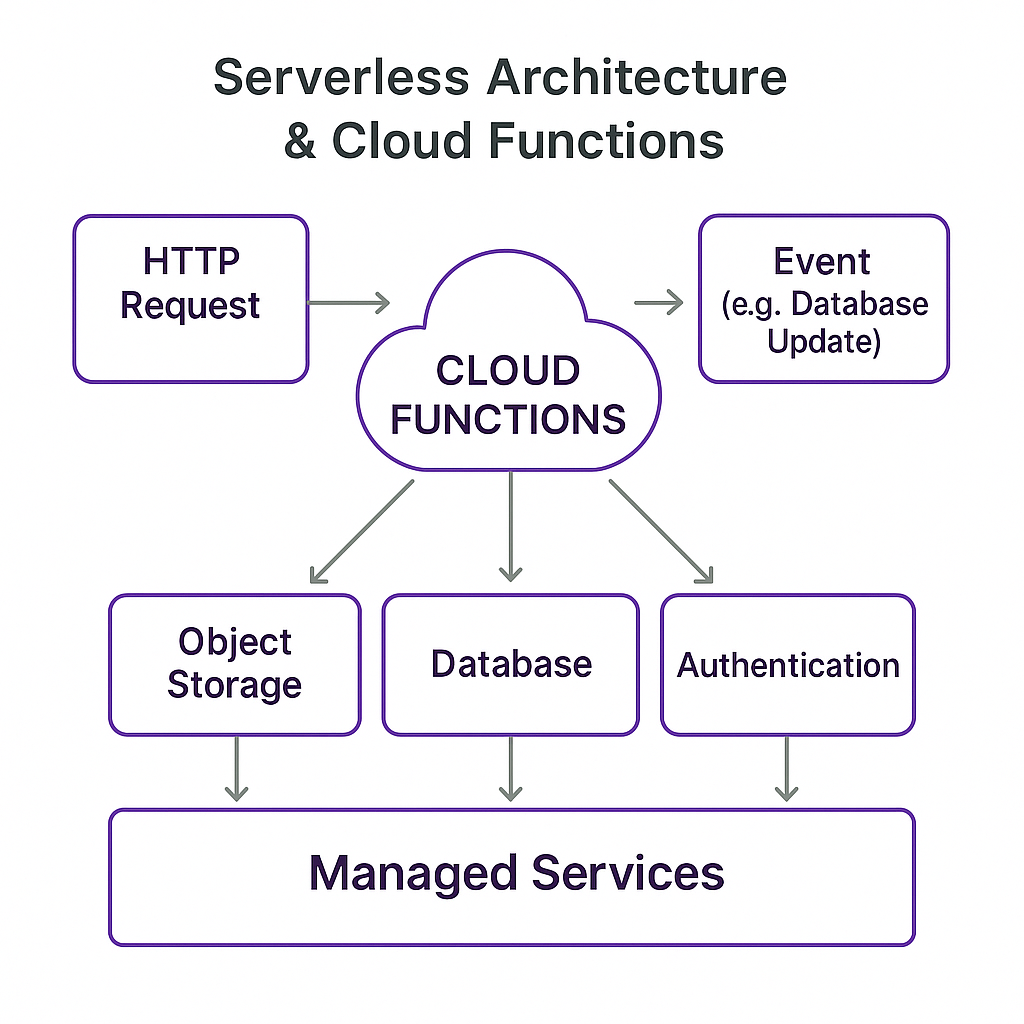
Serverless architecture and cloud functions represent a major shift in how modern web and mobile applications are built, deployed, and scaled. Traditionally, developers had to manage servers, operating systems, hardware, scaling rules, and configurations manually. With serverless computing, all of this is handled automatically by cloud providers such as AWS, Google Cloud, Azure, and Cloudflare. In serverless architecture, developers focus only on writing the application logic, while the cloud platform manages provisioning, scaling, availability, security patches, and infrastructure maintenance. Cloud functions—like AWS Lambda, Google Cloud Functions, Azure Functions, and Netlify Functions—act as small, event-driven pieces of code that execute only when triggered. They run for a very short duration, scale instantly to meet demand, and incur cost only for the execution time used. This makes serverless extremely cost-efficient for applications with unpredictable or fluctuating traffic. The serverless model relies on event-driven architecture where triggers such as HTTP requests, database updates, storage uploads, authentication events, or cron jobs initiate function execution. Developers no longer need to maintain long-running servers, choose instance sizes, or over-provision resources. Combining managed databases, API gateways, authentication services, object storage, and cloud functions allows businesses to build fully scalable applications easily. With this architecture, companies can move faster, innovate quickly, release features rapidly, and cut operational costs dramatically. Serverless is not about having no servers, but about not having to manage them manually.
One of the major advantages of serverless architecture is automatic scaling. Whether an application gets 10 requests per minute or 10,000 requests per second, serverless functions scale instantly and independently. This eliminates the need for load balancers, auto-scaling groups, or manual capacity planning. Serverless also improves developer productivity because teams can ship code quickly without worrying about infrastructure. Deployment becomes easier—developers simply upload a function, and the cloud provider handles the rest. Cost efficiency is another key benefit. Because serverless follows a pay-as-you-go model, users only pay for actual execution time rather than pre-purchasing server capacity. This is highly beneficial for startups and enterprise applications with variable workloads. Serverless is ideal for APIs, chatbots, machine learning inference, authentication systems, IoT backends, cron automation, file processing, event notifications, media compression, and real-time applications. The serverless workflow typically involves API Gateway handling incoming requests, cloud functions executing business logic, and managed services like DynamoDB, Firestore, S3, Cosmos DB, or BigQuery handling data storage. Popular tools like AWS SAM, Serverless Framework, Cloudflare Workers, Firebase Functions, and Vercel maximize productivity by automating deployment and simplifying configuration. Despite its advantages, serverless also introduces challenges such as cold starts, debugging complexity, function timeouts, vendor lock-in, and difficulty in handling long-running tasks. However, cloud providers are continuously optimizing execution environments, reducing latency, and offering hybrid features like provisioned concurrency and container-based functions to solve these issues. With the right architecture, organizations can build extremely scalable, secure, and performant systems without heavy DevOps overhead.
The future of serverless architecture is expanding rapidly as companies adopt microservices, distributed systems, and event-driven computing. Emerging trends include serverless containers, edge computing functions, globally distributed runtimes, AI-powered infrastructure automation, and zero-configuration deployments. Edge-based serverless platforms like Cloudflare Workers, AWS Lambda@Edge, and Vercel Edge Functions allow applications to run extremely fast by executing code near the end-user. This enables ultra-low latency experiences for real-time apps, streaming, personalization, and global content delivery. Another major trend is the integration of serverless with AI and machine learning. Cloud functions are being used for inference, automation pipelines, real-time predictions, computer vision processing, and transforming raw data into intelligent insights. Serverless will also play a major role in IoT ecosystems where millions of devices generate events that must be processed instantly. As cloud providers continue to simplify deployments, increase execution limits, and reduce costs, serverless will become the default architecture for most modern applications. In conclusion, serverless architecture and cloud functions provide a powerful, cost-effective, scalable, and developer-friendly approach to building applications. They reduce the complexity of server management, speed up development cycles, and allow businesses to focus entirely on innovation rather than infrastructure. Whether you're building APIs, automation workflows, real-time services, or AI-powered products, serverless provides the agility, scalability, and reliability required in the modern digital world.
Cloud providers play a vital role in shaping how serverless solutions work. AWS Lambda is the most widely adopted serverless platform, supporting multiple runtimes like Node.js, Python, Java, Go, and .NET. It integrates deeply with AWS services such as S3, DynamoDB, SNS, SQS, and API Gateway, making it ideal for event-driven architectures. Google Cloud Functions and Cloud Run provide lightweight and container-based serverless runtimes, enabling flexible deployments and automatic scaling backed by Google’s global infrastructure. Azure Functions allow seamless integration with Office 365, Azure Storage, Cosmos DB, and Microsoft’s enterprise systems, making them popular in corporate environments. Cloudflare Workers run serverless functions at the edge, reducing latency significantly because code is executed near the user's geographical location. These platforms continuously enhance capabilities, support more languages, improve cold start times, and provide advanced monitoring and debugging features. Understanding each provider’s ecosystem helps businesses choose the right serverless stack that aligns with their needs and budget.
Serverless architecture can power a wide range of applications across industries.
Some compelling use cases include:
1. E-commerce
a)Real-time inventory updates
b)Order processing workflows
c)Personalized recommendations
d)Payment notifications
e)Fraud detection triggers
2. FinTech
a)Automated transaction monitoring
b)Risk assessment calculations
c)Real-time alerts for suspicious activity
3. Media & Entertainment
a)On-the-fly video transcoding
b)Image compression & optimization
c)Content personalization based on user behavior
4. Logistics & Supply Chain
a)Sensor data processing
b)Shipment tracking
c)Route optimization algorithms
5. Healthcare
a)health device analytics
b)Appointment scheduling
c)Secure handling of patient data
d)Serverless is also ideal for backend APIs, chat applications, real-time dashboards, CRON automation, lead generation workflows, SMS/email triggers, and data pipelines.
e)Extended Section: Architecture Best Practices
f)To build robust serverless applications, developers need to follow certain best practices:
1. Use Smaller, Single-Purpose Functions
Each function should do one task well. This reduces complexity, improves performance, and simplifies debugging.
2. Optimize Cold Starts
Use lightweight runtimes, keep dependencies minimal, and consider provisioned concurrency for critical APIs.
3. Secure by Design
Apply identity and access management (IAM), API keys, JWT authentication, and least privilege access for every function.
4. Logging & Monitoring
Use cloud monitoring tools such as:
a)AWS CloudWatch
b)Google Stackdriver
c)Azure Monitor
d)Datadog
e)New Relic
5. Use Environment Variables
Keep configurations separate from code to improve security and version control.
6. Avoid Long-Running Tasks
Break down heavy tasks into smaller subtasks and process them using queues like SQS, Pub/Sub, or RabbitMQ.
One of the major advantages of serverless architecture is automatic scaling. Whether an application gets 10 requests per minute or 10,000 requests per second, serverless functions scale instantly and independently. This eliminates the need for load balancers, auto-scaling groups, or manual capacity planning. Serverless also improves developer productivity because teams can ship code quickly without worrying about infrastructure. Deployment becomes easier—developers simply upload a function, and the cloud provider handles the rest. Cost efficiency is another key benefit. Because serverless follows a pay-as-you-go model, users only pay for actual execution time rather than pre-purchasing server capacity. This is highly beneficial for startups and enterprise applications with variable workloads. Serverless is ideal for APIs, chatbots, machine learning inference, authentication systems, IoT backends, cron automation, file processing, event notifications, media compression, and real-time applications. The serverless workflow typically involves API Gateway handling incoming requests, cloud functions executing business logic, and managed services like DynamoDB, Firestore, S3, Cosmos DB, or BigQuery handling data storage. Popular tools like AWS SAM, Serverless Framework, Cloudflare Workers, Firebase Functions, and Vercel maximize productivity by automating deployment and simplifying configuration. Despite its advantages, serverless also introduces challenges such as cold starts, debugging complexity, function timeouts, vendor lock-in, and difficulty in handling long-running tasks. However, cloud providers are continuously optimizing execution environments, reducing latency, and offering hybrid features like provisioned concurrency and container-based functions to solve these issues. With the right architecture, organizations can build extremely scalable, secure, and performant systems without heavy DevOps overhead.
The future of serverless architecture is expanding rapidly as companies adopt microservices, distributed systems, and event-driven computing. Emerging trends include serverless containers, edge computing functions, globally distributed runtimes, AI-powered infrastructure automation, and zero-configuration deployments. Edge-based serverless platforms like Cloudflare Workers, AWS Lambda@Edge, and Vercel Edge Functions allow applications to run extremely fast by executing code near the end-user. This enables ultra-low latency experiences for real-time apps, streaming, personalization, and global content delivery. Another major trend is the integration of serverless with AI and machine learning. Cloud functions are being used for inference, automation pipelines, real-time predictions, computer vision processing, and transforming raw data into intelligent insights. Serverless will also play a major role in IoT ecosystems where millions of devices generate events that must be processed instantly. As cloud providers continue to simplify deployments, increase execution limits, and reduce costs, serverless will become the default architecture for most modern applications. In conclusion, serverless architecture and cloud functions provide a powerful, cost-effective, scalable, and developer-friendly approach to building applications. They reduce the complexity of server management, speed up development cycles, and allow businesses to focus entirely on innovation rather than infrastructure. Whether you're building APIs, automation workflows, real-time services, or AI-powered products, serverless provides the agility, scalability, and reliability required in the modern digital world.
Cloud providers play a vital role in shaping how serverless solutions work. AWS Lambda is the most widely adopted serverless platform, supporting multiple runtimes like Node.js, Python, Java, Go, and .NET. It integrates deeply with AWS services such as S3, DynamoDB, SNS, SQS, and API Gateway, making it ideal for event-driven architectures. Google Cloud Functions and Cloud Run provide lightweight and container-based serverless runtimes, enabling flexible deployments and automatic scaling backed by Google’s global infrastructure. Azure Functions allow seamless integration with Office 365, Azure Storage, Cosmos DB, and Microsoft’s enterprise systems, making them popular in corporate environments. Cloudflare Workers run serverless functions at the edge, reducing latency significantly because code is executed near the user's geographical location. These platforms continuously enhance capabilities, support more languages, improve cold start times, and provide advanced monitoring and debugging features. Understanding each provider’s ecosystem helps businesses choose the right serverless stack that aligns with their needs and budget.
Serverless architecture can power a wide range of applications across industries.
Some compelling use cases include:
1. E-commerce
a)Real-time inventory updates
b)Order processing workflows
c)Personalized recommendations
d)Payment notifications
e)Fraud detection triggers
2. FinTech
a)Automated transaction monitoring
b)Risk assessment calculations
c)Real-time alerts for suspicious activity
3. Media & Entertainment
a)On-the-fly video transcoding
b)Image compression & optimization
c)Content personalization based on user behavior
4. Logistics & Supply Chain
a)Sensor data processing
b)Shipment tracking
c)Route optimization algorithms
5. Healthcare
a)health device analytics
b)Appointment scheduling
c)Secure handling of patient data
d)Serverless is also ideal for backend APIs, chat applications, real-time dashboards, CRON automation, lead generation workflows, SMS/email triggers, and data pipelines.
e)Extended Section: Architecture Best Practices
f)To build robust serverless applications, developers need to follow certain best practices:
1. Use Smaller, Single-Purpose Functions
Each function should do one task well. This reduces complexity, improves performance, and simplifies debugging.
2. Optimize Cold Starts
Use lightweight runtimes, keep dependencies minimal, and consider provisioned concurrency for critical APIs.
3. Secure by Design
Apply identity and access management (IAM), API keys, JWT authentication, and least privilege access for every function.
4. Logging & Monitoring
Use cloud monitoring tools such as:
a)AWS CloudWatch
b)Google Stackdriver
c)Azure Monitor
d)Datadog
e)New Relic
5. Use Environment Variables
Keep configurations separate from code to improve security and version control.
6. Avoid Long-Running Tasks
Break down heavy tasks into smaller subtasks and process them using queues like SQS, Pub/Sub, or RabbitMQ.