
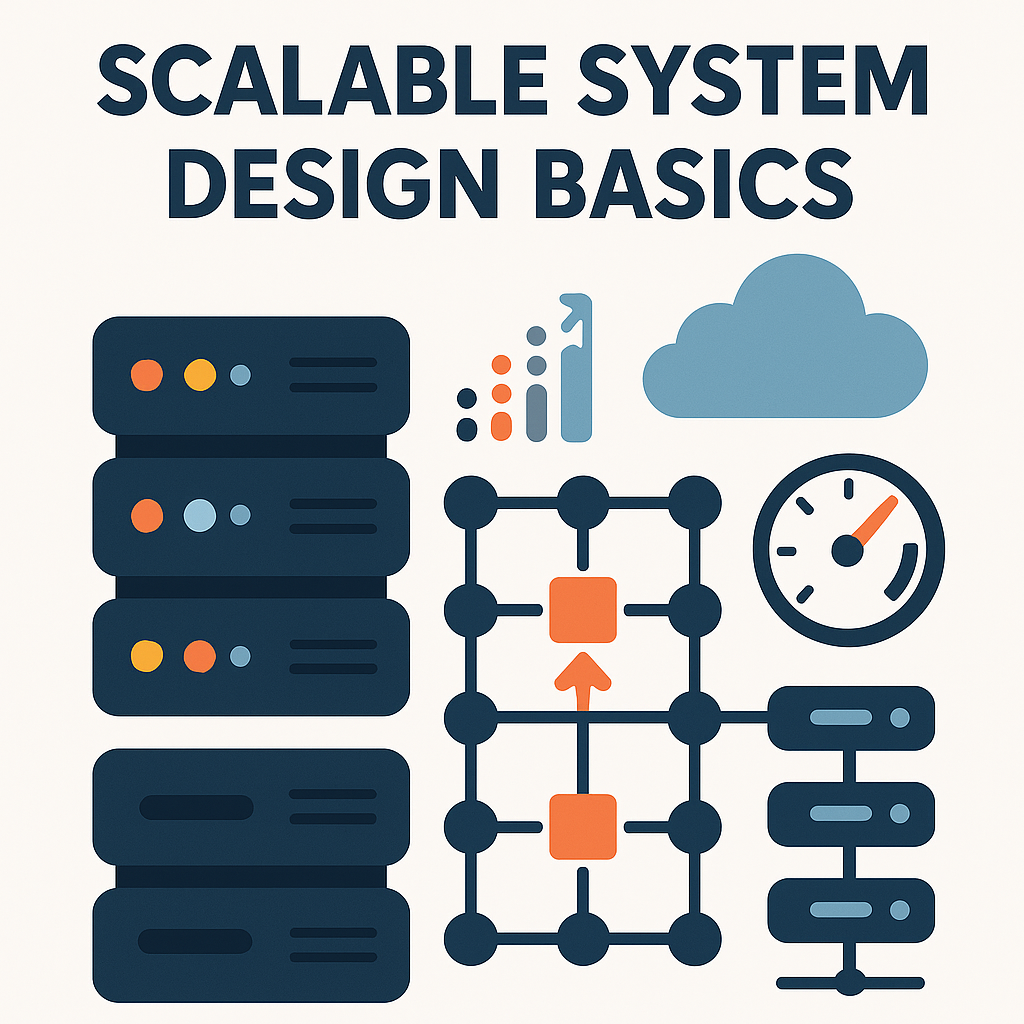
Scalability is one of the most important principles in modern software engineering. As applications grow, attract users, handle more data, or face unpredictable traffic spikes, they must continue operating smoothly without performance degradation. Scalable system design ensures that a system can expand its capacity, maintain reliability, and operate efficiently under increasing workloads. Whether you’re building a mobile app backend, an e-commerce platform, a social media service, or a real-time analytics pipeline, understanding scalability is essential. It ensures your system doesn’t just work today—it continues to work tomorrow, next year, and beyond.
At its core, scalability means the system can handle growth. This growth may come in the form of increased users, transactions, storage, or computational demands. Two primary approaches support scalability: vertical scaling and horizontal scaling. Vertical scaling increases the power of a single machine, such as adding more RAM or faster CPUs, while horizontal scaling adds more machines to distribute the load. Horizontal scaling is more sustainable and cost-effective for large systems because it avoids single points of failure and enables elastic expansion across distributed environments like cloud platforms.
Another foundational aspect of scalable system design is decoupling. Tight coupling between components makes scaling difficult because changes in one module impact others. Scalable architectures use concepts like microservices, message queues, and asynchronous communication to ensure each component can scale independently. For example, if your application's database experiences heavy read traffic, you can scale only the read replicas instead of upgrading the entire system. Decoupling makes systems more flexible, resilient, and easier to optimize.
Data management also plays a critical role in designing scalable systems. As the system grows, data volume, velocity, and variety increase dramatically. Solutions such as database sharding, replication, and caching become essential. Caching—using tools like Redis or Memcached—provides quick access to frequently requested data and reduces load on the primary database. Replication helps distribute read traffic across multiple nodes, improving performance. Sharding spreads data across multiple servers based on key values, enabling horizontal scaling. A scalable system must choose data strategies based on the workload pattern, consistency requirements, and latency constraints.
Scalable systems also depend heavily on load balancing, which distributes incoming traffic across multiple servers or services. Without load balancing, one server may become overloaded while others remain underutilized. Tools like NGINX, HAProxy, AWS ELB/ALB, and Kubernetes Ingress Controllers help route traffic intelligently. Load balancers monitor server health, remove unhealthy instances, and maintain consistent performance under peak traffic. They also enable elasticity by automatically adjusting system capacity based on demand.
Another important principle is fault tolerance and redundancy. A highly scalable system must continue operating even when some components fail. Redundancy ensures spare capacity is always available, while fault tolerance ensures graceful failure without service interruption. Techniques like replication, failover mechanisms, distributed storage, and rolling updates help maintain system availability. Modern systems often use container orchestrators like Kubernetes, which automatically restart failed pods, scale resources, and self-heal components.
Monitoring and observability are equally crucial because a system cannot scale effectively without clear visibility into performance metrics. Tools like Prometheus, Grafana, ELK Stack, CloudWatch, and Datadog help track CPU usage, memory consumption, network latency, error rates, and request throughput. Observability enhances debugging, capacity planning, and performance tuning. It also enables automated scaling through predefined thresholds or adaptive algorithms. A scalable system constantly learns from metrics and adjusts itself accordingly.
Finally, scalability is not a one-time activity—it is an ongoing discipline. Software evolves, user behavior changes, and infrastructure upgrades introduce new challenges. Scalable system design requires continuous optimization, periodic load testing, and architecture reviews. Teams must adopt a culture of performance awareness, writing efficient code, using lightweight libraries, and avoiding unnecessary computation. A scalable architecture grows with the business, adapting to traffic bursts, peak seasons, and global expansion with minimal friction.
In conclusion, scalable system design is the foundation of modern high-performance software. By embracing horizontal scaling, decoupling, caching strategies, load balancing, fault tolerance, and continuous monitoring, developers can build systems that perform consistently, remain reliable under heavy load, and adapt to growth seamlessly. Whether you are preparing for system design interviews or building real-world distributed applications, mastering these scalability principles will empower you to create robust, efficient, and future-proof solutions in the evolving world of technology.
At its core, scalability means the system can handle growth. This growth may come in the form of increased users, transactions, storage, or computational demands. Two primary approaches support scalability: vertical scaling and horizontal scaling. Vertical scaling increases the power of a single machine, such as adding more RAM or faster CPUs, while horizontal scaling adds more machines to distribute the load. Horizontal scaling is more sustainable and cost-effective for large systems because it avoids single points of failure and enables elastic expansion across distributed environments like cloud platforms.
Another foundational aspect of scalable system design is decoupling. Tight coupling between components makes scaling difficult because changes in one module impact others. Scalable architectures use concepts like microservices, message queues, and asynchronous communication to ensure each component can scale independently. For example, if your application's database experiences heavy read traffic, you can scale only the read replicas instead of upgrading the entire system. Decoupling makes systems more flexible, resilient, and easier to optimize.
Data management also plays a critical role in designing scalable systems. As the system grows, data volume, velocity, and variety increase dramatically. Solutions such as database sharding, replication, and caching become essential. Caching—using tools like Redis or Memcached—provides quick access to frequently requested data and reduces load on the primary database. Replication helps distribute read traffic across multiple nodes, improving performance. Sharding spreads data across multiple servers based on key values, enabling horizontal scaling. A scalable system must choose data strategies based on the workload pattern, consistency requirements, and latency constraints.
Scalable systems also depend heavily on load balancing, which distributes incoming traffic across multiple servers or services. Without load balancing, one server may become overloaded while others remain underutilized. Tools like NGINX, HAProxy, AWS ELB/ALB, and Kubernetes Ingress Controllers help route traffic intelligently. Load balancers monitor server health, remove unhealthy instances, and maintain consistent performance under peak traffic. They also enable elasticity by automatically adjusting system capacity based on demand.
Another important principle is fault tolerance and redundancy. A highly scalable system must continue operating even when some components fail. Redundancy ensures spare capacity is always available, while fault tolerance ensures graceful failure without service interruption. Techniques like replication, failover mechanisms, distributed storage, and rolling updates help maintain system availability. Modern systems often use container orchestrators like Kubernetes, which automatically restart failed pods, scale resources, and self-heal components.
Monitoring and observability are equally crucial because a system cannot scale effectively without clear visibility into performance metrics. Tools like Prometheus, Grafana, ELK Stack, CloudWatch, and Datadog help track CPU usage, memory consumption, network latency, error rates, and request throughput. Observability enhances debugging, capacity planning, and performance tuning. It also enables automated scaling through predefined thresholds or adaptive algorithms. A scalable system constantly learns from metrics and adjusts itself accordingly.
Finally, scalability is not a one-time activity—it is an ongoing discipline. Software evolves, user behavior changes, and infrastructure upgrades introduce new challenges. Scalable system design requires continuous optimization, periodic load testing, and architecture reviews. Teams must adopt a culture of performance awareness, writing efficient code, using lightweight libraries, and avoiding unnecessary computation. A scalable architecture grows with the business, adapting to traffic bursts, peak seasons, and global expansion with minimal friction.
In conclusion, scalable system design is the foundation of modern high-performance software. By embracing horizontal scaling, decoupling, caching strategies, load balancing, fault tolerance, and continuous monitoring, developers can build systems that perform consistently, remain reliable under heavy load, and adapt to growth seamlessly. Whether you are preparing for system design interviews or building real-world distributed applications, mastering these scalability principles will empower you to create robust, efficient, and future-proof solutions in the evolving world of technology.