
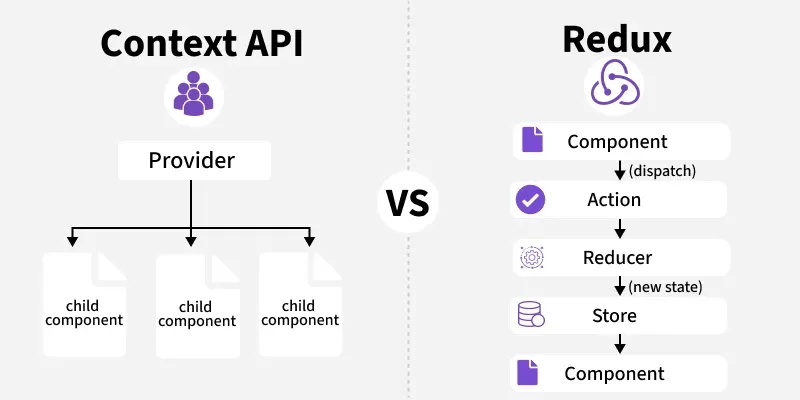
Redux and the Context API are two widely used state management approaches in React and React Native applications. They help developers manage global application state in a predictable and organized way, especially as applications grow in size and complexity.
In React-based applications, managing shared state across multiple components can become challenging. Passing data through props at many levels, known as prop drilling, makes code harder to read and maintain. Redux and Context API solve this problem by providing centralized mechanisms to share and control state.
Redux is a state management library that follows a strict unidirectional data flow. The entire application state is stored in a single source of truth known as the store. State changes occur only through dispatched actions, which describe what happened in the application.
Reducers in Redux are pure functions that take the current state and an action, and return a new state. This strict structure ensures that state transitions are predictable and consistent. Because reducers are pure, they are easy to test and reason about.
One of Redux’s biggest strengths is predictability. Every state change is explicit, traceable, and logged. Tools such as Redux DevTools allow developers to inspect actions, replay state changes, and debug issues efficiently. This makes Redux ideal for complex applications.
Redux is especially useful in large-scale applications with complex business logic, shared state across many components, or frequent asynchronous operations. As the application grows, Redux provides a structured framework that prevents state management from becoming chaotic.
The Context API, on the other hand, is a built-in feature of React that provides a simpler way to share data across components without passing props manually. It allows developers to define a context and make its data available to any component in the component tree.
Context API is best suited for relatively simple or moderately complex state, such as theme settings, authentication status, language preferences, or user information. It reduces boilerplate and keeps the codebase lightweight.
Unlike Redux, Context API does not enforce a strict pattern for updating state. While this makes it easier to use, it can lead to less predictable state updates if not carefully structured, especially in large applications.
Both Redux and Context API help decouple UI components from business logic. By separating state management from presentation components, applications become cleaner, more modular, and easier to maintain.
Redux supports middleware, which enables handling side effects such as API calls, logging, and asynchronous operations. Middleware intercepts actions before they reach reducers, allowing developers to manage complex workflows in a controlled manner.
This middleware-based approach gives Redux strong control over asynchronous logic, making it well-suited for data-driven applications that interact heavily with external services.
Context API can also be combined with custom hooks to manage state logic more cleanly. This pattern improves reusability and helps maintain separation of concerns without introducing external libraries.
Choosing between Redux and Context API depends on application requirements. Redux is preferred when predictability, scalability, and complex state transitions are critical. Context API is often chosen for simpler shared state needs where minimal setup is desired.
In conclusion, understanding both Redux and Context API is essential for building scalable, maintainable, and data-driven web and mobile applications. Each approach has its strengths, and selecting the right one ensures better architecture and long-term success.
In React-based applications, managing shared state across multiple components can become challenging. Passing data through props at many levels, known as prop drilling, makes code harder to read and maintain. Redux and Context API solve this problem by providing centralized mechanisms to share and control state.
Redux is a state management library that follows a strict unidirectional data flow. The entire application state is stored in a single source of truth known as the store. State changes occur only through dispatched actions, which describe what happened in the application.
Reducers in Redux are pure functions that take the current state and an action, and return a new state. This strict structure ensures that state transitions are predictable and consistent. Because reducers are pure, they are easy to test and reason about.
One of Redux’s biggest strengths is predictability. Every state change is explicit, traceable, and logged. Tools such as Redux DevTools allow developers to inspect actions, replay state changes, and debug issues efficiently. This makes Redux ideal for complex applications.
Redux is especially useful in large-scale applications with complex business logic, shared state across many components, or frequent asynchronous operations. As the application grows, Redux provides a structured framework that prevents state management from becoming chaotic.
The Context API, on the other hand, is a built-in feature of React that provides a simpler way to share data across components without passing props manually. It allows developers to define a context and make its data available to any component in the component tree.
Context API is best suited for relatively simple or moderately complex state, such as theme settings, authentication status, language preferences, or user information. It reduces boilerplate and keeps the codebase lightweight.
Unlike Redux, Context API does not enforce a strict pattern for updating state. While this makes it easier to use, it can lead to less predictable state updates if not carefully structured, especially in large applications.
Both Redux and Context API help decouple UI components from business logic. By separating state management from presentation components, applications become cleaner, more modular, and easier to maintain.
Redux supports middleware, which enables handling side effects such as API calls, logging, and asynchronous operations. Middleware intercepts actions before they reach reducers, allowing developers to manage complex workflows in a controlled manner.
This middleware-based approach gives Redux strong control over asynchronous logic, making it well-suited for data-driven applications that interact heavily with external services.
Context API can also be combined with custom hooks to manage state logic more cleanly. This pattern improves reusability and helps maintain separation of concerns without introducing external libraries.
Choosing between Redux and Context API depends on application requirements. Redux is preferred when predictability, scalability, and complex state transitions are critical. Context API is often chosen for simpler shared state needs where minimal setup is desired.
In conclusion, understanding both Redux and Context API is essential for building scalable, maintainable, and data-driven web and mobile applications. Each approach has its strengths, and selecting the right one ensures better architecture and long-term success.