
In the digital world, data is no longer something that arrives periodically in batches—it flows continuously, every second, from millions of devices, sensors, applications, and platforms. As businesses and systems move toward instant responsiveness, the ability to analyze data the moment it is generated has become a critical competitive advantage. This paradigm is known as Real-Time Stream Analytics, a powerful approach where data is processed, analyzed, and acted upon within milliseconds of its creation. From fraud detection to IoT monitoring, real-time analytics is transforming how industries operate, enabling instant decisions, automation, and predictive intelligence.
Real-Time Stream Analytics refers to the continuous collection, ingestion, processing, and analysis of data in motion. Unlike traditional batch analytics—where data is stored first and analyzed later—stream analytics works with live data flows. It constantly processes event streams as they arrive from sources such as mobile apps, security logs, IoT devices, social media posts, financial transactions, and more. This instant analysis allows systems to detect anomalies, identify trends, trigger alerts, and execute actions without delay. In essence, real-time analytics turns raw data into immediate intelligence.
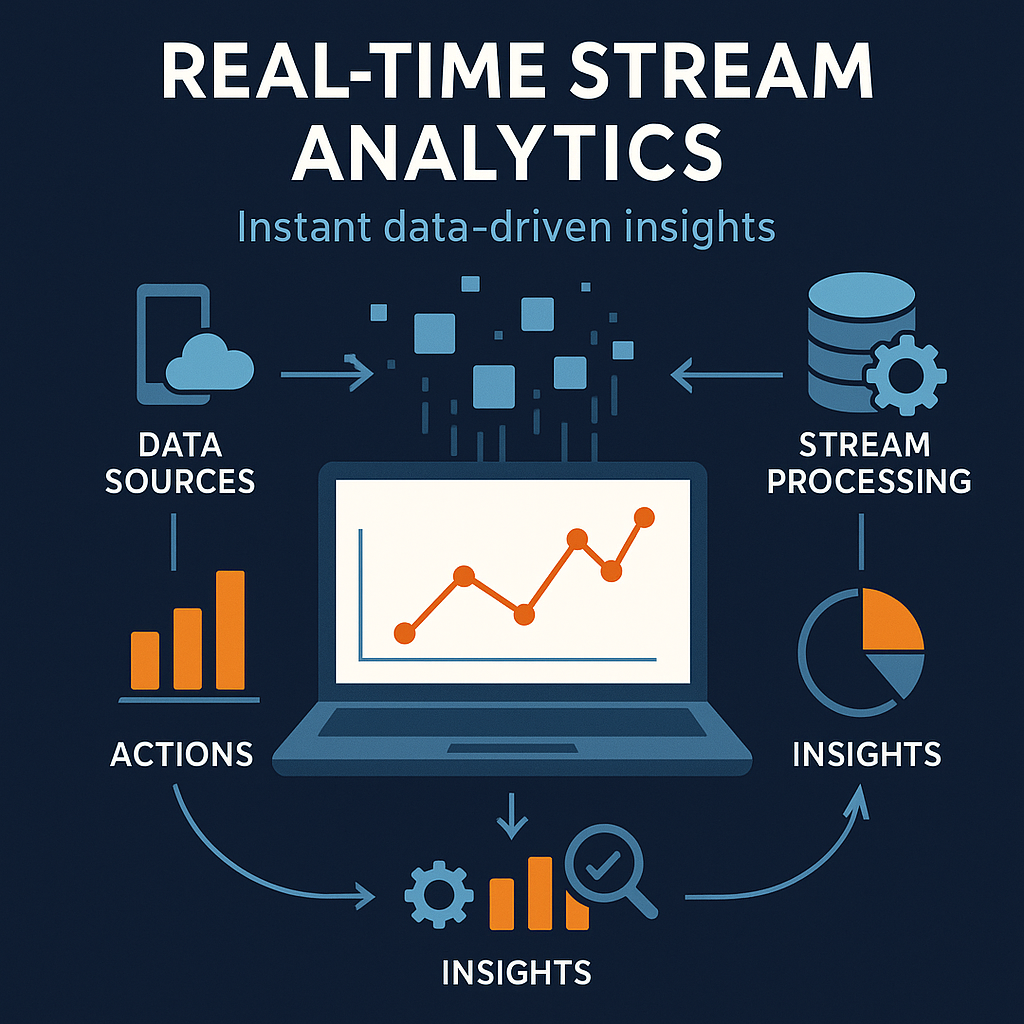
At the heart of stream analytics is a pipeline consisting of event producers, message brokers, processing engines, storage layers, and action triggers. Event producers send data into message brokers like Apache Kafka or AWS Kinesis, which organize and distribute the data. Stream processing frameworks—such as Apache Flink, Spark Streaming, or Google Dataflow—analyze data in micro-batches or pure event-by-event mode. Machine learning models can also be embedded to classify events or predict outcomes. The results are then forwarded to dashboards, automation systems, alerting services, or real-time business applications.
Real-time analytics relies on highly scalable and fault-tolerant technologies. Apache Kafka has become the backbone of streaming systems due to its high throughput and durability. Apache Flink enables event-driven, low-latency processing with exactly-once guarantees. Spark Streaming and Storm support near real-time micro-batch processing. Cloud-native platforms like Azure Stream Analytics, AWS Kinesis Analytics, and Google Pub/Sub simplify deployment. Machine learning integration uses frameworks such as TensorFlow, PyTorch, or built-in ML libraries to analyze data on the fly. These technologies together enable processing at massive scale—sometimes millions of events per second.
Modern systems demand speed. Businesses cannot afford to wait hours or days to detect issues, process transactions, or gather insights. Real-time analytics enables instant anomaly detection, faster customer experiences, proactive systems, and automation at scale. For example, banks can detect fraud the moment a suspicious transaction occurs. Smart factories can shut down malfunctioning equipment before damage spreads. Logistics companies can predict delays instantly based on traffic or weather. Across every industry, the ability to respond in real time drives both operational efficiency and customer satisfaction.
Real-time streaming analytics is rapidly transforming sectors around the world:
1)Finance: detects fraud, manages high-frequency trading, and monitors transactions in milliseconds.
2)Healthcare: enables remote patient monitoring and instant alerts for critical health metrics.
3)Retail: tracks customer behavior in real time to adjust offers, prices, and inventory.
4)IoT & Smart Cities: monitors sensors for traffic, pollution, energy use, and safety.
5)Cybersecurity: identifies intrusions, malware, and suspicious activities instantly.
6)Supply Chain: predicts delays, optimizes routing, and monitors fleet conditions live.
7)Media & Telecom: analyzes user activity in milliseconds to prevent churn or optimize networks.
Real-time analytics has become the backbone of intelligent, automated decision-making.
Machine learning amplifies the power of real-time analytics by providing predictive intelligence in the moment. Instead of just reacting to events, ML models allow systems to anticipate outcomes—detecting when equipment is likely to fail, predicting customer churn, forecasting demand spikes, or identifying anomalies before they become failures. Technologies like feature stores, online inference engines, and model-serving layers allow ML predictions to run at the speed of streaming data. As a result, businesses can shift from reactive to fully proactive operations.
Despite its power, real-time analytics comes with challenges. Building streaming pipelines requires indexing massive data flows, ensuring low latency, maintaining accuracy, and scaling reliably. Improper design can lead to bottlenecks, data loss, or inconsistent outputs. Integrating machine learning models adds complexity around model drift, latency, and version control. Privacy and security considerations are critical, especially when processing sensitive data in real time. Organizations must implement strong governance, scalable architectures, and robust monitoring capabilities to ensure smooth performance.
The future of real-time analytics is moving toward autonomous decisioning systems, where AI, automation, and streaming data work together to enable fully self-operating environments. Expect increasing integration with edge AI, where processing happens directly on devices. Digital twins will pair with real-time streams to mirror physical systems and predict outcomes. Large language models (LLMs) will become natural interfaces for querying live data. As organizations adopt 5G, IoT, and intelligent automation, real-time analytics will be the central nervous system that powers next-generation digital ecosystems.
Real-Time Stream Analytics refers to the continuous collection, ingestion, processing, and analysis of data in motion. Unlike traditional batch analytics—where data is stored first and analyzed later—stream analytics works with live data flows. It constantly processes event streams as they arrive from sources such as mobile apps, security logs, IoT devices, social media posts, financial transactions, and more. This instant analysis allows systems to detect anomalies, identify trends, trigger alerts, and execute actions without delay. In essence, real-time analytics turns raw data into immediate intelligence.
At the heart of stream analytics is a pipeline consisting of event producers, message brokers, processing engines, storage layers, and action triggers. Event producers send data into message brokers like Apache Kafka or AWS Kinesis, which organize and distribute the data. Stream processing frameworks—such as Apache Flink, Spark Streaming, or Google Dataflow—analyze data in micro-batches or pure event-by-event mode. Machine learning models can also be embedded to classify events or predict outcomes. The results are then forwarded to dashboards, automation systems, alerting services, or real-time business applications.
Real-time analytics relies on highly scalable and fault-tolerant technologies. Apache Kafka has become the backbone of streaming systems due to its high throughput and durability. Apache Flink enables event-driven, low-latency processing with exactly-once guarantees. Spark Streaming and Storm support near real-time micro-batch processing. Cloud-native platforms like Azure Stream Analytics, AWS Kinesis Analytics, and Google Pub/Sub simplify deployment. Machine learning integration uses frameworks such as TensorFlow, PyTorch, or built-in ML libraries to analyze data on the fly. These technologies together enable processing at massive scale—sometimes millions of events per second.
Modern systems demand speed. Businesses cannot afford to wait hours or days to detect issues, process transactions, or gather insights. Real-time analytics enables instant anomaly detection, faster customer experiences, proactive systems, and automation at scale. For example, banks can detect fraud the moment a suspicious transaction occurs. Smart factories can shut down malfunctioning equipment before damage spreads. Logistics companies can predict delays instantly based on traffic or weather. Across every industry, the ability to respond in real time drives both operational efficiency and customer satisfaction.
Real-time streaming analytics is rapidly transforming sectors around the world:
1)Finance: detects fraud, manages high-frequency trading, and monitors transactions in milliseconds.
2)Healthcare: enables remote patient monitoring and instant alerts for critical health metrics.
3)Retail: tracks customer behavior in real time to adjust offers, prices, and inventory.
4)IoT & Smart Cities: monitors sensors for traffic, pollution, energy use, and safety.
5)Cybersecurity: identifies intrusions, malware, and suspicious activities instantly.
6)Supply Chain: predicts delays, optimizes routing, and monitors fleet conditions live.
7)Media & Telecom: analyzes user activity in milliseconds to prevent churn or optimize networks.
Real-time analytics has become the backbone of intelligent, automated decision-making.
Machine learning amplifies the power of real-time analytics by providing predictive intelligence in the moment. Instead of just reacting to events, ML models allow systems to anticipate outcomes—detecting when equipment is likely to fail, predicting customer churn, forecasting demand spikes, or identifying anomalies before they become failures. Technologies like feature stores, online inference engines, and model-serving layers allow ML predictions to run at the speed of streaming data. As a result, businesses can shift from reactive to fully proactive operations.
Despite its power, real-time analytics comes with challenges. Building streaming pipelines requires indexing massive data flows, ensuring low latency, maintaining accuracy, and scaling reliably. Improper design can lead to bottlenecks, data loss, or inconsistent outputs. Integrating machine learning models adds complexity around model drift, latency, and version control. Privacy and security considerations are critical, especially when processing sensitive data in real time. Organizations must implement strong governance, scalable architectures, and robust monitoring capabilities to ensure smooth performance.
The future of real-time analytics is moving toward autonomous decisioning systems, where AI, automation, and streaming data work together to enable fully self-operating environments. Expect increasing integration with edge AI, where processing happens directly on devices. Digital twins will pair with real-time streams to mirror physical systems and predict outcomes. Large language models (LLMs) will become natural interfaces for querying live data. As organizations adopt 5G, IoT, and intelligent automation, real-time analytics will be the central nervous system that powers next-generation digital ecosystems.