
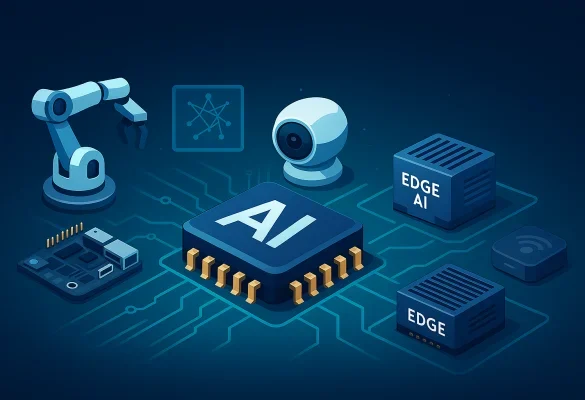
On-device AI inference enables mobile applications to run artificial intelligence models directly on the user’s device rather than relying on cloud-based servers. This approach shifts computation closer to the user, allowing apps to deliver faster, more responsive, and more reliable intelligent features. As mobile hardware continues to advance, on-device AI has become increasingly practical and powerful.
One of the most significant advantages of on-device AI inference is reduced latency. Since data does not need to be sent to remote servers for processing, AI-powered features can respond instantly. This real-time performance is critical for applications such as face recognition, gesture detection, voice commands, and camera-based interactions where delays would negatively impact user experience.
Privacy is greatly enhanced with Edge AI. Sensitive information such as images, voice recordings, and personal behavior data remains on the device instead of being transmitted over the network. This reduces the risk of data breaches and aligns with growing user expectations and regulatory requirements around data protection and privacy.
On-device AI also improves reliability by enabling applications to function without an internet connection. Features such as offline voice assistants, image classification, and activity detection continue to work even in low-connectivity or no-connectivity environments. This capability is especially valuable in regions with unstable networks or during travel.
Common use cases for on-device AI inference include face and fingerprint recognition, speech recognition for voice assistants, real-time image and video processing, text prediction, and activity recognition using sensor data. These applications benefit from fast execution and continuous availability without relying on cloud infrastructure.
Optimized AI frameworks make on-device inference feasible on mobile hardware. Technologies such as TensorFlow Lite, Core ML, and ONNX Runtime are designed to run lightweight, efficient models on smartphones and tablets. These frameworks support model compression, quantization, and hardware acceleration to maximize performance while minimizing resource usage.
Battery efficiency and model optimization are key challenges in Edge AI development. Running AI models consumes processing power, which can impact battery life if not managed carefully. Developers must optimize models, schedule inference intelligently, and leverage specialized hardware like neural processing units (NPUs) to balance performance and energy consumption.
Achieving the right balance between accuracy, speed, and resource usage requires careful design decisions. Developers must choose appropriate model architectures, adjust precision levels, and tailor inference frequency based on application needs. Continuous testing and profiling are essential to ensure smooth performance across different devices.
Overall, on-device AI inference represents the future of fast, secure, and privacy-focused mobile applications. By combining low latency, offline functionality, and strong data protection, Edge AI enables intelligent experiences that are both user-friendly and trustworthy.
One of the most significant advantages of on-device AI inference is reduced latency. Since data does not need to be sent to remote servers for processing, AI-powered features can respond instantly. This real-time performance is critical for applications such as face recognition, gesture detection, voice commands, and camera-based interactions where delays would negatively impact user experience.
Privacy is greatly enhanced with Edge AI. Sensitive information such as images, voice recordings, and personal behavior data remains on the device instead of being transmitted over the network. This reduces the risk of data breaches and aligns with growing user expectations and regulatory requirements around data protection and privacy.
On-device AI also improves reliability by enabling applications to function without an internet connection. Features such as offline voice assistants, image classification, and activity detection continue to work even in low-connectivity or no-connectivity environments. This capability is especially valuable in regions with unstable networks or during travel.
Common use cases for on-device AI inference include face and fingerprint recognition, speech recognition for voice assistants, real-time image and video processing, text prediction, and activity recognition using sensor data. These applications benefit from fast execution and continuous availability without relying on cloud infrastructure.
Optimized AI frameworks make on-device inference feasible on mobile hardware. Technologies such as TensorFlow Lite, Core ML, and ONNX Runtime are designed to run lightweight, efficient models on smartphones and tablets. These frameworks support model compression, quantization, and hardware acceleration to maximize performance while minimizing resource usage.
Battery efficiency and model optimization are key challenges in Edge AI development. Running AI models consumes processing power, which can impact battery life if not managed carefully. Developers must optimize models, schedule inference intelligently, and leverage specialized hardware like neural processing units (NPUs) to balance performance and energy consumption.
Achieving the right balance between accuracy, speed, and resource usage requires careful design decisions. Developers must choose appropriate model architectures, adjust precision levels, and tailor inference frequency based on application needs. Continuous testing and profiling are essential to ensure smooth performance across different devices.
Overall, on-device AI inference represents the future of fast, secure, and privacy-focused mobile applications. By combining low latency, offline functionality, and strong data protection, Edge AI enables intelligent experiences that are both user-friendly and trustworthy.