
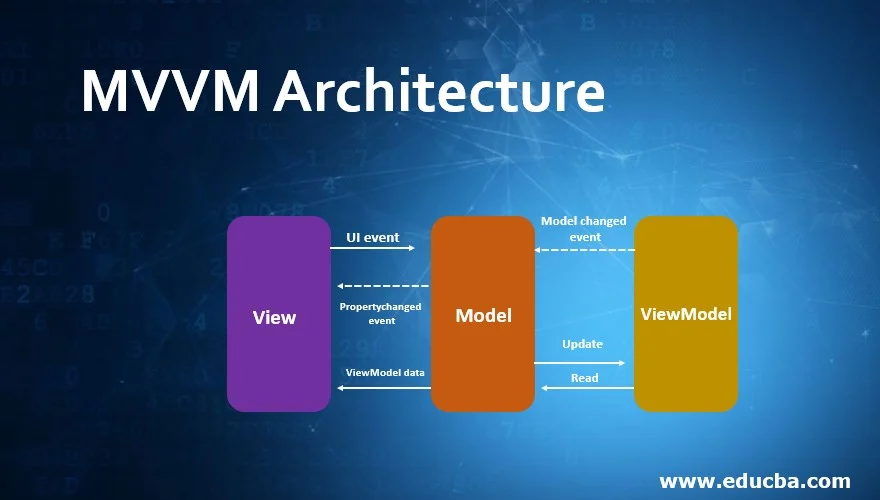
MVVM (Model–View–ViewModel) Architecture is a widely used design pattern in modern mobile application development that focuses on separating business logic from user interface logic. By enforcing a clear structure, MVVM improves code maintainability, scalability, and overall application quality, especially in large and long-term projects.
In the MVVM pattern, the Model layer is responsible for handling application data and core business rules. It manages tasks such as API communication, database operations, data validation, and business workflows. The Model is completely independent of the UI, ensuring that core logic remains reusable and easy to maintain.
The View layer represents the user interface of the application. Its primary role is to display data and capture user interactions such as button clicks, text input, or gestures. The View does not contain business logic; instead, it observes data changes and reacts accordingly, keeping the UI layer clean and focused.
The ViewModel acts as an intermediary between the Model and the View. It retrieves data from the Model, processes it if needed, and exposes it in a format that the View can easily consume. This abstraction ensures that the View does not need to understand how data is fetched or processed.
A key advantage of MVVM is its support for observable data patterns. The ViewModel exposes data using observable constructs, allowing the View to automatically update whenever the underlying data changes. This reactive behavior reduces the need for manual UI refresh logic and minimizes boilerplate code.
Because business logic resides in the ViewModel and Model layers, developers can modify or redesign the UI without affecting core functionality. This separation of concerns makes the codebase more flexible and easier to evolve as requirements change.
MVVM significantly improves testability. Since ViewModels do not depend on UI components, they can be unit tested independently. Developers can validate business logic, data transformations, and state management without involving the UI, leading to more reliable applications.
Modern mobile frameworks strongly promote MVVM due to its clean and predictable structure. Framework tools often provide built-in support for lifecycle-aware components and data observation, making MVVM easier to implement and maintain.
MVVM also enhances team collaboration. UI developers can focus on the View layer, while backend or logic-focused developers work on Models and ViewModels. This clear division of responsibilities reduces conflicts and improves development efficiency.
The architecture supports reactive and asynchronous programming models, which are essential for modern mobile apps. Network calls, database updates, and background tasks can be handled efficiently without blocking the UI thread.
MVVM scales well for large applications with complex state management. As features grow, the architecture prevents the UI layer from becoming cluttered with logic, ensuring long-term maintainability.
In conclusion, MVVM is a foundational architecture pattern for building robust, scalable, and maintainable mobile applications. Its clear separation of concerns, strong testability, and support for reactive updates make it a preferred choice in modern mobile development.
In the MVVM pattern, the Model layer is responsible for handling application data and core business rules. It manages tasks such as API communication, database operations, data validation, and business workflows. The Model is completely independent of the UI, ensuring that core logic remains reusable and easy to maintain.
The View layer represents the user interface of the application. Its primary role is to display data and capture user interactions such as button clicks, text input, or gestures. The View does not contain business logic; instead, it observes data changes and reacts accordingly, keeping the UI layer clean and focused.
The ViewModel acts as an intermediary between the Model and the View. It retrieves data from the Model, processes it if needed, and exposes it in a format that the View can easily consume. This abstraction ensures that the View does not need to understand how data is fetched or processed.
A key advantage of MVVM is its support for observable data patterns. The ViewModel exposes data using observable constructs, allowing the View to automatically update whenever the underlying data changes. This reactive behavior reduces the need for manual UI refresh logic and minimizes boilerplate code.
Because business logic resides in the ViewModel and Model layers, developers can modify or redesign the UI without affecting core functionality. This separation of concerns makes the codebase more flexible and easier to evolve as requirements change.
MVVM significantly improves testability. Since ViewModels do not depend on UI components, they can be unit tested independently. Developers can validate business logic, data transformations, and state management without involving the UI, leading to more reliable applications.
Modern mobile frameworks strongly promote MVVM due to its clean and predictable structure. Framework tools often provide built-in support for lifecycle-aware components and data observation, making MVVM easier to implement and maintain.
MVVM also enhances team collaboration. UI developers can focus on the View layer, while backend or logic-focused developers work on Models and ViewModels. This clear division of responsibilities reduces conflicts and improves development efficiency.
The architecture supports reactive and asynchronous programming models, which are essential for modern mobile apps. Network calls, database updates, and background tasks can be handled efficiently without blocking the UI thread.
MVVM scales well for large applications with complex state management. As features grow, the architecture prevents the UI layer from becoming cluttered with logic, ensuring long-term maintainability.
In conclusion, MVVM is a foundational architecture pattern for building robust, scalable, and maintainable mobile applications. Its clear separation of concerns, strong testability, and support for reactive updates make it a preferred choice in modern mobile development.