
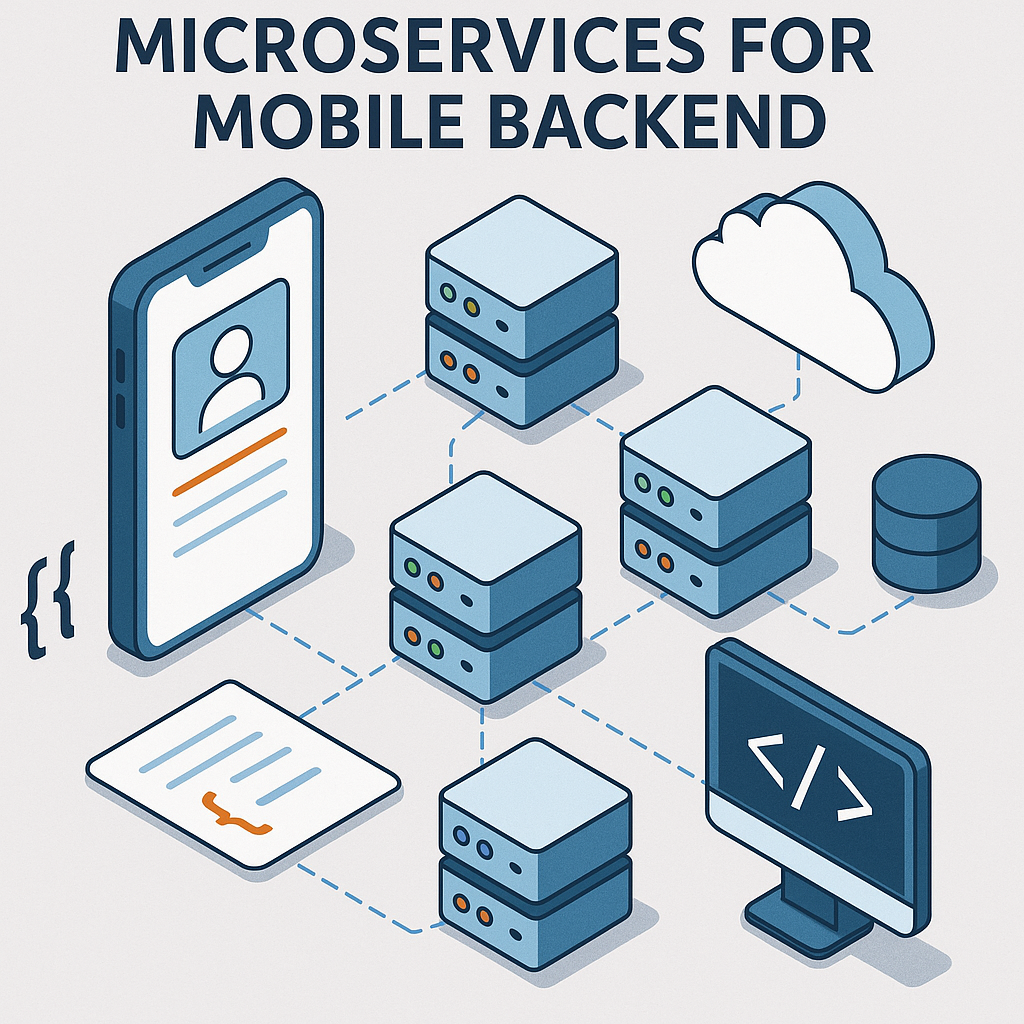
Mobile apps have unique constraints — intermittent connectivity, limited CPU/memory, varying network latency, and a relentless user expectation for responsiveness. Traditional monolithic backends can become bottlenecks as an app grows: a single deployment affects all features, scaling is coarse-grained, and teams step on each other’s toes. Microservices offer a way to split backend functionality into small, independently deployable services that each own a single responsibility (authentication, media processing, notifications, payments, search, etc.). For mobile-focused products, this decomposition maps nicely to feature teams, lets you scale only the parts that need it (e.g., media transcoding during a viral moment), and enables faster iteration because teams can deploy and roll back services independently. In short, microservices lower the blast radius of changes, help tailor SLAs per service, and make it easier to adopt heterogeneous technologies where appropriate — all useful when delivering a mobile app that must stay fast and reliable under diverse load patterns.
Good microservice design starts with careful boundaries. For mobile backends, organize services around use cases and data ownership rather than technical layers. For example, group everything related to user profile management (profile data, avatar upload, preferences) under a “User” service and keep push-notification logic in a dedicated “Notifications” service. Define explicit API contracts (often with OpenAPI/Swagger) and version them — mobile clients are long-lived and slower to update than internal services, so backward compatibility matters. Use API gateways to provide a single entry point for mobile clients; the gateway can implement request aggregation, protocol translation (HTTP/2, WebSocket, gRPC), authentication routing, rate limiting, and coarse-grained caching. Keep payloads compact for mobile networks: use concise JSON shapes, consider binary formats like Protobuf where appropriate, and support field-level selection to avoid sending unnecessary data over slow links.
Microservices communicate either synchronously (HTTP/REST or gRPC) or asynchronously (message brokers, event streaming). For mobile backends, a hybrid approach usually fits best. Use synchronous APIs for request/response flows initiated by mobile clients — e.g., fetching a user timeline — because they provide immediate results. Use asynchronous events for long-running or eventual workflows — e.g., order processing, media transcoding, analytics — where the mobile app can be notified later (push or polling). Design for eventual consistency: when a mobile user performs an action, show optimistic UI feedback to avoid blocking the UX while the backend converges. Implement idempotency keys for operations that might be retried due to flaky mobile networks (payment or create-order endpoints) and choose appropriate consistency models per domain — strong consistency where correctness is critical, and eventual consistency where latency and availability matter more.
A common misconception is that microservices require separate databases for each service; while that’s ideal for true decoupling, it should be pragmatic. For mobile backends, enable services to own their data and expose bounded-context APIs; this prevents schema coupling. Use different storage technologies depending on access patterns: user sessions and tokens in in-memory stores (Redis), write-heavy events in append-only logs (Kafka), document-like data in document stores (MongoDB) for flexible user content, and relational databases for transactional domains. For media-heavy apps, separate object storage (S3-compatible) for blobs and a CDN in front for delivery. Also adopt data replication and read replicas to improve read latency for mobile clients in diverse regions. Finally, build materialized views or API-side caching for expensive joins or aggregations so mobile clients get fast responses without hammering multiple services.
Mobile apps must handle offline scenarios gracefully. Microservices don’t change this requirement but influence how you design sync protocols. Implement lightweight sync endpoints that accept delta changes and return server-side change tokens (timestamps, incremental IDs). Prefer conflict-free replicated data types (CRDTs) or clearly defined merge rules for user-editable content to reduce complex conflict resolution on the client. Where conflicts are rare but impactful, provide server-side resolution strategies and surface human-readable conflict prompts to the user if necessary. Push notifications and background fetches can help mobile clients stay updated after coming back online, and webhooks or server-sent events can notify interested devices of important state changes. Keep payloads minimal for sync operations and support exponential backoff and retry strategies to cope with poor connectivity.
Security is foundational for mobile backends. Use OAuth 2.0 / OpenID Connect flows appropriate for mobile (e.g., authorization code with PKCE), and avoid storing long-lived secrets on the client. Issue short-lived access tokens and refresh tokens with secure handling. The API gateway should validate tokens, enforce scopes, and perform device-level rate limits. Protect against mobile-specific attacks: prevent easy reverse-engineering (obfuscation, but not as a substitute for server-side checks), detect jailbroken/rooted devices if that aligns with your security posture, and use certificate pinning where necessary to avoid MITM attacks (being mindful of maintenance burdens). For media uploads, scan files for malware and validate content on the server. Encrypt sensitive data at rest and enforce TLS for all transport. Finally, implement anomaly detection to spot suspicious device behavior (sudden high-volume API usage from a single token or IP) and provide rapid revocation paths for compromised credentials.
With many microservices, observability becomes essential. Instrument services with structured logs, distributed tracing (e.g., OpenTelemetry), and metrics (Prometheus-style) so you can trace a mobile request end-to-end. Mobile clients are often the origin point for complex flows (e.g., user uploads image → transcoding → CDN invalidate), so correlate client identifiers, request IDs, and trace IDs across components to recreate issues. Monitor latency, error rates, and saturation per service and set meaningful alerts that avoid noise. For mobile-specific visibility, capture metrics like payload sizes, retry counts, offline sync failures, and geographic distribution of errors. Provide tools or APIs for remote debugging and log retrieval for a given user session (redacting sensitive data). Good observability reduces mean-time-to-diagnosis and helps teams iterate quickly while catching regressions before they affect large user populations.
Deploying many services demands automation. Adopt a robust CI/CD pipeline that runs unit tests, contract tests (consumer-driven contracts for service compatibility), integration tests, and security scans. Canary and blue/green deployments are helpful for mobile backends because they let you route a subset of traffic to a new version before full rollout, reducing the risk of breaking production for mobile users. Use autoscaling rules per service tuned to realistic metrics (request queue depth, CPU, custom application metrics) and leverage managed Kubernetes, serverless functions, or a mix depending on workload characteristics. For compute-heavy tasks like video processing, consider separate worker clusters or serverless jobs that can scale horizontally without impacting latency-sensitive services. Also design for multi-region deployment if you have a global user base — use geo-routing and replication to minimize latency for mobile clients.
Testing microservices for a mobile product is multidisciplinary: unit tests for individual services, end-to-end tests to validate composed flows, and contract tests to maintain API compatibility with mobile clients. Maintain a versioning strategy (semantic versioning for APIs, deprecation policies) and communicate breaking changes clearly so mobile apps have time to adapt. Governance matters — set standards for logging, monitoring, error handling, and security across teams to avoid fragmented practices. Establish SLOs/SLA for key services (auth, push, media delivery) and run regular game-days or chaos experiments to validate system resilience under real failure modes typical for mobile scenarios (slow networks, partitioning, burst traffic). Finally, invest in developer experience: templates, libraries, and shared platform services (auth, CDN, observability) that reduce cognitive load and accelerate feature delivery across teams.
Good microservice design starts with careful boundaries. For mobile backends, organize services around use cases and data ownership rather than technical layers. For example, group everything related to user profile management (profile data, avatar upload, preferences) under a “User” service and keep push-notification logic in a dedicated “Notifications” service. Define explicit API contracts (often with OpenAPI/Swagger) and version them — mobile clients are long-lived and slower to update than internal services, so backward compatibility matters. Use API gateways to provide a single entry point for mobile clients; the gateway can implement request aggregation, protocol translation (HTTP/2, WebSocket, gRPC), authentication routing, rate limiting, and coarse-grained caching. Keep payloads compact for mobile networks: use concise JSON shapes, consider binary formats like Protobuf where appropriate, and support field-level selection to avoid sending unnecessary data over slow links.
Microservices communicate either synchronously (HTTP/REST or gRPC) or asynchronously (message brokers, event streaming). For mobile backends, a hybrid approach usually fits best. Use synchronous APIs for request/response flows initiated by mobile clients — e.g., fetching a user timeline — because they provide immediate results. Use asynchronous events for long-running or eventual workflows — e.g., order processing, media transcoding, analytics — where the mobile app can be notified later (push or polling). Design for eventual consistency: when a mobile user performs an action, show optimistic UI feedback to avoid blocking the UX while the backend converges. Implement idempotency keys for operations that might be retried due to flaky mobile networks (payment or create-order endpoints) and choose appropriate consistency models per domain — strong consistency where correctness is critical, and eventual consistency where latency and availability matter more.
A common misconception is that microservices require separate databases for each service; while that’s ideal for true decoupling, it should be pragmatic. For mobile backends, enable services to own their data and expose bounded-context APIs; this prevents schema coupling. Use different storage technologies depending on access patterns: user sessions and tokens in in-memory stores (Redis), write-heavy events in append-only logs (Kafka), document-like data in document stores (MongoDB) for flexible user content, and relational databases for transactional domains. For media-heavy apps, separate object storage (S3-compatible) for blobs and a CDN in front for delivery. Also adopt data replication and read replicas to improve read latency for mobile clients in diverse regions. Finally, build materialized views or API-side caching for expensive joins or aggregations so mobile clients get fast responses without hammering multiple services.
Mobile apps must handle offline scenarios gracefully. Microservices don’t change this requirement but influence how you design sync protocols. Implement lightweight sync endpoints that accept delta changes and return server-side change tokens (timestamps, incremental IDs). Prefer conflict-free replicated data types (CRDTs) or clearly defined merge rules for user-editable content to reduce complex conflict resolution on the client. Where conflicts are rare but impactful, provide server-side resolution strategies and surface human-readable conflict prompts to the user if necessary. Push notifications and background fetches can help mobile clients stay updated after coming back online, and webhooks or server-sent events can notify interested devices of important state changes. Keep payloads minimal for sync operations and support exponential backoff and retry strategies to cope with poor connectivity.
Security is foundational for mobile backends. Use OAuth 2.0 / OpenID Connect flows appropriate for mobile (e.g., authorization code with PKCE), and avoid storing long-lived secrets on the client. Issue short-lived access tokens and refresh tokens with secure handling. The API gateway should validate tokens, enforce scopes, and perform device-level rate limits. Protect against mobile-specific attacks: prevent easy reverse-engineering (obfuscation, but not as a substitute for server-side checks), detect jailbroken/rooted devices if that aligns with your security posture, and use certificate pinning where necessary to avoid MITM attacks (being mindful of maintenance burdens). For media uploads, scan files for malware and validate content on the server. Encrypt sensitive data at rest and enforce TLS for all transport. Finally, implement anomaly detection to spot suspicious device behavior (sudden high-volume API usage from a single token or IP) and provide rapid revocation paths for compromised credentials.
With many microservices, observability becomes essential. Instrument services with structured logs, distributed tracing (e.g., OpenTelemetry), and metrics (Prometheus-style) so you can trace a mobile request end-to-end. Mobile clients are often the origin point for complex flows (e.g., user uploads image → transcoding → CDN invalidate), so correlate client identifiers, request IDs, and trace IDs across components to recreate issues. Monitor latency, error rates, and saturation per service and set meaningful alerts that avoid noise. For mobile-specific visibility, capture metrics like payload sizes, retry counts, offline sync failures, and geographic distribution of errors. Provide tools or APIs for remote debugging and log retrieval for a given user session (redacting sensitive data). Good observability reduces mean-time-to-diagnosis and helps teams iterate quickly while catching regressions before they affect large user populations.
Deploying many services demands automation. Adopt a robust CI/CD pipeline that runs unit tests, contract tests (consumer-driven contracts for service compatibility), integration tests, and security scans. Canary and blue/green deployments are helpful for mobile backends because they let you route a subset of traffic to a new version before full rollout, reducing the risk of breaking production for mobile users. Use autoscaling rules per service tuned to realistic metrics (request queue depth, CPU, custom application metrics) and leverage managed Kubernetes, serverless functions, or a mix depending on workload characteristics. For compute-heavy tasks like video processing, consider separate worker clusters or serverless jobs that can scale horizontally without impacting latency-sensitive services. Also design for multi-region deployment if you have a global user base — use geo-routing and replication to minimize latency for mobile clients.
Testing microservices for a mobile product is multidisciplinary: unit tests for individual services, end-to-end tests to validate composed flows, and contract tests to maintain API compatibility with mobile clients. Maintain a versioning strategy (semantic versioning for APIs, deprecation policies) and communicate breaking changes clearly so mobile apps have time to adapt. Governance matters — set standards for logging, monitoring, error handling, and security across teams to avoid fragmented practices. Establish SLOs/SLA for key services (auth, push, media delivery) and run regular game-days or chaos experiments to validate system resilience under real failure modes typical for mobile scenarios (slow networks, partitioning, burst traffic). Finally, invest in developer experience: templates, libraries, and shared platform services (auth, CDN, observability) that reduce cognitive load and accelerate feature delivery across teams.