
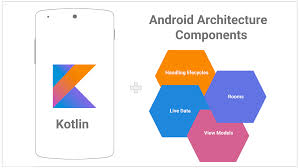
LiveData and ViewModel are fundamental components of Android’s modern architecture that help manage UI-related data in a lifecycle-aware and efficient manner. They are designed to solve long-standing Android problems such as memory leaks, configuration change issues, and complex lifecycle management. By separating data handling from UI components, they create a cleaner and more reliable application structure.
ViewModel is responsible for storing and managing data required by the UI. Unlike Activities and Fragments, a ViewModel survives configuration changes such as screen rotations. When the device orientation changes, the UI is recreated, but the ViewModel remains in memory, preventing unnecessary data reloads and preserving application state.
Another important advantage of ViewModel is that it does not hold references to UI elements. This prevents memory leaks and ensures that business logic remains independent of the Android UI framework. As a result, the code becomes easier to maintain, test, and reuse across different parts of the application.
LiveData is an observable data holder class that allows the UI to observe changes in data. When the data inside LiveData changes, the UI automatically receives updates without requiring manual intervention. This reactive behavior simplifies UI updates and eliminates the need for complex callback handling.
A key feature of LiveData is its lifecycle awareness. LiveData only notifies observers when the associated Activity or Fragment is in an active state such as STARTED or RESUMED. This prevents UI updates when the screen is not visible, reducing unnecessary processing and avoiding crashes.
When the UI moves into an inactive state, LiveData automatically stops sending updates. Once the UI becomes active again, it immediately receives the latest available data. This automatic pause-and-resume behavior improves efficiency and ensures the UI always displays up-to-date information.
LiveData and ViewModel work together seamlessly within the MVVM architecture. The ViewModel exposes LiveData objects, and the View observes them. This clear separation ensures that UI logic remains simple while data processing and business logic stay within the ViewModel.
These components significantly reduce boilerplate code related to lifecycle management. Developers no longer need to override multiple lifecycle methods or manually handle data persistence. This results in cleaner code, fewer bugs, and faster development.
In conclusion, LiveData and ViewModel form the backbone of robust Android application architecture. By handling lifecycle complexities automatically, improving data consistency, and enhancing stability, they enable developers to build scalable, responsive, and maintainable Android applications with confidence.
ViewModel is responsible for storing and managing data required by the UI. Unlike Activities and Fragments, a ViewModel survives configuration changes such as screen rotations. When the device orientation changes, the UI is recreated, but the ViewModel remains in memory, preventing unnecessary data reloads and preserving application state.
Another important advantage of ViewModel is that it does not hold references to UI elements. This prevents memory leaks and ensures that business logic remains independent of the Android UI framework. As a result, the code becomes easier to maintain, test, and reuse across different parts of the application.
LiveData is an observable data holder class that allows the UI to observe changes in data. When the data inside LiveData changes, the UI automatically receives updates without requiring manual intervention. This reactive behavior simplifies UI updates and eliminates the need for complex callback handling.
A key feature of LiveData is its lifecycle awareness. LiveData only notifies observers when the associated Activity or Fragment is in an active state such as STARTED or RESUMED. This prevents UI updates when the screen is not visible, reducing unnecessary processing and avoiding crashes.
When the UI moves into an inactive state, LiveData automatically stops sending updates. Once the UI becomes active again, it immediately receives the latest available data. This automatic pause-and-resume behavior improves efficiency and ensures the UI always displays up-to-date information.
LiveData and ViewModel work together seamlessly within the MVVM architecture. The ViewModel exposes LiveData objects, and the View observes them. This clear separation ensures that UI logic remains simple while data processing and business logic stay within the ViewModel.
These components significantly reduce boilerplate code related to lifecycle management. Developers no longer need to override multiple lifecycle methods or manually handle data persistence. This results in cleaner code, fewer bugs, and faster development.
In conclusion, LiveData and ViewModel form the backbone of robust Android application architecture. By handling lifecycle complexities automatically, improving data consistency, and enhancing stability, they enable developers to build scalable, responsive, and maintainable Android applications with confidence.