
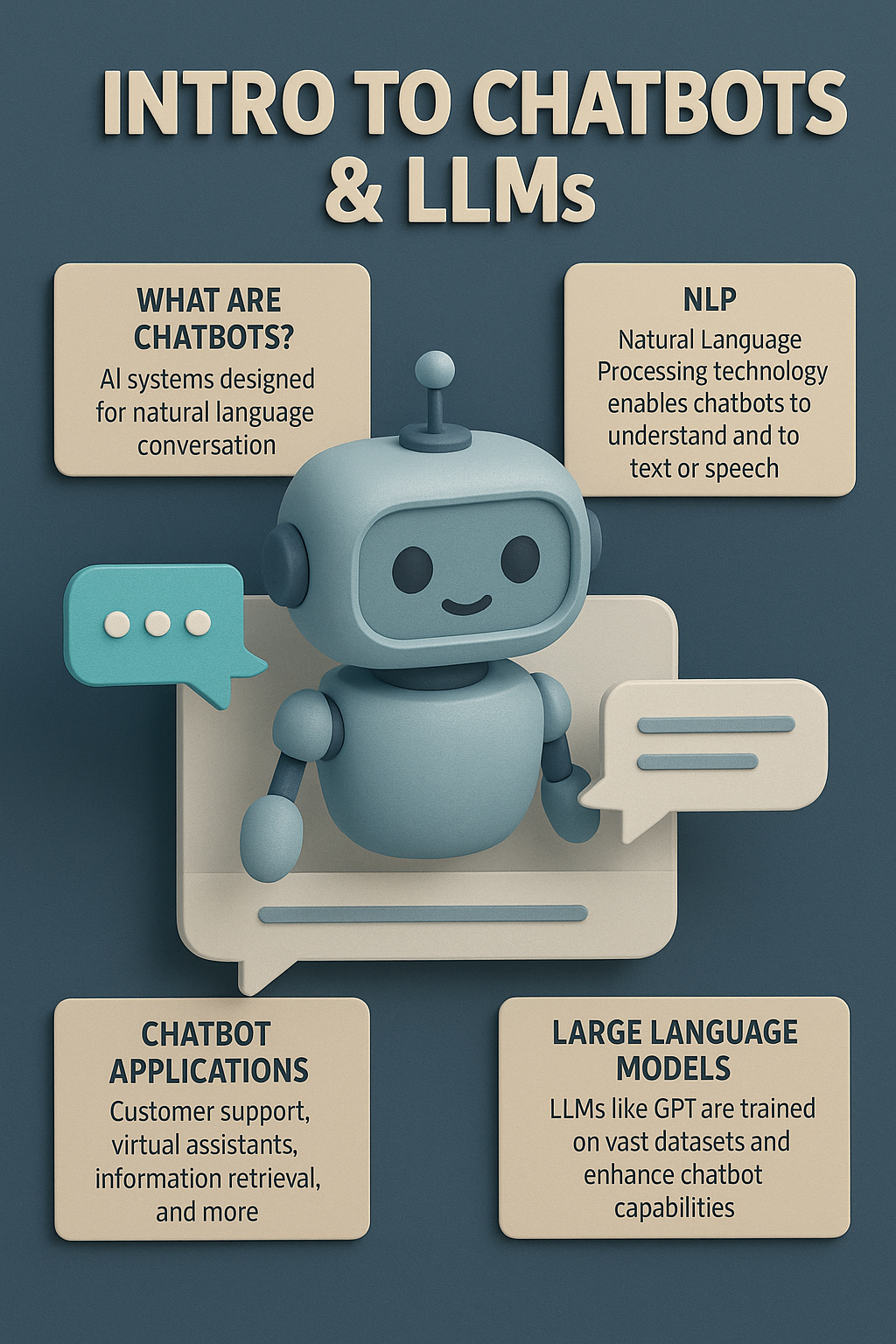
Chatbots and Large Language Models (LLMs) have become one of the most transformative technologies in the world of Artificial Intelligence, enabling machines to converse, assist, and solve problems like humans. Over the past decade, AI-powered conversational systems have evolved dramatically—from simple rule-based bots that followed predefined scripts to advanced LLMs such as ChatGPT, Gemini, Claude, and others capable of generating human-like responses, understanding context, reasoning, and even creating content. Their rise reshaped industries including customer service, healthcare, education, e-commerce, and software development. For beginners, learning about chatbots and LLMs is important because these technologies represent the future of intelligent automation and digital communication. At the core, they leverage Natural Language Processing (NLP) and deep learning to understand user queries and deliver meaningful responses.
Chatbots did not start out as smart conversational agents—they began as simple rule-based systems restricted to fixed commands and predefined responses. Early examples include ELIZA (1966), a scripted program that mimicked a psychotherapist using pattern matching. These early bots lacked understanding and relied heavily on keywords. With advancements in machine learning, chatbots evolved into retrieval-based systems that selected the best possible response from a database. These bots were more interactive but still limited by the rules created by developers. The real revolution arrived with the introduction of deep learning and transformer-based architectures. These models enabled chatbots to understand context, learn from data, and generate natural-sounding responses. Modern LLMs are not restricted to predefined responses—they create them in real time based on the meaning of the input.
Large Language Models are advanced neural networks trained on massive amounts of text. Their job is to understand and generate human language. LLMs are built using transformer architectures that allow them to process relationships between words across long sentences and paragraphs, making them extremely powerful in language understanding. These models learn grammar, vocabulary, world knowledge, patterns, and reasoning from the data they are trained on. The “large” aspect refers to billions or even trillions of parameters—mathematical weights that help the model understand language. Some well-known LLMs include GPT-4/5, Llama 3, Google Gemini, Claude 3, Mistral, and others. These models can perform multiple tasks—answering questions, summarizing text, translating languages, generating code, writing articles, and more. Their versatility makes them central to modern AI advancements.
A chatbot typically involves several components working together. First, the input processing stage takes the user’s text and converts it into a machine-readable format. Next, the NLP/LLM engine interprets the meaning behind the text by converting words into embeddings (numerical vectors). Using deep learning, the model predicts the best possible response. Finally, the output generation stage converts this response into readable language. Rule-based bots use fixed logic, while AI-powered bots rely on data-driven patterns. Modern LLM-based chatbots also maintain context across conversations, allowing them to remember earlier parts of the dialogue and respond intelligently. Many chatbots also integrate APIs or backend systems to fetch weather updates, perform bookings, or control devices. This combination of natural language understanding and functional integration makes chatbots practical and powerful tools.
There are three main types of chatbots:
1)Rule-Based Chatbots – Work using predefined scripts and “if-else” logic. They are simple, predictable, but limited.
2)AI-Based Chatbots – Use machine learning and NLP to understand language patterns and generate responses.
3)LLM-Powered Chatbots – The most advanced type; they generate real-time responses, reason, understand context deeply, and work across many tasks.
LLMs make chatbots more flexible because they require less manual rule creation. Instead of programming responses, developers fine-tune or prompt the model to handle different tasks. This allows companies to deploy highly intelligent assistants faster.
Training an LLM requires massive datasets, powerful GPUs, and sophisticated engineering. During training, the model learns to predict the next word in a sentence, gradually capturing patterns in language. However, most organizations do not train LLMs from scratch due to cost. Instead, they fine-tune existing models for specific needs using techniques like:
1)Supervised fine-tuning (SFT)
2)Reinforcement learning from human feedback (RLHF)
3)Prompt engineering
4)Low-rank adaptation (LoRA)
Fine-tuning helps the model understand domain-specific information such as finance, healthcare, law, or customer service. The rise of smaller, efficient models enables businesses to deploy chatbots even on local devices.
Chatbots and LLMs have widespread applications across industries. In customer support, they handle queries instantly, reducing wait times and workload for human agents. In healthcare, AI assistants help answer medical questions, schedule appointments, and analyze symptoms. In education, they act as personal tutors or writing assistants. Developers use LLMs for coding, debugging, and documentation. Businesses use them for marketing, product recommendations, email generation, and automation. LLMs also support creativity—writing stories, composing music, generating ideas, and designing content. As they continue evolving, these AI systems are becoming essential tools for productivity, personalization, and automation.
Chatbots and LLMs offer major advantages: they reduce operational costs, provide instant 24/7 assistance, scale easily, and enhance user experience. However, they also come with limitations. They may generate inaccurate information (hallucinations), lack real-time understanding of emotions, and require careful dataset curation. Safety is one of the biggest priorities—LLMs must avoid harmful content, bias, or misinformation. Developers implement safety layers, filters, and monitoring to ensure responsible use. Ethical issues like privacy, data leaks, and AI misuse are also addressed through strict guidelines and continuous improvements. While LLMs are extremely powerful, they function best when used with human oversight.
Chatbots and Large Language Models represent a major leap in AI, transforming how humans interact with technology. Their ability to understand natural language, generate intelligent responses, and provide personalized assistance makes them central to the future of digital services. For beginners, understanding how they work opens doors to opportunities in AI development, automation, NLP, and product design. As LLMs evolve, their role in society will continue expanding, making this field exciting, dynamic, and full of innovation. Mastering the basics today will help you stay prepared for the next wave of AI evolution.
Chatbots did not start out as smart conversational agents—they began as simple rule-based systems restricted to fixed commands and predefined responses. Early examples include ELIZA (1966), a scripted program that mimicked a psychotherapist using pattern matching. These early bots lacked understanding and relied heavily on keywords. With advancements in machine learning, chatbots evolved into retrieval-based systems that selected the best possible response from a database. These bots were more interactive but still limited by the rules created by developers. The real revolution arrived with the introduction of deep learning and transformer-based architectures. These models enabled chatbots to understand context, learn from data, and generate natural-sounding responses. Modern LLMs are not restricted to predefined responses—they create them in real time based on the meaning of the input.
Large Language Models are advanced neural networks trained on massive amounts of text. Their job is to understand and generate human language. LLMs are built using transformer architectures that allow them to process relationships between words across long sentences and paragraphs, making them extremely powerful in language understanding. These models learn grammar, vocabulary, world knowledge, patterns, and reasoning from the data they are trained on. The “large” aspect refers to billions or even trillions of parameters—mathematical weights that help the model understand language. Some well-known LLMs include GPT-4/5, Llama 3, Google Gemini, Claude 3, Mistral, and others. These models can perform multiple tasks—answering questions, summarizing text, translating languages, generating code, writing articles, and more. Their versatility makes them central to modern AI advancements.
A chatbot typically involves several components working together. First, the input processing stage takes the user’s text and converts it into a machine-readable format. Next, the NLP/LLM engine interprets the meaning behind the text by converting words into embeddings (numerical vectors). Using deep learning, the model predicts the best possible response. Finally, the output generation stage converts this response into readable language. Rule-based bots use fixed logic, while AI-powered bots rely on data-driven patterns. Modern LLM-based chatbots also maintain context across conversations, allowing them to remember earlier parts of the dialogue and respond intelligently. Many chatbots also integrate APIs or backend systems to fetch weather updates, perform bookings, or control devices. This combination of natural language understanding and functional integration makes chatbots practical and powerful tools.
There are three main types of chatbots:
1)Rule-Based Chatbots – Work using predefined scripts and “if-else” logic. They are simple, predictable, but limited.
2)AI-Based Chatbots – Use machine learning and NLP to understand language patterns and generate responses.
3)LLM-Powered Chatbots – The most advanced type; they generate real-time responses, reason, understand context deeply, and work across many tasks.
LLMs make chatbots more flexible because they require less manual rule creation. Instead of programming responses, developers fine-tune or prompt the model to handle different tasks. This allows companies to deploy highly intelligent assistants faster.
Training an LLM requires massive datasets, powerful GPUs, and sophisticated engineering. During training, the model learns to predict the next word in a sentence, gradually capturing patterns in language. However, most organizations do not train LLMs from scratch due to cost. Instead, they fine-tune existing models for specific needs using techniques like:
1)Supervised fine-tuning (SFT)
2)Reinforcement learning from human feedback (RLHF)
3)Prompt engineering
4)Low-rank adaptation (LoRA)
Fine-tuning helps the model understand domain-specific information such as finance, healthcare, law, or customer service. The rise of smaller, efficient models enables businesses to deploy chatbots even on local devices.
Chatbots and LLMs have widespread applications across industries. In customer support, they handle queries instantly, reducing wait times and workload for human agents. In healthcare, AI assistants help answer medical questions, schedule appointments, and analyze symptoms. In education, they act as personal tutors or writing assistants. Developers use LLMs for coding, debugging, and documentation. Businesses use them for marketing, product recommendations, email generation, and automation. LLMs also support creativity—writing stories, composing music, generating ideas, and designing content. As they continue evolving, these AI systems are becoming essential tools for productivity, personalization, and automation.
Chatbots and LLMs offer major advantages: they reduce operational costs, provide instant 24/7 assistance, scale easily, and enhance user experience. However, they also come with limitations. They may generate inaccurate information (hallucinations), lack real-time understanding of emotions, and require careful dataset curation. Safety is one of the biggest priorities—LLMs must avoid harmful content, bias, or misinformation. Developers implement safety layers, filters, and monitoring to ensure responsible use. Ethical issues like privacy, data leaks, and AI misuse are also addressed through strict guidelines and continuous improvements. While LLMs are extremely powerful, they function best when used with human oversight.
Chatbots and Large Language Models represent a major leap in AI, transforming how humans interact with technology. Their ability to understand natural language, generate intelligent responses, and provide personalized assistance makes them central to the future of digital services. For beginners, understanding how they work opens doors to opportunities in AI development, automation, NLP, and product design. As LLMs evolve, their role in society will continue expanding, making this field exciting, dynamic, and full of innovation. Mastering the basics today will help you stay prepared for the next wave of AI evolution.