
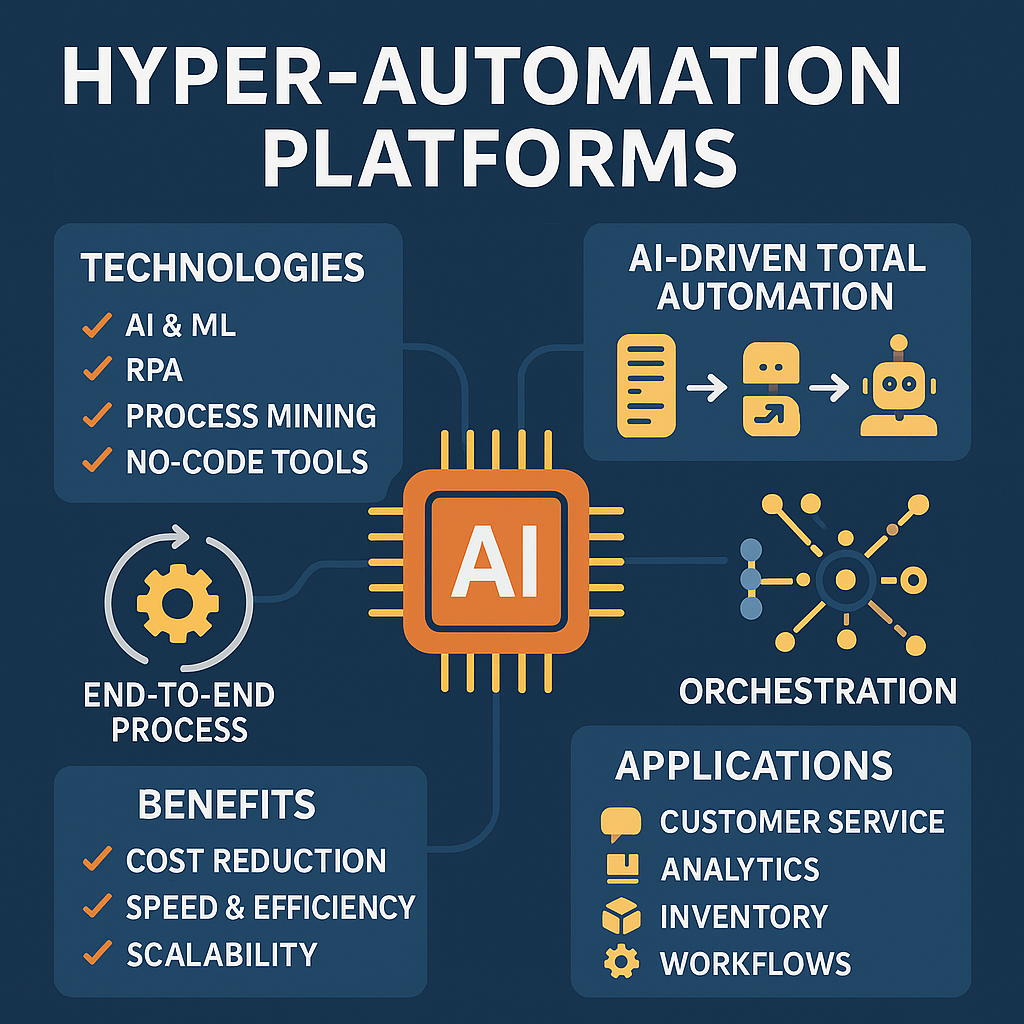
Hyper-automation represents one of the most transformative shifts in modern technology. It goes far beyond simple workflow automation or rule-based systems. Instead, hyper-automation combines AI, machine learning, natural language processing, RPA (Robotic Process Automation), no-code tools, process mining, IoT, orchestration engines, and data intelligence to create systems that can operate, optimise, and even make decisions with minimal human involvement. This is not about automating one task—this is about automating entire business processes end-to-end, allowing organizations to function like intelligent, self-driven engines.
Hyper-automation is a comprehensive approach to automation where multiple advanced technologies work together to completely digitize, analyse, execute, and optimize workflows. Unlike traditional automation—where a predefined script handles a fixed task—hyper-automation integrates AI models that can learn, adapt, and evolve. It identifies what should be automated, decides how automation should occur, generates the automation, executes it, and continuously improves it. This creates a digitally intelligent organization capable of running at high speed with reduced errors.
Hyper-automation is powered by a cluster of high-impact, interconnected technologies. AI and machine learning make decisions in real time. Robotic Process Automation (RPA) handles repetitive, rule-based tasks. Process mining and task mining reveal inefficiencies and opportunities for automation. No-code/low-code tools allow rapid deployment without heavy development effort. Generative AI creates workflows and logic automatically. IoT sensors gather real-time data, while orchestration engines ensure that all automation components work in harmony. Together, these form a dynamic ecosystem where intelligence flows across people, data, and systems.
With hyper-automation, businesses shift from reactive operations to a real-time intelligent model. Imagine an enterprise where customer service, backend processing, inventory management, fraud detection, analytics reporting, and compliance checks all run autonomously without manual intervention. Processes that once took days now occur in seconds. Systems anticipate issues before they occur. Data becomes self-correcting. Employee workload drops as mundane tasks disappear, unlocking more time for creativity and innovation. The result is a leaner, faster, smarter digital enterprise.
Hyper-automation is rapidly reshaping industries. In banking, AI-driven bots process loan applications, verify documents, check fraud risks, and approve applications instantly. In healthcare, automated platforms handle appointment scheduling, patient triage, billing, and diagnostic analysis. In manufacturing, IoT-enabled machines self-monitor and order maintenance automatically. In retail, hyper-automation forecasts demand, adjusts pricing, restocks inventory, and personalizes product recommendations in real time. In logistics, autonomous routing systems optimize delivery paths dynamically. Every industry gains precision, speed, and cost reduction.
Generative AI is the new powerhouse inside hyper-automation platforms. Instead of manually designing workflows, generative AI builds them automatically. It can interpret documents, read emails, extract data, design dashboards, create business logic, write code, and even orchestrate multi-step business processes with minimal input. Generative AI agents can collaborate—one agent processes data, another triggers alerts, another performs tasks, and another monitors performance. Together, they form self-evolving automation systems capable of scaling endlessly.
The advantages are profound. Hyper-automation dramatically reduces operational costs, increases accuracy, eliminates human errors, and accelerates delivery. It improves customer satisfaction through faster response times and personalized experiences. Productivity boosts by 300% to 600% in many organizations adopting intelligent automation. Decision-making becomes data-driven and predictive. Even small teams can handle massive workloads because automation scales infinitely. For enterprises, this becomes a competitive edge that determines survival in the digital era.
Despite its power, hyper-automation comes with challenges. Integrating multiple AI and automation technologies requires strong architecture. Businesses may struggle with data quality, legacy systems, cybersecurity concerns, or lack of skilled talent. Over-automation can also lead to unintended dependencies or reduced human oversight. Transparency becomes critical—AI decisions must be explainable. Ethical governance, compliance frameworks, and continuous monitoring ensure the automation remains accurate, fair, and secure.
Hyper-automation is moving toward Autonomous Enterprises—organizations that operate, learn, and optimize themselves. AI agents will collaborate and negotiate with each other. End-to-end business cycles will run without human intervention. Decision-making will be predictive and self-improving. Hyper-automation will integrate with the next generation of technologies: digital twins, quantum computing, self-optimizing databases, and AGI-level decision systems. Businesses that embrace hyper-automation now will lead the future landscape of intelligent digital ecosystems.
Hyper-automation is a comprehensive approach to automation where multiple advanced technologies work together to completely digitize, analyse, execute, and optimize workflows. Unlike traditional automation—where a predefined script handles a fixed task—hyper-automation integrates AI models that can learn, adapt, and evolve. It identifies what should be automated, decides how automation should occur, generates the automation, executes it, and continuously improves it. This creates a digitally intelligent organization capable of running at high speed with reduced errors.
Hyper-automation is powered by a cluster of high-impact, interconnected technologies. AI and machine learning make decisions in real time. Robotic Process Automation (RPA) handles repetitive, rule-based tasks. Process mining and task mining reveal inefficiencies and opportunities for automation. No-code/low-code tools allow rapid deployment without heavy development effort. Generative AI creates workflows and logic automatically. IoT sensors gather real-time data, while orchestration engines ensure that all automation components work in harmony. Together, these form a dynamic ecosystem where intelligence flows across people, data, and systems.
With hyper-automation, businesses shift from reactive operations to a real-time intelligent model. Imagine an enterprise where customer service, backend processing, inventory management, fraud detection, analytics reporting, and compliance checks all run autonomously without manual intervention. Processes that once took days now occur in seconds. Systems anticipate issues before they occur. Data becomes self-correcting. Employee workload drops as mundane tasks disappear, unlocking more time for creativity and innovation. The result is a leaner, faster, smarter digital enterprise.
Hyper-automation is rapidly reshaping industries. In banking, AI-driven bots process loan applications, verify documents, check fraud risks, and approve applications instantly. In healthcare, automated platforms handle appointment scheduling, patient triage, billing, and diagnostic analysis. In manufacturing, IoT-enabled machines self-monitor and order maintenance automatically. In retail, hyper-automation forecasts demand, adjusts pricing, restocks inventory, and personalizes product recommendations in real time. In logistics, autonomous routing systems optimize delivery paths dynamically. Every industry gains precision, speed, and cost reduction.
Generative AI is the new powerhouse inside hyper-automation platforms. Instead of manually designing workflows, generative AI builds them automatically. It can interpret documents, read emails, extract data, design dashboards, create business logic, write code, and even orchestrate multi-step business processes with minimal input. Generative AI agents can collaborate—one agent processes data, another triggers alerts, another performs tasks, and another monitors performance. Together, they form self-evolving automation systems capable of scaling endlessly.
The advantages are profound. Hyper-automation dramatically reduces operational costs, increases accuracy, eliminates human errors, and accelerates delivery. It improves customer satisfaction through faster response times and personalized experiences. Productivity boosts by 300% to 600% in many organizations adopting intelligent automation. Decision-making becomes data-driven and predictive. Even small teams can handle massive workloads because automation scales infinitely. For enterprises, this becomes a competitive edge that determines survival in the digital era.
Despite its power, hyper-automation comes with challenges. Integrating multiple AI and automation technologies requires strong architecture. Businesses may struggle with data quality, legacy systems, cybersecurity concerns, or lack of skilled talent. Over-automation can also lead to unintended dependencies or reduced human oversight. Transparency becomes critical—AI decisions must be explainable. Ethical governance, compliance frameworks, and continuous monitoring ensure the automation remains accurate, fair, and secure.
Hyper-automation is moving toward Autonomous Enterprises—organizations that operate, learn, and optimize themselves. AI agents will collaborate and negotiate with each other. End-to-end business cycles will run without human intervention. Decision-making will be predictive and self-improving. Hyper-automation will integrate with the next generation of technologies: digital twins, quantum computing, self-optimizing databases, and AGI-level decision systems. Businesses that embrace hyper-automation now will lead the future landscape of intelligent digital ecosystems.