
Event-driven programming is one of the most important paradigms in modern software development. Whether you are building mobile apps, web applications, game engines, desktop tools, or distributed systems, the concept of reacting to events sits at the heart of interactive software. Unlike traditional linear programming where the flow of execution follows a fixed sequence of instructions, event-driven programs respond to user actions, system triggers, external messages, and environmental changes. This approach makes applications more flexible, responsive, and scalable. In today’s world—filled with real-time applications, microservices, and UI-heavy systems—event-driven architecture is more relevant than ever.
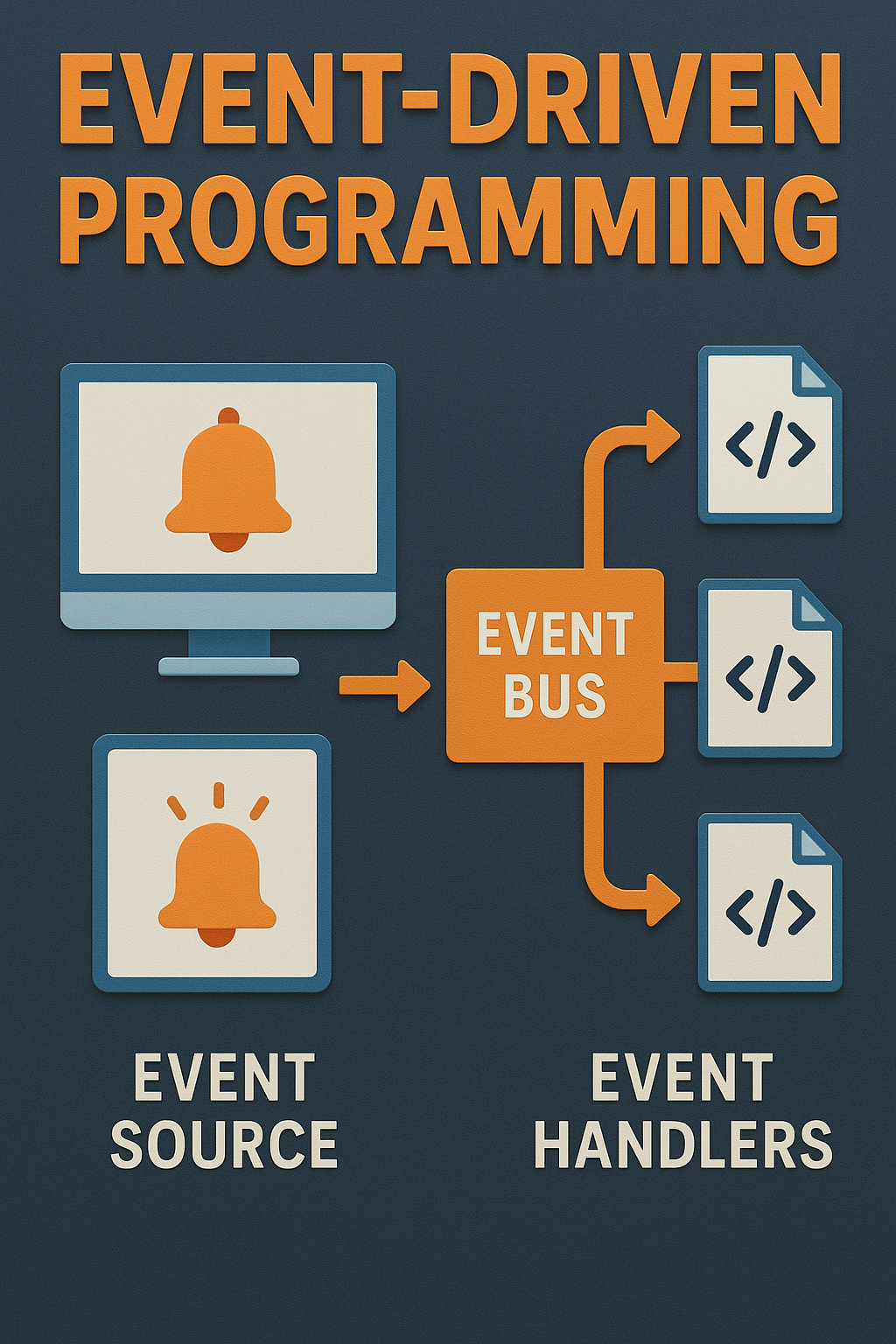
At the core of event-driven programming are events, which can be anything that triggers a response. A user clicking a button, an incoming message from a server, a file change in a directory, or a sensor reporting new data—each of these is an event. The system listens for these events and triggers corresponding event handlers. Handlers are functions that execute when an event occurs, defining what the program should do. This model makes software highly interactive and dynamic because the program is never waiting for a single linear flow; instead, it responds to events as they come, often in real time.
Most modern technologies embrace event-driven programming naturally. In frontend web development, JavaScript uses event listeners for clicks, keyboard inputs, mouse movement, and network responses. In backend development, Node.js is built entirely around event-driven, non-blocking architecture that handles massive numbers of concurrent requests efficiently. In mobile apps, frameworks like Flutter, Android, and SwiftUI use event-driven widgets and listeners to handle touch gestures, input, animation triggers, and UI updates. Even in enterprise systems, microservices communicate via asynchronous events using event brokers such as Kafka, RabbitMQ, or AWS SNS/SQS.
One of the biggest strengths of event-driven programming is its ability to support asynchronous execution. Instead of blocking the program until a task completes, the system can register a callback or promise to handle the result once the event fires. This leads to more efficient use of resources—especially in applications that deal with heavy I/O operations like database queries, file processing, and network communication. Asynchronous event-driven systems scale well because they avoid bottlenecks that commonly plague synchronous architectures.
Another key aspect of event-driven programming is loose coupling. In an event-driven system, components don’t need to know the inner details of each other. They communicate through events, allowing modules to evolve independently. This makes the architecture flexible, maintainable, and easy to extend. For example, adding a new feature that reacts to an event does not require modifying the existing code that triggers the event. This modularity is a major reason why event-driven design is widely used in large-scale systems, distributed applications, and real-time analytics platforms.
Despite its advantages, event-driven programming introduces challenges. One major concern is complexity in control flow. Because actions occur in response to events—which may come in unpredictable sequences—tracking the flow of execution can become difficult. Developers may face issues like callback hell, race conditions, or hard-to-debug asynchronous operations. Another challenge is excessive event generation, leading to performance bottlenecks or memory leaks if event listeners are not properly removed. Tools like async/await, reactive programming libraries, and structured state management systems help mitigate these issues.
Event-driven programming also plays a crucial role in designing high-performance systems that process streams of data. Real-time dashboards, stock trading systems, IoT devices, and messaging platforms rely on event streams for continuous updates. Technologies like Apache Kafka, Spark Streaming, and AWS Lambda are built around this paradigm and enable massive-scale event processing. In these architectures, events flow through pipelines where multiple services react, transform, and analyze data asynchronously. This model helps organizations build scalable, resilient, and fault-tolerant systems.
Looking ahead, the importance of event-driven programming will continue to rise. With the growth of IoT, AI-powered systems, microservices, and serverless computing, software needs to react faster and more intelligently. Event-driven design creates applications that adapt in real time, handle huge amounts of concurrent events, and operate efficiently even under unpredictable workloads. From responsive UI design to real-time communication and distributed system architecture, event-driven programming is shaping the future of software development.
At the core of event-driven programming are events, which can be anything that triggers a response. A user clicking a button, an incoming message from a server, a file change in a directory, or a sensor reporting new data—each of these is an event. The system listens for these events and triggers corresponding event handlers. Handlers are functions that execute when an event occurs, defining what the program should do. This model makes software highly interactive and dynamic because the program is never waiting for a single linear flow; instead, it responds to events as they come, often in real time.
Most modern technologies embrace event-driven programming naturally. In frontend web development, JavaScript uses event listeners for clicks, keyboard inputs, mouse movement, and network responses. In backend development, Node.js is built entirely around event-driven, non-blocking architecture that handles massive numbers of concurrent requests efficiently. In mobile apps, frameworks like Flutter, Android, and SwiftUI use event-driven widgets and listeners to handle touch gestures, input, animation triggers, and UI updates. Even in enterprise systems, microservices communicate via asynchronous events using event brokers such as Kafka, RabbitMQ, or AWS SNS/SQS.
One of the biggest strengths of event-driven programming is its ability to support asynchronous execution. Instead of blocking the program until a task completes, the system can register a callback or promise to handle the result once the event fires. This leads to more efficient use of resources—especially in applications that deal with heavy I/O operations like database queries, file processing, and network communication. Asynchronous event-driven systems scale well because they avoid bottlenecks that commonly plague synchronous architectures.
Another key aspect of event-driven programming is loose coupling. In an event-driven system, components don’t need to know the inner details of each other. They communicate through events, allowing modules to evolve independently. This makes the architecture flexible, maintainable, and easy to extend. For example, adding a new feature that reacts to an event does not require modifying the existing code that triggers the event. This modularity is a major reason why event-driven design is widely used in large-scale systems, distributed applications, and real-time analytics platforms.
Despite its advantages, event-driven programming introduces challenges. One major concern is complexity in control flow. Because actions occur in response to events—which may come in unpredictable sequences—tracking the flow of execution can become difficult. Developers may face issues like callback hell, race conditions, or hard-to-debug asynchronous operations. Another challenge is excessive event generation, leading to performance bottlenecks or memory leaks if event listeners are not properly removed. Tools like async/await, reactive programming libraries, and structured state management systems help mitigate these issues.
Event-driven programming also plays a crucial role in designing high-performance systems that process streams of data. Real-time dashboards, stock trading systems, IoT devices, and messaging platforms rely on event streams for continuous updates. Technologies like Apache Kafka, Spark Streaming, and AWS Lambda are built around this paradigm and enable massive-scale event processing. In these architectures, events flow through pipelines where multiple services react, transform, and analyze data asynchronously. This model helps organizations build scalable, resilient, and fault-tolerant systems.
Looking ahead, the importance of event-driven programming will continue to rise. With the growth of IoT, AI-powered systems, microservices, and serverless computing, software needs to react faster and more intelligently. Event-driven design creates applications that adapt in real time, handle huge amounts of concurrent events, and operate efficiently even under unpredictable workloads. From responsive UI design to real-time communication and distributed system architecture, event-driven programming is shaping the future of software development.