
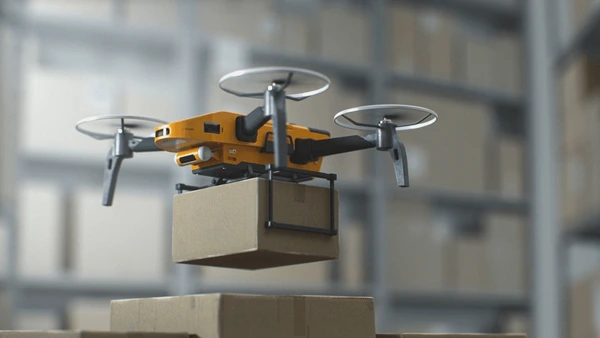
Drone technology is revolutionizing logistics by enabling fast, cost-effective, and remote delivery capabilities. Logistics companies use drones to transport packages, medicine, emergency supplies, and high-value goods. Their ability to bypass road traffic and reach inaccessible areas makes them a powerful tool for modern supply chains.
Modern drones use GPS, LiDAR, cameras, and onboard AI to navigate safely. They detect obstacles, adjust flight paths, and maintain stability in various weather conditions. Many delivery drones support vertical takeoff and landing (VTOL), making them suitable for urban environments with limited space.
Major companies like Amazon, UPS, and Wing (Google) have invested heavily in drone logistics. Amazon Prime Air focuses on ultra-fast deliveries within 30 minutes using autonomous drones. UPS received FAA approval for drone airline operations, enabling large-scale expansion across the U.S. These developments are shaping the future of last-mile delivery.
Drones are particularly impactful in healthcare logistics. They deliver vaccines, blood samples, and urgent medications to rural or disaster-hit regions where ground transport is slow or impossible. Countries like Rwanda and Ghana use drone fleets for national medical delivery networks, significantly reducing emergency response times.
Regulatory frameworks for drone operations are evolving worldwide. Authorities must ensure safety, manage air traffic, and protect citizens’ privacy. Drone delivery systems typically operate within regulated corridors, maintain altitude limits, and use remote ID systems for identification during flights.
Payload capacity and battery life remain technical challenges. While small drones can carry lightweight packages, larger drones are under development for heavier cargo. Improvements in battery technology, solar-powered drones, and hybrid engines will further expand logistics capabilities.
Security and reliability are top priorities. Drones must handle communication failures, GPS spoofing, and environmental hazards. Redundant systems, automatic return-to-home features, and geofencing ensure safe operation during emergencies.
Integration with logistics software is crucial. Drones communicate with dispatch systems, update delivery statuses, and sync with inventory records. Real-time tracking allows customers and companies to monitor deliveries as they happen.
Drone logistics is rapidly accelerating, reshaping last-mile delivery, healthcare supply chains, and emergency response. As regulation and technology improve, drones will become a mainstream component of global logistics systems.
Modern drones use GPS, LiDAR, cameras, and onboard AI to navigate safely. They detect obstacles, adjust flight paths, and maintain stability in various weather conditions. Many delivery drones support vertical takeoff and landing (VTOL), making them suitable for urban environments with limited space.
Major companies like Amazon, UPS, and Wing (Google) have invested heavily in drone logistics. Amazon Prime Air focuses on ultra-fast deliveries within 30 minutes using autonomous drones. UPS received FAA approval for drone airline operations, enabling large-scale expansion across the U.S. These developments are shaping the future of last-mile delivery.
Drones are particularly impactful in healthcare logistics. They deliver vaccines, blood samples, and urgent medications to rural or disaster-hit regions where ground transport is slow or impossible. Countries like Rwanda and Ghana use drone fleets for national medical delivery networks, significantly reducing emergency response times.
Regulatory frameworks for drone operations are evolving worldwide. Authorities must ensure safety, manage air traffic, and protect citizens’ privacy. Drone delivery systems typically operate within regulated corridors, maintain altitude limits, and use remote ID systems for identification during flights.
Payload capacity and battery life remain technical challenges. While small drones can carry lightweight packages, larger drones are under development for heavier cargo. Improvements in battery technology, solar-powered drones, and hybrid engines will further expand logistics capabilities.
Security and reliability are top priorities. Drones must handle communication failures, GPS spoofing, and environmental hazards. Redundant systems, automatic return-to-home features, and geofencing ensure safe operation during emergencies.
Integration with logistics software is crucial. Drones communicate with dispatch systems, update delivery statuses, and sync with inventory records. Real-time tracking allows customers and companies to monitor deliveries as they happen.
Drone logistics is rapidly accelerating, reshaping last-mile delivery, healthcare supply chains, and emergency response. As regulation and technology improve, drones will become a mainstream component of global logistics systems.