
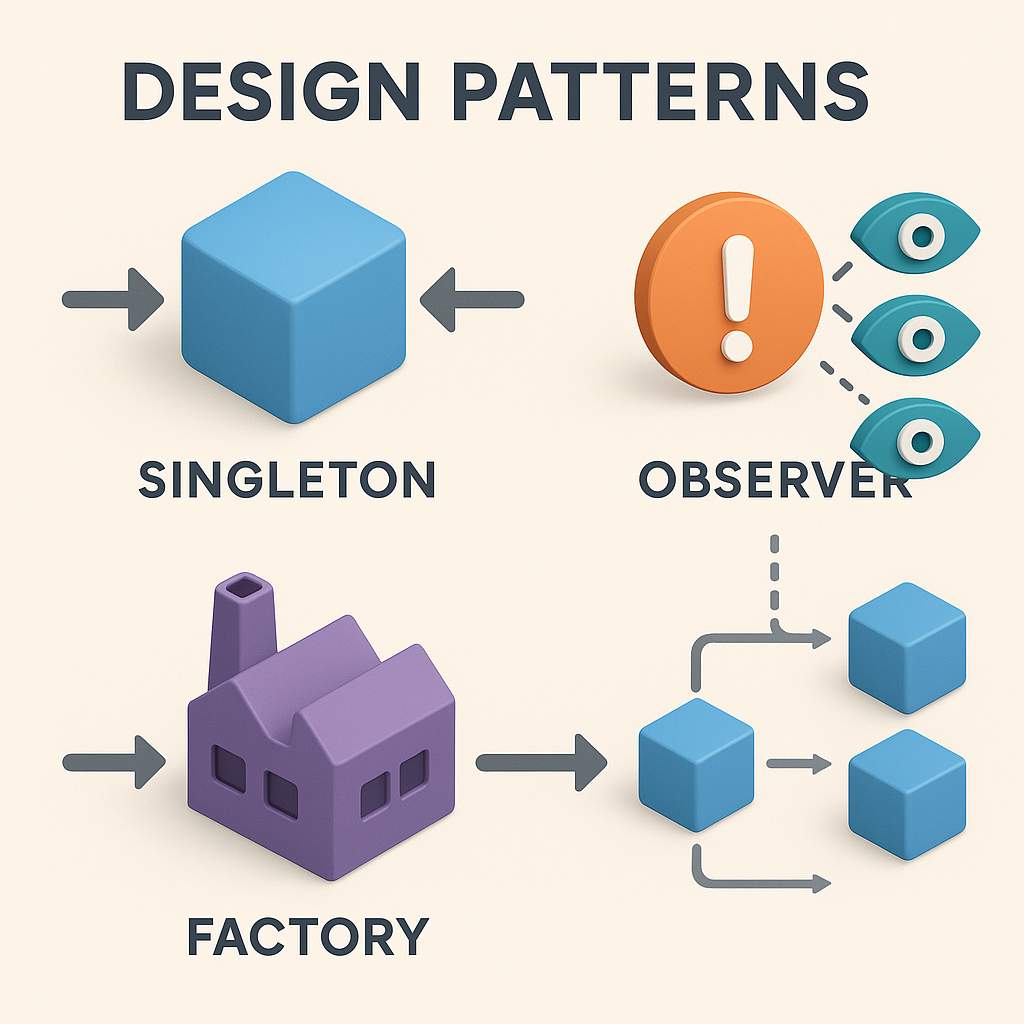
Design patterns are reusable solutions to common software engineering problems. They help developers write clean, maintainable, and scalable code by providing proven approaches that work across languages and technologies. Among the most important patterns every developer should master are the Singleton, Factory, and Observer patterns. These three patterns solve different architectural challenges such as object creation, controlled access, and communication between components. Whether you're building backend systems, mobile apps, or enterprise software, understanding these patterns will make you a more efficient and effective programmer.
The Singleton Pattern ensures that only one instance of a class exists throughout an application’s lifecycle. It’s commonly used in scenarios where a single resource must coordinate the entire system. Examples include logging systems, configuration managers, database connections, and caching layers. The Singleton pattern typically involves a private constructor, a static instance variable, and a public method to access it. While it provides controlled access and reduces memory usage, developers must be careful—overusing Singletons or making them globally accessible can lead to tight coupling, difficulty in testing, and hidden dependencies.
Next is the Factory Pattern, one of the most widely used creational patterns. It solves the complexity of object creation by delegating the responsibility to a dedicated factory class. Instead of calling constructors directly, the program requests objects from the factory, which decides which concrete class to instantiate. This pattern is useful when you need to create many related objects or when the exact class of the object must remain hidden from client code. The Factory pattern enhances flexibility, supports loose coupling, and makes it easy to introduce new object types without modifying existing logic. It’s widely used in frameworks, UI components, database drivers, and plugin-based architectures.
The Observer Pattern is a behavioral pattern that defines a one-to-many relationship between objects. When one object (the “subject”) changes its state, all subscribed observers are automatically notified. This pattern is the backbone of event-driven systems. It is heavily used in GUIs (button click listeners), real-time applications, publish-subscribe systems, messaging queues, and reactive programming frameworks. The Observer pattern decouples the subject from observers, allowing the system to dynamically add or remove listeners at runtime. This flexibility makes it ideal for designing interactive, modular, and scalable applications.
While each pattern is useful individually, they often appear together in real-world systems. For example, a Singleton class might act as an event manager responsible for triggering notifications to observers. A Factory may instantiate components that automatically subscribe to updates. Understanding how design patterns interact within an architecture helps developers build systems that are clean, extensible, and easy to maintain. But patterns must be used wisely—misusing or forcing patterns can lead to overcomplicated or inefficient designs. The key is to identify the right pattern for the right problem.
Learning design patterns also improves your ability to understand existing codebases. Most large applications, frameworks, and libraries internally rely on these patterns. For instance, Java’s Observable, Android’s LiveData, JavaScript's event emitters, React’s state updates, and many backend services follow variations of the Observer pattern. Dependency Injection containers often use factories. Singleton-like structures are common in global configuration providers. Knowing these patterns helps you decode frameworks more quickly and write interoperable code.
Another benefit of learning design patterns is improved testability and maintainability. Patterns such as Factory make unit testing easier by allowing the injection of mock objects. Observer patterns allow isolated modules that communicate through events, reducing tight coupling. Meanwhile, Singleton patterns centralize shared resources, although excessive use may hinder testing. Clean implementation of patterns ensures your system remains modular, easier to refactor, and more adaptable to future changes.
Design patterns also matter in system design interviews and real-world software architecture. Most interviewers expect developers to recognize where patterns apply—such as using Factory to manage database connections, or Observer for building notification systems. Understanding these core patterns strengthens your architectural thinking, improves collaboration with senior engineers, and enhances your ability to break down complex software problems. Patterns aren’t language-specific; their principles apply across Java, Python, C++, JavaScript, Swift, Kotlin, and more.
In conclusion, design patterns like Singleton, Factory, and Observer provide essential building blocks for robust software development. They address common structural and behavioral challenges, encourage clean architecture, reduce code duplication, and improve flexibility. Mastering these patterns equips developers to build scalable, modular, and maintainable systems across all types of platforms and applications. By consistently applying the right patterns at the right time, you can significantly elevate the quality and reliability of your software.
The Singleton Pattern ensures that only one instance of a class exists throughout an application’s lifecycle. It’s commonly used in scenarios where a single resource must coordinate the entire system. Examples include logging systems, configuration managers, database connections, and caching layers. The Singleton pattern typically involves a private constructor, a static instance variable, and a public method to access it. While it provides controlled access and reduces memory usage, developers must be careful—overusing Singletons or making them globally accessible can lead to tight coupling, difficulty in testing, and hidden dependencies.
Next is the Factory Pattern, one of the most widely used creational patterns. It solves the complexity of object creation by delegating the responsibility to a dedicated factory class. Instead of calling constructors directly, the program requests objects from the factory, which decides which concrete class to instantiate. This pattern is useful when you need to create many related objects or when the exact class of the object must remain hidden from client code. The Factory pattern enhances flexibility, supports loose coupling, and makes it easy to introduce new object types without modifying existing logic. It’s widely used in frameworks, UI components, database drivers, and plugin-based architectures.
The Observer Pattern is a behavioral pattern that defines a one-to-many relationship between objects. When one object (the “subject”) changes its state, all subscribed observers are automatically notified. This pattern is the backbone of event-driven systems. It is heavily used in GUIs (button click listeners), real-time applications, publish-subscribe systems, messaging queues, and reactive programming frameworks. The Observer pattern decouples the subject from observers, allowing the system to dynamically add or remove listeners at runtime. This flexibility makes it ideal for designing interactive, modular, and scalable applications.
While each pattern is useful individually, they often appear together in real-world systems. For example, a Singleton class might act as an event manager responsible for triggering notifications to observers. A Factory may instantiate components that automatically subscribe to updates. Understanding how design patterns interact within an architecture helps developers build systems that are clean, extensible, and easy to maintain. But patterns must be used wisely—misusing or forcing patterns can lead to overcomplicated or inefficient designs. The key is to identify the right pattern for the right problem.
Learning design patterns also improves your ability to understand existing codebases. Most large applications, frameworks, and libraries internally rely on these patterns. For instance, Java’s Observable, Android’s LiveData, JavaScript's event emitters, React’s state updates, and many backend services follow variations of the Observer pattern. Dependency Injection containers often use factories. Singleton-like structures are common in global configuration providers. Knowing these patterns helps you decode frameworks more quickly and write interoperable code.
Another benefit of learning design patterns is improved testability and maintainability. Patterns such as Factory make unit testing easier by allowing the injection of mock objects. Observer patterns allow isolated modules that communicate through events, reducing tight coupling. Meanwhile, Singleton patterns centralize shared resources, although excessive use may hinder testing. Clean implementation of patterns ensures your system remains modular, easier to refactor, and more adaptable to future changes.
Design patterns also matter in system design interviews and real-world software architecture. Most interviewers expect developers to recognize where patterns apply—such as using Factory to manage database connections, or Observer for building notification systems. Understanding these core patterns strengthens your architectural thinking, improves collaboration with senior engineers, and enhances your ability to break down complex software problems. Patterns aren’t language-specific; their principles apply across Java, Python, C++, JavaScript, Swift, Kotlin, and more.
In conclusion, design patterns like Singleton, Factory, and Observer provide essential building blocks for robust software development. They address common structural and behavioral challenges, encourage clean architecture, reduce code duplication, and improve flexibility. Mastering these patterns equips developers to build scalable, modular, and maintainable systems across all types of platforms and applications. By consistently applying the right patterns at the right time, you can significantly elevate the quality and reliability of your software.