
Deployment strategies are essential techniques in modern software engineering that help development teams release new features, updates, or fixes without disrupting the user experience. As applications scale and user expectations grow, businesses can no longer afford downtime or unstable releases. This is why deployment strategies such as Blue-Green and Canary deployments have become widely adopted in DevOps, cloud engineering, and software operations. They provide structured, safe, and reliable ways to transition from an old version of an application to a new one, minimizing risks while ensuring continuous delivery. These strategies are especially useful for high-traffic and business-critical platforms where reliability is a top priority.
In traditional deployment models, the new software version replaces the old version directly on production servers. While simple, this approach can cause major issues: outages, broken features, inconsistent behavior, or unexpectedly high error rates. Even small mistakes become costly when they affect thousands of users at once. Deployment strategies attempt to eliminate these risks by controlling how and when new versions are exposed to users. Instead of replacing an application instantly, these strategies create safe testing grounds, allow gradual rollouts, and enable quick rollbacks if something goes wrong. As a result, teams gain far better control over changes and achieve higher deployment confidence.
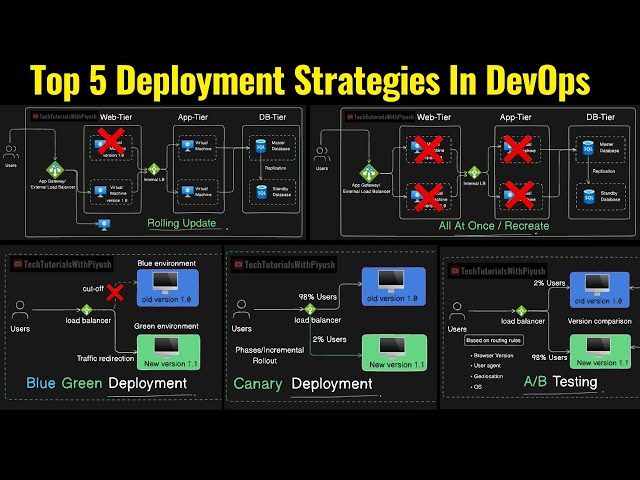
Blue-Green Deployment is among the most popular strategies because it offers a clean, predictable approach with almost zero downtime. In this model, two identical production environments exist: the Blue environment hosts the current live application, while the Green environment contains the new version. Users are connected only to one environment at a time. When developers deploy updates, they push the new version into the Green environment, test it thoroughly, and ensure everything is functioning correctly. Once the team is confident that the new version is stable, traffic is smoothly switched from Blue to Green. This switch often happens at the load balancer level, making the transition immediate and seamless from a user perspective.
The biggest advantage of Blue-Green deployment is the ability to rollback instantly. If the new version unexpectedly fails after being released, the team can redirect traffic back to the Blue environment with one click or command. This makes it one of the safest deployment techniques for mission-critical systems such as banking, e-commerce, or SaaS products. Blue-Green deployment also eliminates in-place upgrades, meaning the old version remains untouched and operational until the new version is fully validated. However, it requires double the infrastructure since two complete environments must be maintained. This cost can be a limitation for smaller organizations.
Canary Deployment, inspired by the “canary in a coal mine” principle, offers a more gradual approach compared to Blue-Green. Instead of switching all traffic at once, the new version is rolled out to a small subset of users first. These users act as real-world testers who validate the system under natural load. The rollout may begin with just 1–5% of traffic, and if no issues appear, it gradually expands to 10%, 25%, 50%, and eventually 100%. This slow, controlled exposure significantly reduces risk because bugs can be detected early before they reach the entire user base. Canary deployments are especially useful for large distributed systems where user behavior varies across regions or device types.
One of the biggest strengths of Canary deployment is fine-grained monitoring. During each rollout phase, DevOps teams carefully observe key metrics such as latency, error rates, CPU usage, database load, and user behavior analytics. If an anomaly is detected at any stage, the rollout is halted and rolled back quickly. Instead of affecting everyone, only the small canary group experiences the issue, making recovery fast and safe. This method provides data-driven insights, enabling developers to refine their code, optimize performance, and release changes with higher confidence. Canary deployments are also cost-effective, as they do not require full duplicate environments like Blue-Green deployments.
Both Blue-Green and Canary deployment strategies are powerful tools, and choosing the right one depends on system complexity, team size, infrastructure, and business goals. Blue-Green is ideal when organizations need guaranteed rollback, immediate switching, and full environmental isolation. It's simple, predictable, and perfect for applications requiring near-zero downtime. On the other hand, Canary deployment shines when gradual rollout and real-world testing are important. It is highly suitable for microservices, distributed architectures, and modern cloud-native applications where different user segments might behave differently. Many companies, including Netflix, Amazon, and Google, rely heavily on Canary strategies through automated pipelines.
In modern DevOps pipelines, these deployment strategies are often automated using tools such as Kubernetes, Argo Rollouts, Istio, Spinnaker, Jenkins, and AWS CodeDeploy. Automation enhances precision, reduces manual errors, and ensures consistent deployment behavior every time. Kubernetes, in particular, has built-in support for rolling updates and canary-style deployments through advanced traffic-routing mechanisms. As software development continues evolving toward continuous delivery and continuous deployment, strategies like Blue-Green and Canary have become essential components of high-performance engineering teams.
In summary, deployment strategies are not just technical methods—they are part of a larger philosophy of reducing risk, improving user experience, and creating reliable digital products. Blue-Green deployment provides a clean switch between two full environments with instant rollback guarantees. Canary deployment offers gradual exposure, real-world validation, and safer experimentation. Both strategies ultimately empower teams to innovate faster while ensuring stability. In a world that demands both speed and reliability, mastering these deployment strategies is a crucial step for any developer or DevOps engineer aiming to build robust, scalable, and dependable software systems.
In traditional deployment models, the new software version replaces the old version directly on production servers. While simple, this approach can cause major issues: outages, broken features, inconsistent behavior, or unexpectedly high error rates. Even small mistakes become costly when they affect thousands of users at once. Deployment strategies attempt to eliminate these risks by controlling how and when new versions are exposed to users. Instead of replacing an application instantly, these strategies create safe testing grounds, allow gradual rollouts, and enable quick rollbacks if something goes wrong. As a result, teams gain far better control over changes and achieve higher deployment confidence.
Blue-Green Deployment is among the most popular strategies because it offers a clean, predictable approach with almost zero downtime. In this model, two identical production environments exist: the Blue environment hosts the current live application, while the Green environment contains the new version. Users are connected only to one environment at a time. When developers deploy updates, they push the new version into the Green environment, test it thoroughly, and ensure everything is functioning correctly. Once the team is confident that the new version is stable, traffic is smoothly switched from Blue to Green. This switch often happens at the load balancer level, making the transition immediate and seamless from a user perspective.
The biggest advantage of Blue-Green deployment is the ability to rollback instantly. If the new version unexpectedly fails after being released, the team can redirect traffic back to the Blue environment with one click or command. This makes it one of the safest deployment techniques for mission-critical systems such as banking, e-commerce, or SaaS products. Blue-Green deployment also eliminates in-place upgrades, meaning the old version remains untouched and operational until the new version is fully validated. However, it requires double the infrastructure since two complete environments must be maintained. This cost can be a limitation for smaller organizations.
Canary Deployment, inspired by the “canary in a coal mine” principle, offers a more gradual approach compared to Blue-Green. Instead of switching all traffic at once, the new version is rolled out to a small subset of users first. These users act as real-world testers who validate the system under natural load. The rollout may begin with just 1–5% of traffic, and if no issues appear, it gradually expands to 10%, 25%, 50%, and eventually 100%. This slow, controlled exposure significantly reduces risk because bugs can be detected early before they reach the entire user base. Canary deployments are especially useful for large distributed systems where user behavior varies across regions or device types.
One of the biggest strengths of Canary deployment is fine-grained monitoring. During each rollout phase, DevOps teams carefully observe key metrics such as latency, error rates, CPU usage, database load, and user behavior analytics. If an anomaly is detected at any stage, the rollout is halted and rolled back quickly. Instead of affecting everyone, only the small canary group experiences the issue, making recovery fast and safe. This method provides data-driven insights, enabling developers to refine their code, optimize performance, and release changes with higher confidence. Canary deployments are also cost-effective, as they do not require full duplicate environments like Blue-Green deployments.
Both Blue-Green and Canary deployment strategies are powerful tools, and choosing the right one depends on system complexity, team size, infrastructure, and business goals. Blue-Green is ideal when organizations need guaranteed rollback, immediate switching, and full environmental isolation. It's simple, predictable, and perfect for applications requiring near-zero downtime. On the other hand, Canary deployment shines when gradual rollout and real-world testing are important. It is highly suitable for microservices, distributed architectures, and modern cloud-native applications where different user segments might behave differently. Many companies, including Netflix, Amazon, and Google, rely heavily on Canary strategies through automated pipelines.
In modern DevOps pipelines, these deployment strategies are often automated using tools such as Kubernetes, Argo Rollouts, Istio, Spinnaker, Jenkins, and AWS CodeDeploy. Automation enhances precision, reduces manual errors, and ensures consistent deployment behavior every time. Kubernetes, in particular, has built-in support for rolling updates and canary-style deployments through advanced traffic-routing mechanisms. As software development continues evolving toward continuous delivery and continuous deployment, strategies like Blue-Green and Canary have become essential components of high-performance engineering teams.
In summary, deployment strategies are not just technical methods—they are part of a larger philosophy of reducing risk, improving user experience, and creating reliable digital products. Blue-Green deployment provides a clean switch between two full environments with instant rollback guarantees. Canary deployment offers gradual exposure, real-world validation, and safer experimentation. Both strategies ultimately empower teams to innovate faster while ensuring stability. In a world that demands both speed and reliability, mastering these deployment strategies is a crucial step for any developer or DevOps engineer aiming to build robust, scalable, and dependable software systems.