
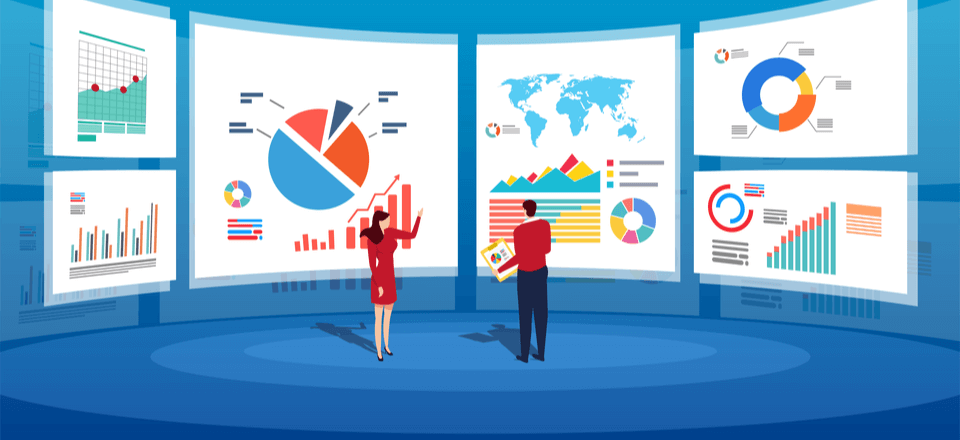
Data Visualization for Marketing Teams focuses on transforming complex metrics into clear, digestible visual stories that improve decision-making. Marketing generates massive data across channels — website analytics, social media engagement, campaign performance, CRM pipelines — and visualization helps uncover actionable patterns that are difficult to interpret in raw numbers.
Effective visualization highlights what truly matters: which channels drive conversions, where customers drop from funnels, which campaigns deliver the highest ROI, and how audience behavior changes over time. Dashboards and visual reports bring KPIs like CAC, CLV, CTR, and ROAS to life, enabling teams to act faster and smarter.
Charts and visuals must match the type of insights needed. Funnel charts show conversion flow, heatmaps highlight user interaction, stacked bar charts compare campaigns, scatterplots reveal correlation, and cohort charts track retention patterns. Choosing the right chart for the right question prevents misinterpretation and ensures clarity.
Real-time dashboards give marketers agility. Tools like Google Analytics, Data Studio, Power BI, Tableau, Mixpanel, and Amplitude allow continuous monitoring of campaign performance. Automatic alerts can trigger when costs spike or traffic declines so teams respond before damage spreads — especially in paid advertising.
Data storytelling enhances influence beyond the analytics team. Using annotated visuals, narrative summaries, and simplified dashboards helps stakeholders — from sales to executives — understand insights instantly. Great visualization doesn’t just show data… it communicates meaning and inspires the right action.
Segmentation visualization reveals hidden opportunities. By comparing behavior across locations, devices, demographics, and campaign audiences, marketers personalize strategies and improve ROI. Visual analytics also uncover attribution trends — showing how multiple touchpoints contribute to conversion rather than crediting only the last click.
Ethics and data transparency matter. Visuals should be accurate, honest, and free from manipulation — no misleading axes or selective data. Marketing teams must ensure charts reflect the truth, even when results seem unfavorable. Trust built through integrity leads to stronger long-term progress.
In a world filled with data noise, visualization becomes the marketer’s decision compass. It turns data into insight, insight into strategy, and strategy into business growth. Strong visualization skills empower marketing teams to find clarity faster, collaborate better, and deliver high-impact results backed by data — not guesswork.
Effective visualization highlights what truly matters: which channels drive conversions, where customers drop from funnels, which campaigns deliver the highest ROI, and how audience behavior changes over time. Dashboards and visual reports bring KPIs like CAC, CLV, CTR, and ROAS to life, enabling teams to act faster and smarter.
Charts and visuals must match the type of insights needed. Funnel charts show conversion flow, heatmaps highlight user interaction, stacked bar charts compare campaigns, scatterplots reveal correlation, and cohort charts track retention patterns. Choosing the right chart for the right question prevents misinterpretation and ensures clarity.
Real-time dashboards give marketers agility. Tools like Google Analytics, Data Studio, Power BI, Tableau, Mixpanel, and Amplitude allow continuous monitoring of campaign performance. Automatic alerts can trigger when costs spike or traffic declines so teams respond before damage spreads — especially in paid advertising.
Data storytelling enhances influence beyond the analytics team. Using annotated visuals, narrative summaries, and simplified dashboards helps stakeholders — from sales to executives — understand insights instantly. Great visualization doesn’t just show data… it communicates meaning and inspires the right action.
Segmentation visualization reveals hidden opportunities. By comparing behavior across locations, devices, demographics, and campaign audiences, marketers personalize strategies and improve ROI. Visual analytics also uncover attribution trends — showing how multiple touchpoints contribute to conversion rather than crediting only the last click.
Ethics and data transparency matter. Visuals should be accurate, honest, and free from manipulation — no misleading axes or selective data. Marketing teams must ensure charts reflect the truth, even when results seem unfavorable. Trust built through integrity leads to stronger long-term progress.
In a world filled with data noise, visualization becomes the marketer’s decision compass. It turns data into insight, insight into strategy, and strategy into business growth. Strong visualization skills empower marketing teams to find clarity faster, collaborate better, and deliver high-impact results backed by data — not guesswork.