
Data Structures and Algorithms (DSA) form the essential foundation of software development, computational problem-solving, and system design. Every application we use—from search engines and banking systems to mobile apps and social media—internally relies on efficient ways to store, organize, and process data. A data structure defines how data is stored, while an algorithm defines how operations like searching, sorting, or updating are performed on that data. Together, they determine how fast an application responds, how much memory it consumes, and how well it scales under heavy load. Without understanding DSA, developers struggle to build optimized solutions, debug performance issues, or design robust systems. Therefore, mastering DSA is considered a core step for every beginner entering the world of programming, interviews, and software engineering.
In modern software systems, efficiency is not a luxury—it is a requirement. Applications must perform smoothly even with millions of users or vast amounts of data. This is where DSA becomes crucial. For example, choosing between a list, a hash table, or a tree can drastically change the speed of a program. While a beginner may write code that “works,” an engineer with strong DSA knowledge writes code that is fast, reliable, and scalable. Companies like Google, Meta, Amazon, and Microsoft evaluate DSA skills heavily because they reveal a developer’s ability to think logically, break down complex problems, and design efficient solutions. Whether optimizing database queries, designing new app features, or improving mobile app performance, every engineering task benefits from sound DSA knowledge.
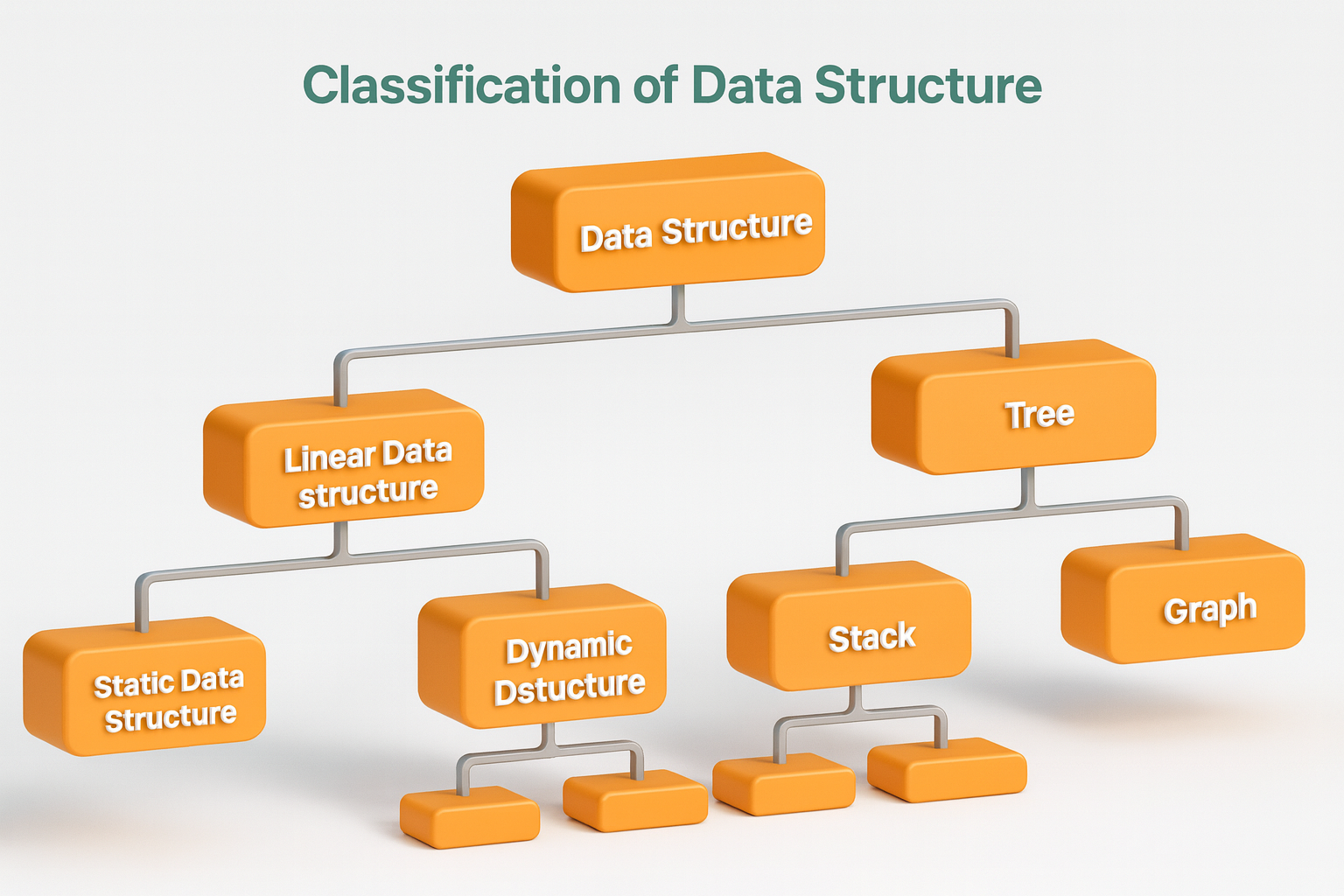
Data structures are broadly categorized into linear and non-linear types. Linear structures—such as arrays, linked lists, stacks, and queues—store data sequentially and are widely used in operating systems, compilers, and everyday application logic. Non-linear structures—such as trees, graphs, and heaps—allow complex relationships and hierarchical data modeling. Each data structure solves a specific problem: arrays provide constant-time indexing, linked lists offer dynamic memory usage, stacks manage call flows, queues are crucial in scheduling systems, hash tables give near-instant lookups, while trees and graphs manage networked data. Understanding the strengths and trade-offs of each structure helps developers choose the right tool, avoid unnecessary complexity, and optimize execution.
Algorithms are step-by-step processes designed to solve computational tasks efficiently. Sorting and searching algorithms like QuickSort, MergeSort, Binary Search, and Depth-First Search (DFS) are standard building blocks of software development. Efficient algorithms reduce computation time, prevent lag, and ensure systems scale well as data grows. Good problem-solving involves identifying constraints, selecting appropriate data structures, and applying algorithmic techniques such as divide-and-conquer, dynamic programming, greedy methods, recursion, and backtracking. Each approach has unique performance characteristics and use cases. For example, dynamic programming shines in optimizing overlapping subproblems, whereas greedy algorithms offer fast, locally optimal decisions that work well for scheduling or network routing.
A key reason DSA is considered an advanced skill is the concept of time and space complexity, typically expressed using Big-O notation. This metric helps developers evaluate how algorithms scale with increasing data. For example, O(1) represents constant time, O(log n) represents logarithmic growth, O(n) linear growth, and O(n²) quadratic growth. Choosing an efficient algorithm can save exponential computation. For instance, searching through a million entries takes milliseconds using O(log n) binary search but could take minutes with O(n²) brute force logic. Complexity analysis teaches developers to see beyond “working code” and instead build “optimal code.” This is why interviews emphasize questions like “Can it be optimized further?” or “Is there a faster approach?”
DSA directly powers real-world systems we rely on daily. Search engines use trees and graph algorithms for indexing and ranking. Social networks use graph structures to manage relationships between users. Navigation apps like Google Maps depend on Dijkstra’s and A* algorithms for shortest-path calculations. E-commerce platforms use hashing to manage sessions and inventory systems. Databases use B-trees for indexing, ensuring quick reads and writes. Even simple features like undo/redo use stacks, while CPU scheduling uses queues. When developers understand these structures and their uses, they can design better systems, troubleshoot performance issues, and create applications that function seamlessly under heavy user loads.
Technical job interviews worldwide rely heavily on DSA to evaluate candidates’ problem-solving skills. Companies want to see how developers think, structure their logic, and optimize solutions—not just whether they can write code. Most interview problems revolve around arrays, linked lists, trees, graphs, dynamic programming, and strings. Interviewers assess how candidates break down questions, explain trade-offs, handle edge cases, and write clean, efficient code. Learning DSA improves clarity of thought, boosts confidence, and prepares candidates for high-paying roles. Even students preparing for TCS, Infosys, Wipro, Capgemini, or core product-based companies find DSA essential for passing online assessments and technical rounds.
Learning DSA requires consistency and smart strategies. Beginners should start with basic structures like arrays and linked lists, then move to stacks, queues, trees, graphs, and dynamic programming. Practicing problems from platforms like LeetCode, CodeStudio, HackerRank, and GeeksforGeeks is highly effective. Visualizing data structures using diagrams helps in understanding how memory is used. Writing code in languages like Java, Python, C++, or JavaScript builds strong intuition. Additionally, understanding dry runs, analyzing patterns, and solving progressively harder problems helps solidify algorithmic thinking. With time, learners develop an instinct for recognizing which structure or algorithm fits a problem best.
Even as AI, low-code platforms, and automation tools evolve, the need for optimized systems will never disappear. Machine learning models require graph structures for neural networks. Big data engineering uses advanced tree-based indexing. Real-time systems—from robotics to IoT—depend on efficient scheduling and optimization. Blockchain, cybersecurity, cloud platforms, and distributed systems all rely heavily on DSA principles. Developers who master DSA can adapt to any new technology because they understand the underlying logic that makes systems work. This foundation ensures longevity in a fast-changing tech landscape and gives developers an edge in innovation, performance optimization, and architectural design.
In modern software systems, efficiency is not a luxury—it is a requirement. Applications must perform smoothly even with millions of users or vast amounts of data. This is where DSA becomes crucial. For example, choosing between a list, a hash table, or a tree can drastically change the speed of a program. While a beginner may write code that “works,” an engineer with strong DSA knowledge writes code that is fast, reliable, and scalable. Companies like Google, Meta, Amazon, and Microsoft evaluate DSA skills heavily because they reveal a developer’s ability to think logically, break down complex problems, and design efficient solutions. Whether optimizing database queries, designing new app features, or improving mobile app performance, every engineering task benefits from sound DSA knowledge.
Data structures are broadly categorized into linear and non-linear types. Linear structures—such as arrays, linked lists, stacks, and queues—store data sequentially and are widely used in operating systems, compilers, and everyday application logic. Non-linear structures—such as trees, graphs, and heaps—allow complex relationships and hierarchical data modeling. Each data structure solves a specific problem: arrays provide constant-time indexing, linked lists offer dynamic memory usage, stacks manage call flows, queues are crucial in scheduling systems, hash tables give near-instant lookups, while trees and graphs manage networked data. Understanding the strengths and trade-offs of each structure helps developers choose the right tool, avoid unnecessary complexity, and optimize execution.
Algorithms are step-by-step processes designed to solve computational tasks efficiently. Sorting and searching algorithms like QuickSort, MergeSort, Binary Search, and Depth-First Search (DFS) are standard building blocks of software development. Efficient algorithms reduce computation time, prevent lag, and ensure systems scale well as data grows. Good problem-solving involves identifying constraints, selecting appropriate data structures, and applying algorithmic techniques such as divide-and-conquer, dynamic programming, greedy methods, recursion, and backtracking. Each approach has unique performance characteristics and use cases. For example, dynamic programming shines in optimizing overlapping subproblems, whereas greedy algorithms offer fast, locally optimal decisions that work well for scheduling or network routing.
A key reason DSA is considered an advanced skill is the concept of time and space complexity, typically expressed using Big-O notation. This metric helps developers evaluate how algorithms scale with increasing data. For example, O(1) represents constant time, O(log n) represents logarithmic growth, O(n) linear growth, and O(n²) quadratic growth. Choosing an efficient algorithm can save exponential computation. For instance, searching through a million entries takes milliseconds using O(log n) binary search but could take minutes with O(n²) brute force logic. Complexity analysis teaches developers to see beyond “working code” and instead build “optimal code.” This is why interviews emphasize questions like “Can it be optimized further?” or “Is there a faster approach?”
DSA directly powers real-world systems we rely on daily. Search engines use trees and graph algorithms for indexing and ranking. Social networks use graph structures to manage relationships between users. Navigation apps like Google Maps depend on Dijkstra’s and A* algorithms for shortest-path calculations. E-commerce platforms use hashing to manage sessions and inventory systems. Databases use B-trees for indexing, ensuring quick reads and writes. Even simple features like undo/redo use stacks, while CPU scheduling uses queues. When developers understand these structures and their uses, they can design better systems, troubleshoot performance issues, and create applications that function seamlessly under heavy user loads.
Technical job interviews worldwide rely heavily on DSA to evaluate candidates’ problem-solving skills. Companies want to see how developers think, structure their logic, and optimize solutions—not just whether they can write code. Most interview problems revolve around arrays, linked lists, trees, graphs, dynamic programming, and strings. Interviewers assess how candidates break down questions, explain trade-offs, handle edge cases, and write clean, efficient code. Learning DSA improves clarity of thought, boosts confidence, and prepares candidates for high-paying roles. Even students preparing for TCS, Infosys, Wipro, Capgemini, or core product-based companies find DSA essential for passing online assessments and technical rounds.
Learning DSA requires consistency and smart strategies. Beginners should start with basic structures like arrays and linked lists, then move to stacks, queues, trees, graphs, and dynamic programming. Practicing problems from platforms like LeetCode, CodeStudio, HackerRank, and GeeksforGeeks is highly effective. Visualizing data structures using diagrams helps in understanding how memory is used. Writing code in languages like Java, Python, C++, or JavaScript builds strong intuition. Additionally, understanding dry runs, analyzing patterns, and solving progressively harder problems helps solidify algorithmic thinking. With time, learners develop an instinct for recognizing which structure or algorithm fits a problem best.
Even as AI, low-code platforms, and automation tools evolve, the need for optimized systems will never disappear. Machine learning models require graph structures for neural networks. Big data engineering uses advanced tree-based indexing. Real-time systems—from robotics to IoT—depend on efficient scheduling and optimization. Blockchain, cybersecurity, cloud platforms, and distributed systems all rely heavily on DSA principles. Developers who master DSA can adapt to any new technology because they understand the underlying logic that makes systems work. This foundation ensures longevity in a fast-changing tech landscape and gives developers an edge in innovation, performance optimization, and architectural design.