
Data Cleaning, Preparation, and Wrangling are the most crucial stages of the data science workflow, forming the foundation upon which accurate models and insights are built. In the real world, data rarely comes in a clean, structured, or ready-to-use format. Instead, it arrives from sensors, websites, social platforms, surveys, IoT devices, transaction logs, and databases in messy, inconsistent, incomplete, or unstructured form. Without cleaning and preparing this raw data, even the best machine learning models will produce unreliable predictions or biased outcomes. Data quality directly determines the success of analytics. Clean, properly prepared data reduces noise, enhances model stability, improves interpretability, and leads to better decision-making. In industries like healthcare, incorrect data can affect diagnosis accuracy; in finance, wrong data can influence risk models; in marketing, poor-quality data may result in failed campaigns. As modern enterprises accumulate massive datasets, data cleaning has become more important than ever. It is not just a technical necessity—it is a strategic advantage for any business that wants to extract reliable insights.
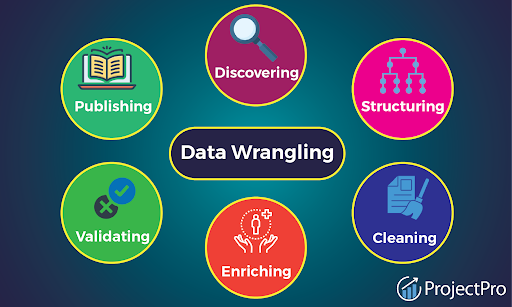
Data Cleaning focuses on correcting or removing inaccurate, corrupted, improperly formatted, duplicate, or incomplete data within a dataset. This stage deals with missing values, outliers, inconsistencies, formatting issues, and type mismatches. Data Preparation goes beyond cleaning by transforming datasets into usable formats—scaling numerical features, encoding categorical variables, and splitting datasets for training and testing. Meanwhile, Data Wrangling refers to reshaping, merging, enriching, and restructuring datasets to make them suitable for analysis. It involves converting unstructured data into structured formats, joining multiple sources, aggregating data, and normalizing schemas. While these terms overlap, they form a complete system where cleaning ensures correctness, preparation ensures usability, and wrangling ensures structure. Successful data handling always combines all three components effectively.
Data cleaning uses a wide set of techniques, depending on the type and origin of the data. Missing values can be handled in many ways: removing rows, filling with mean/median/mode, using advanced interpolation, or applying machine learning–based imputers (KNN, MICE). Duplicate detection ensures repeated entries do not distort results. Outlier detection identifies values that fall outside expected ranges using Z-score, IQR, DBSCAN clustering, or visualization-based inspection with boxplots and scatterplots. Handling inconsistent formats—date mismatches, inconsistent spellings, incorrect units, mixed data types—is essential for standardization. Error detection methods identify human entry mistakes, sensor noise, or corrupt logs. Cleaning also involves validating constraints such as age ranges, unique IDs, or logical conditions (e.g., end date cannot be earlier than start date). For text data, cleaning includes removing stop words, correcting spelling errors, handling irregular spacing, stemming, lemmatization, and lowercasing. For image data, cleaning includes resizing, scaling, removing blur, object cropping, and color correction. Each method improves data reliability for downstream use.
After cleaning, data preparation transforms raw data into a suitable format for machine learning algorithms. Numerical scaling methods such as Standardization (Z-score) and MinMax normalization ensure that values share similar ranges, preventing models like KNN or SVM from being biased toward larger numbers. Categorical encoding techniques—One-Hot Encoding, Label Encoding, Target Encoding, Frequency Encoding—convert text labels into numerical representations. Feature engineering enhances datasets with new meaningful attributes such as time-based features (hour, weekday), aggregated metrics (average purchase per user), polynomial features, and domain-specific indicators. Dimensionality reduction techniques like PCA (Principal Component Analysis) and t-SNE reduce high-dimensional datasets into compact, informative structures. Data preparation also includes splitting datasets into training, validation, and testing sets using methods like stratification to preserve class balance. These methods ensure that models learn effectively and generalize well.
Data wrangling involves reshaping and restructuring datasets so that they can be analyzed more easily. Merging datasets using SQL-style joins (inner, left, right, outer) is common when combining data from multiple sources. Pivoting and unpivoting reshape tabular structures depending on analysis needs. Aggregation techniques summarize data at different levels—for example, total sales per month or average revenue per region. Filtering and slicing help extract relevant subsets. Data enrichment involves adding external datasets, such as weather data, demographic profiles, or currency exchange rates, to enhance predictions. Wrangling also includes mapping values, converting data types, parsing JSON/XML, flattening nested data, transforming timestamps, and dealing with multi-level data structures. Tools like Pandas, Dask, Spark, and SQL make wrangling highly efficient. Advanced cloud ETL tools such as AWS Glue, Azure Data Factory, and Google DataPrep automate large-scale wrangling processes for enterprise workloads.
Data cleaning and wrangling are used in almost every industry. In healthcare, patient records often contain missing vitals, inconsistent fields, or duplicated entries. Cleaning ensures reliable diagnostic models and accurate medical predictions. In finance, transaction logs contain anomalies, duplicate charges, or formatting inconsistencies. Wrangling allows fraud detection models to work effectively. In retail, customer behavior data must be cleaned to remove bots, spam clicks, or invalid orders. In telecom, preparing millions of network traffic logs enables anomaly detection. In manufacturing, sensor data must be cleaned to remove noise and false readings before predictive maintenance analysis. In marketing, clean customer segmentation data improves personalization and retention. Clean data literally powers decision-making across industries—bad data leads to bad business decisions.
Clean and well-prepared data has several advantages. It improves model accuracy, reduces noise, increases trustworthiness, and ensures stable predictions. It also saves processing time and reduces computational cost by removing irrelevant or redundant entries. Better-structured data improves decision-making in dashboards, business intelligence, and predictive analytics tools. High-quality data ensures compliance with data protection regulations such as GDPR, HIPAA, and CCPA. From a business perspective, good data enhances customer experience, reduces errors, prevents losses, enables automation, and leads to faster insights. In competitive markets, the quality of data directly affects the quality of decisions.
Despite its importance, data cleaning is one of the most challenging tasks in analytics. Large datasets may contain millions of rows, requiring automated pipelines instead of manual cleaning. Hidden errors, rare anomalies, or incomplete logs can be difficult to detect. Different data sources may use inconsistent formats or schemas, making merging difficult. Some industries—such as healthcare or IoT—produce unstructured data that requires complex parsing. Data drift, where data changes over time, requires constant updates. Noise in sensor data or user-generated content introduces additional challenges for cleaning. Even after cleaning, data may still contain biases if collected incorrectly, affecting fairness in AI models. These challenges require strong data engineering strategies, domain knowledge, and automated workflows.
The future of data cleaning and wrangling is moving toward automation driven by artificial intelligence. Machine learning models will automatically detect missing values, anomalies, duplicate entries, and formatting issues. AI-powered ETL pipelines will clean and transform data in real time, reducing manual intervention. Tools like OpenAI, DataRobot, Trifacta, and Databricks are integrating predictive cleaning features to automatically suggest transformations. Real-time data wrangling will support streaming platforms like Apache Kafka, Spark Streaming, and Flink to clean data as it arrives. The integration of cloud warehouses—Snowflake, BigQuery, Redshift—will make scalable wrangling even more efficient. The future will see less manual cleaning and more intelligent systems that understand context, patterns, and domain knowledge automatically.
In conclusion, data cleaning, preparation, and wrangling are foundational components of any data-driven workflow. Without high-quality data, even the most advanced algorithms or sophisticated dashboards will fail to deliver meaningful results. Clean data builds trust, improves decision-making, enhances model performance, and drives ROI. As businesses continue generating massive amounts of data, the need for efficient, automated, and reliable cleaning and wrangling processes will only increase. Companies that invest in strong data engineering capabilities will gain a competitive edge—transforming raw data into actionable intelligence, innovation, and strategic success.
Data Cleaning focuses on correcting or removing inaccurate, corrupted, improperly formatted, duplicate, or incomplete data within a dataset. This stage deals with missing values, outliers, inconsistencies, formatting issues, and type mismatches. Data Preparation goes beyond cleaning by transforming datasets into usable formats—scaling numerical features, encoding categorical variables, and splitting datasets for training and testing. Meanwhile, Data Wrangling refers to reshaping, merging, enriching, and restructuring datasets to make them suitable for analysis. It involves converting unstructured data into structured formats, joining multiple sources, aggregating data, and normalizing schemas. While these terms overlap, they form a complete system where cleaning ensures correctness, preparation ensures usability, and wrangling ensures structure. Successful data handling always combines all three components effectively.
Data cleaning uses a wide set of techniques, depending on the type and origin of the data. Missing values can be handled in many ways: removing rows, filling with mean/median/mode, using advanced interpolation, or applying machine learning–based imputers (KNN, MICE). Duplicate detection ensures repeated entries do not distort results. Outlier detection identifies values that fall outside expected ranges using Z-score, IQR, DBSCAN clustering, or visualization-based inspection with boxplots and scatterplots. Handling inconsistent formats—date mismatches, inconsistent spellings, incorrect units, mixed data types—is essential for standardization. Error detection methods identify human entry mistakes, sensor noise, or corrupt logs. Cleaning also involves validating constraints such as age ranges, unique IDs, or logical conditions (e.g., end date cannot be earlier than start date). For text data, cleaning includes removing stop words, correcting spelling errors, handling irregular spacing, stemming, lemmatization, and lowercasing. For image data, cleaning includes resizing, scaling, removing blur, object cropping, and color correction. Each method improves data reliability for downstream use.
After cleaning, data preparation transforms raw data into a suitable format for machine learning algorithms. Numerical scaling methods such as Standardization (Z-score) and MinMax normalization ensure that values share similar ranges, preventing models like KNN or SVM from being biased toward larger numbers. Categorical encoding techniques—One-Hot Encoding, Label Encoding, Target Encoding, Frequency Encoding—convert text labels into numerical representations. Feature engineering enhances datasets with new meaningful attributes such as time-based features (hour, weekday), aggregated metrics (average purchase per user), polynomial features, and domain-specific indicators. Dimensionality reduction techniques like PCA (Principal Component Analysis) and t-SNE reduce high-dimensional datasets into compact, informative structures. Data preparation also includes splitting datasets into training, validation, and testing sets using methods like stratification to preserve class balance. These methods ensure that models learn effectively and generalize well.
Data wrangling involves reshaping and restructuring datasets so that they can be analyzed more easily. Merging datasets using SQL-style joins (inner, left, right, outer) is common when combining data from multiple sources. Pivoting and unpivoting reshape tabular structures depending on analysis needs. Aggregation techniques summarize data at different levels—for example, total sales per month or average revenue per region. Filtering and slicing help extract relevant subsets. Data enrichment involves adding external datasets, such as weather data, demographic profiles, or currency exchange rates, to enhance predictions. Wrangling also includes mapping values, converting data types, parsing JSON/XML, flattening nested data, transforming timestamps, and dealing with multi-level data structures. Tools like Pandas, Dask, Spark, and SQL make wrangling highly efficient. Advanced cloud ETL tools such as AWS Glue, Azure Data Factory, and Google DataPrep automate large-scale wrangling processes for enterprise workloads.
Data cleaning and wrangling are used in almost every industry. In healthcare, patient records often contain missing vitals, inconsistent fields, or duplicated entries. Cleaning ensures reliable diagnostic models and accurate medical predictions. In finance, transaction logs contain anomalies, duplicate charges, or formatting inconsistencies. Wrangling allows fraud detection models to work effectively. In retail, customer behavior data must be cleaned to remove bots, spam clicks, or invalid orders. In telecom, preparing millions of network traffic logs enables anomaly detection. In manufacturing, sensor data must be cleaned to remove noise and false readings before predictive maintenance analysis. In marketing, clean customer segmentation data improves personalization and retention. Clean data literally powers decision-making across industries—bad data leads to bad business decisions.
Clean and well-prepared data has several advantages. It improves model accuracy, reduces noise, increases trustworthiness, and ensures stable predictions. It also saves processing time and reduces computational cost by removing irrelevant or redundant entries. Better-structured data improves decision-making in dashboards, business intelligence, and predictive analytics tools. High-quality data ensures compliance with data protection regulations such as GDPR, HIPAA, and CCPA. From a business perspective, good data enhances customer experience, reduces errors, prevents losses, enables automation, and leads to faster insights. In competitive markets, the quality of data directly affects the quality of decisions.
Despite its importance, data cleaning is one of the most challenging tasks in analytics. Large datasets may contain millions of rows, requiring automated pipelines instead of manual cleaning. Hidden errors, rare anomalies, or incomplete logs can be difficult to detect. Different data sources may use inconsistent formats or schemas, making merging difficult. Some industries—such as healthcare or IoT—produce unstructured data that requires complex parsing. Data drift, where data changes over time, requires constant updates. Noise in sensor data or user-generated content introduces additional challenges for cleaning. Even after cleaning, data may still contain biases if collected incorrectly, affecting fairness in AI models. These challenges require strong data engineering strategies, domain knowledge, and automated workflows.
The future of data cleaning and wrangling is moving toward automation driven by artificial intelligence. Machine learning models will automatically detect missing values, anomalies, duplicate entries, and formatting issues. AI-powered ETL pipelines will clean and transform data in real time, reducing manual intervention. Tools like OpenAI, DataRobot, Trifacta, and Databricks are integrating predictive cleaning features to automatically suggest transformations. Real-time data wrangling will support streaming platforms like Apache Kafka, Spark Streaming, and Flink to clean data as it arrives. The integration of cloud warehouses—Snowflake, BigQuery, Redshift—will make scalable wrangling even more efficient. The future will see less manual cleaning and more intelligent systems that understand context, patterns, and domain knowledge automatically.
In conclusion, data cleaning, preparation, and wrangling are foundational components of any data-driven workflow. Without high-quality data, even the most advanced algorithms or sophisticated dashboards will fail to deliver meaningful results. Clean data builds trust, improves decision-making, enhances model performance, and drives ROI. As businesses continue generating massive amounts of data, the need for efficient, automated, and reliable cleaning and wrangling processes will only increase. Companies that invest in strong data engineering capabilities will gain a competitive edge—transforming raw data into actionable intelligence, innovation, and strategic success.