
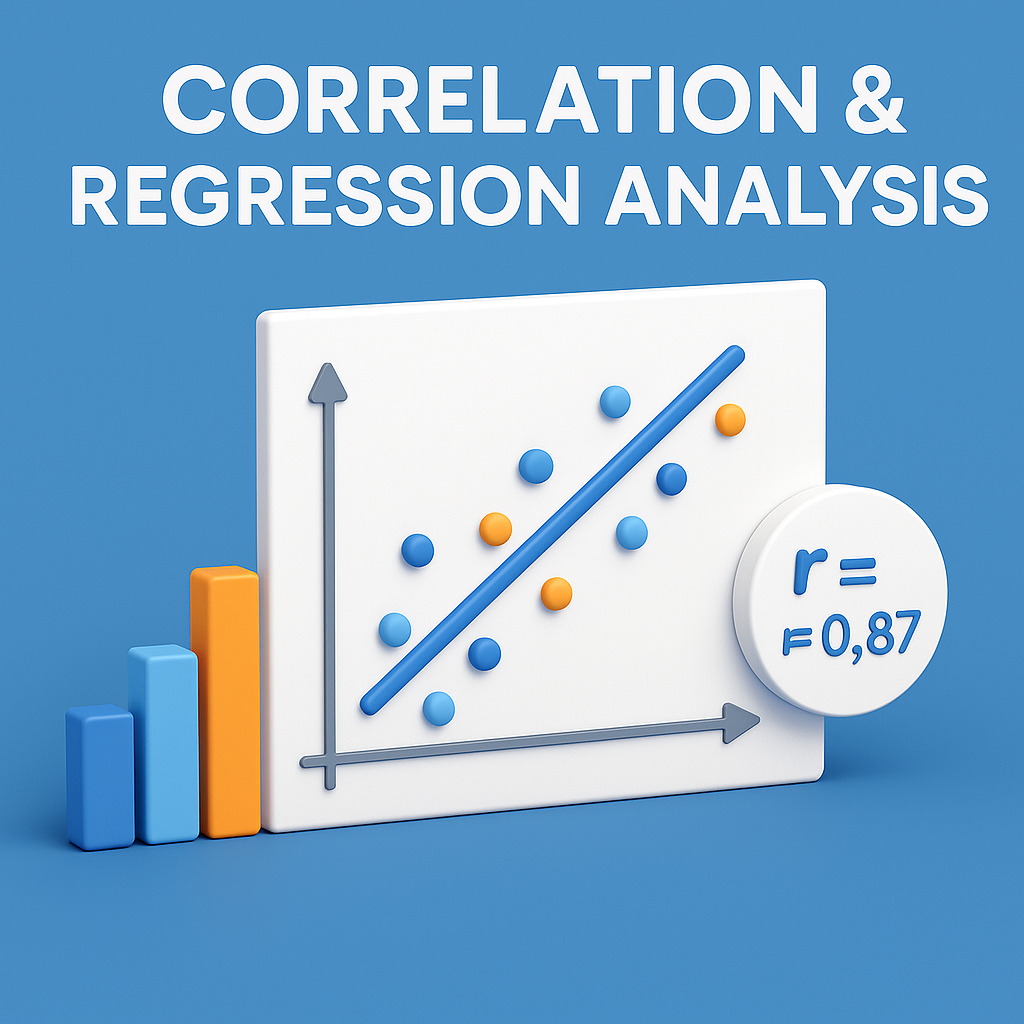
Correlation and regression analysis are two of the most essential tools in data science and analytics, helping us understand how variables relate to each other and how we can use these relationships to make predictions. They play a crucial role in fields such as business forecasting, finance, healthcare analytics, scientific research, and customer behavior modeling. Correlation answers the question of whether two variables move together, while regression goes a step further by determining how strong that relationship is and whether one variable can be used to predict another. For beginners, mastering these two concepts builds the groundwork for more advanced machine learning topics, including predictive modeling, time-series forecasting, and multivariate analysis.
Correlation serves as a statistical measure that indicates the degree and direction of a relationship between two variables. It does not imply a cause-and-effect relationship but simply tells us whether variables move together positively, negatively, or not at all. The Pearson correlation coefficient, one of the most widely used measures, ranges from –1 to +1 and helps quantify the strength of the relationship. A positive value signifies variables moving in the same direction, while a negative value represents inverse movement. Though correlation gives a quick picture of relationships, analysts must interpret it carefully because it can be affected by outliers and only captures linear relationships, requiring visual tools like scatter plots for confirmation.
Regression analysis takes the concept further by modeling and quantifying relationships between variables. Simple linear regression, the most basic form, predicts one variable based on another using a straight-line equation. This approach helps estimate how much a dependent variable changes when an independent variable increases. Regression is widely used for forecasting sales, predicting risk, estimating trends, and modeling real-world systems. As datasets grow more complex, multiple regression allows analysts to incorporate several predictors at once, making it a powerful tool for deeper insights in modern data science applications.
Different types of regression models are used depending on the nature of the data and the complexity of the relationship. Simple and multiple linear regression are ideal for linear relationships, while polynomial regression captures nonlinear patterns by incorporating higher-degree variables. Logistic regression is used when the outcome is categorical rather than numeric. Advanced techniques like ridge and lasso regression help manage multicollinearity or when dealing with large numbers of predictors. Time-series regression is essential when analyzing historical data that changes over time. Understanding when to apply each model is vital for generating accurate predictions.
Interpreting regression results is a critical part of building a reliable model. Key metrics such as slope, intercept, R-squared, p-values, and standard errors help determine whether the model is statistically significant and how well it fits the data. A high R-squared value indicates that a considerable portion of the variation in the dependent variable is explained by the model, while a low p-value suggests that a predictor has a meaningful influence. Analysts must evaluate these metrics holistically rather than in isolation to understand model performance accurately.
A common pitfall is confusing correlation with causation. Just because two variables appear related does not mean one causes the other. Many misleading correlations occur due to confounding factors that influence both variables. For example, ice cream sales and drowning incidents rise together in the summer, but one does not cause the other. To establish causation, analysts rely on controlled experiments, domain knowledge, and advanced statistical methods rather than correlation alone. Recognizing this distinction is crucial for drawing accurate conclusions and avoiding flawed decision-making.
Correlation and regression have broad applications across various domains. Businesses use them for market analysis, demand forecasting, and customer segmentation. Financial analysts rely on them to model stock trends and assess risks. Healthcare professionals use them to study disease patterns and treatment outcomes. Engineers implement them for quality control and optimization, while educators analyze student performance trends. In artificial intelligence and machine learning, these techniques form the mathematical foundation for many algorithms used in prediction, classification, and recommendation systems.
For regression models to produce reliable insights, certain assumptions must be satisfied. These include linearity, equal variance across data points, absence of high correlation among predictors, and normally distributed residuals. Violations of these assumptions can distort results, making the model unreliable. Analysts use diagnostic tools such as residual plots, variance inflation factor (VIF) checks, and normality tests to assess assumption validity. Ensuring high-quality data, handling outliers, and applying transformations when necessary greatly improve model performance.
In conclusion, correlation and regression analysis provide a strong analytical foundation for understanding relationships and making predictions in data-driven fields. By learning how to interpret relationships, evaluate assumptions, and build accurate models, beginners can advance confidently into more complex areas of analytics and machine learning. These techniques not only reveal patterns hidden within data but also support better decision-making, future planning, and deeper insights across industries, making them indispensable tools in modern data science.
Correlation serves as a statistical measure that indicates the degree and direction of a relationship between two variables. It does not imply a cause-and-effect relationship but simply tells us whether variables move together positively, negatively, or not at all. The Pearson correlation coefficient, one of the most widely used measures, ranges from –1 to +1 and helps quantify the strength of the relationship. A positive value signifies variables moving in the same direction, while a negative value represents inverse movement. Though correlation gives a quick picture of relationships, analysts must interpret it carefully because it can be affected by outliers and only captures linear relationships, requiring visual tools like scatter plots for confirmation.
Regression analysis takes the concept further by modeling and quantifying relationships between variables. Simple linear regression, the most basic form, predicts one variable based on another using a straight-line equation. This approach helps estimate how much a dependent variable changes when an independent variable increases. Regression is widely used for forecasting sales, predicting risk, estimating trends, and modeling real-world systems. As datasets grow more complex, multiple regression allows analysts to incorporate several predictors at once, making it a powerful tool for deeper insights in modern data science applications.
Different types of regression models are used depending on the nature of the data and the complexity of the relationship. Simple and multiple linear regression are ideal for linear relationships, while polynomial regression captures nonlinear patterns by incorporating higher-degree variables. Logistic regression is used when the outcome is categorical rather than numeric. Advanced techniques like ridge and lasso regression help manage multicollinearity or when dealing with large numbers of predictors. Time-series regression is essential when analyzing historical data that changes over time. Understanding when to apply each model is vital for generating accurate predictions.
Interpreting regression results is a critical part of building a reliable model. Key metrics such as slope, intercept, R-squared, p-values, and standard errors help determine whether the model is statistically significant and how well it fits the data. A high R-squared value indicates that a considerable portion of the variation in the dependent variable is explained by the model, while a low p-value suggests that a predictor has a meaningful influence. Analysts must evaluate these metrics holistically rather than in isolation to understand model performance accurately.
A common pitfall is confusing correlation with causation. Just because two variables appear related does not mean one causes the other. Many misleading correlations occur due to confounding factors that influence both variables. For example, ice cream sales and drowning incidents rise together in the summer, but one does not cause the other. To establish causation, analysts rely on controlled experiments, domain knowledge, and advanced statistical methods rather than correlation alone. Recognizing this distinction is crucial for drawing accurate conclusions and avoiding flawed decision-making.
Correlation and regression have broad applications across various domains. Businesses use them for market analysis, demand forecasting, and customer segmentation. Financial analysts rely on them to model stock trends and assess risks. Healthcare professionals use them to study disease patterns and treatment outcomes. Engineers implement them for quality control and optimization, while educators analyze student performance trends. In artificial intelligence and machine learning, these techniques form the mathematical foundation for many algorithms used in prediction, classification, and recommendation systems.
For regression models to produce reliable insights, certain assumptions must be satisfied. These include linearity, equal variance across data points, absence of high correlation among predictors, and normally distributed residuals. Violations of these assumptions can distort results, making the model unreliable. Analysts use diagnostic tools such as residual plots, variance inflation factor (VIF) checks, and normality tests to assess assumption validity. Ensuring high-quality data, handling outliers, and applying transformations when necessary greatly improve model performance.
In conclusion, correlation and regression analysis provide a strong analytical foundation for understanding relationships and making predictions in data-driven fields. By learning how to interpret relationships, evaluate assumptions, and build accurate models, beginners can advance confidently into more complex areas of analytics and machine learning. These techniques not only reveal patterns hidden within data but also support better decision-making, future planning, and deeper insights across industries, making them indispensable tools in modern data science.