
Copywriting for ads is one of the most powerful skills in marketing. It’s the art of using words to grab attention, spark curiosity, create desire, and persuade the audience to take action—all within seconds. Good copy doesn’t just inform; it emotionally connects, influences decisions, and drives measurable results. Whether it’s a Google ad, Instagram campaign, YouTube pre-roll, or a billboard, the core principles of ad copywriting remain the same: clarity, persuasion, emotional triggers, and a laser-sharp understanding of the audience. In the digital age, where attention spans are shorter than ever, mastering ad copywriting is essential for anyone looking to create high-converting marketing campaigns.
The foundation of effective ad copywriting starts with knowing your audience deeply. This includes their fears, needs, desires, goals, frustrations, and motivations. An ad is not written for “everyone”; it must speak to a very specific customer in a very specific situation. The more targeted the messaging, the more powerful the impact. Great copywriters spend time understanding customer psychology—what makes them click, buy, trust, or ignore. They identify not just demographics (age, location), but psychographics (mindset, habits, emotions). This understanding shapes the tone, structure, and vocabulary of the ad, ensuring it feels personal and relevant.
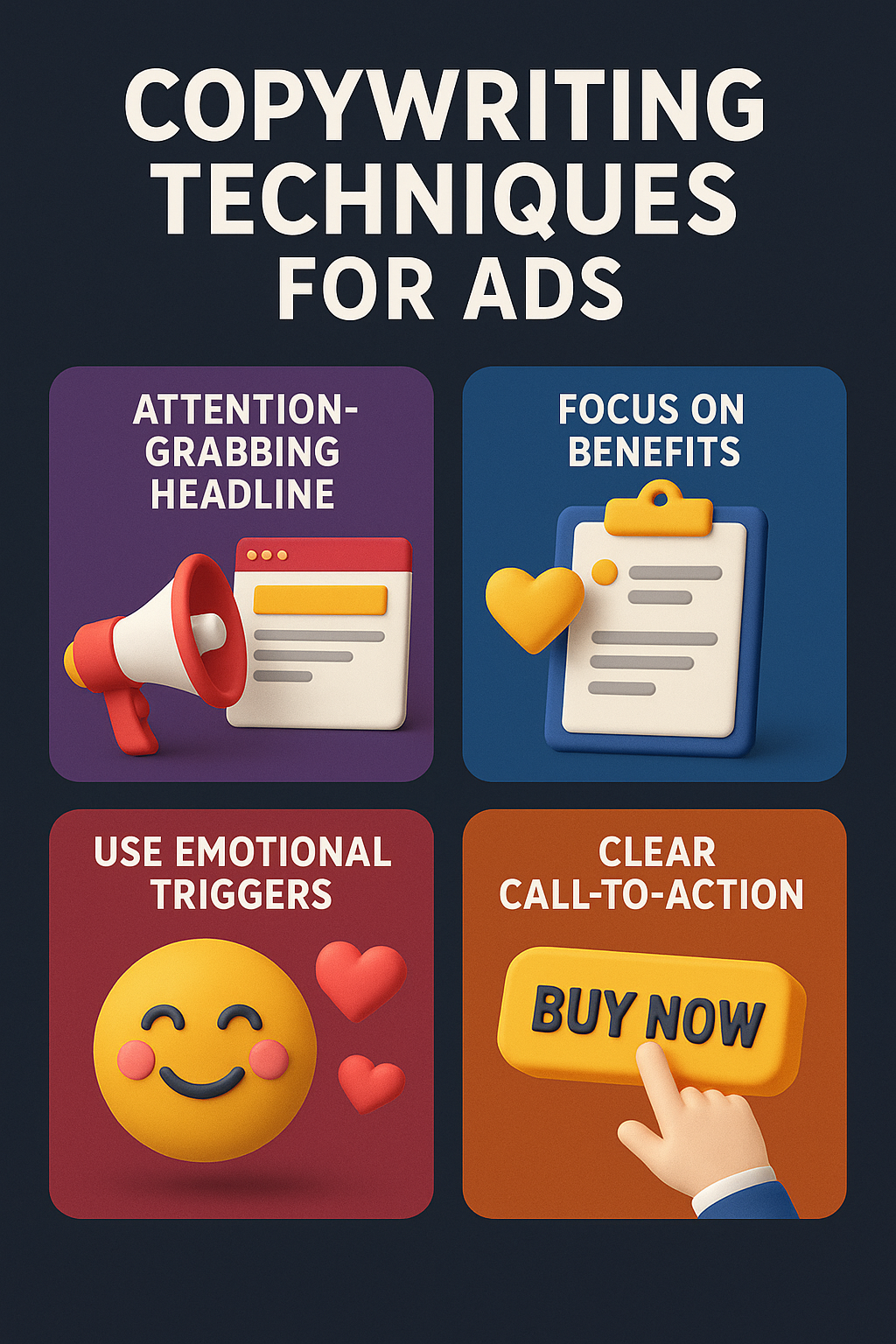
One of the strongest techniques in ad copywriting is using attention-grabbing headlines. The headline is the “doorway” of the ad—if it fails to attract attention, the rest of the copy doesn’t matter. Successful headlines are short, bold, benefit-driven, and often curiosity-based. They may directly state a benefit (“Get Glowing Skin in 7 Days”), use numbers (“Save ₹5,000 on Your First Booking”), ask a question (“Tired of Slow Internet?”), or highlight urgency (“Sale Ends Tonight”). A good headline stops the scroll, interrupts patterns, and forces the user to think, “This is for me.”
Another essential copywriting technique is focusing on benefits, not features. Features describe a product; benefits describe how the product improves the customer’s life. Many brands make the mistake of listing technical details instead of explaining value. For example, a smartphone ad that says “5000 mAh battery” is stating a feature. A benefit-driven version would be “Use your phone all day without charging.” This shift in perspective helps the customer understand the real impact of the product. The strongest ad copy uses emotional benefits (“Feel confident in every outfit”) paired with logical reasons (“Made from premium breathable fabric”) to appeal to both heart and mind.
Persuasion also plays a huge role in copywriting, and one of the most reliable frameworks is AIDA—Attention, Interest, Desire, Action. AIDA helps copywriters structure ads that naturally guide the reader toward conversion. First, capture attention with a headline. Then spark interest through relatable problems or strong statements. Next, build desire by highlighting benefits, social proof, or transformation. Finally, prompt action with a clear, compelling CTA (Call-To-Action). AIDA is used in everything from Facebook ads to landing pages because it aligns perfectly with human decision-making behavior.
Another powerful technique is using emotional triggers. Humans make decisions emotionally first, then justify logically. Good ad copy taps into emotions such as fear (“Don’t leave your data unprotected”), joy (“Make every moment count”), hope (“Your dream body is closer than you think”), and urgency (“Only 10 seats left”). Storytelling also plays a big role—mini-stories, even one-line stories, make ads feel relatable and memorable. For example: “He almost quit, but this course changed everything.” These emotional elements make ads more persuasive and impactful.
To build trust and eliminate doubt, ad copy must include social proof. People believe people—testimonials, ratings, user numbers, reviews, certifications, awards, or product popularity can instantly boost credibility. Social proof reduces friction in the customer’s mind and assures them that the product is legitimate, effective, and safe. Statements like “Trusted by 1,00,000+ users,” “4.9-star rating,” or “Used by experts worldwide” add authority and influence users to act more confidently. In crowded marketplaces, social proof often becomes the deciding factor.
Clarity and simplicity are also key to high-converting ads. The best copy is easy to read, free from jargon, and quickly communicates value. Short sentences, strong verbs, and scannable structure work best. Many ads fail because they try to say too much. The goal is not to explain everything but to spark action. One message, one benefit, and one CTA is usually ideal. In digital formats—where attention lasts 2–3 seconds—clarity determines whether the user stays or scrolls away. Great copy removes all confusion and pushes the user toward the next step.
The last crucial element is a compelling Call-To-Action (CTA). After building interest and desire, the CTA tells the reader exactly what to do next: “Buy Now,” “Get the Offer,” “Start Free Trial,” “Learn More,” “Download Guide,” etc. A CTA should be clear, urgent, and benefit-oriented. Instead of “Submit,” a stronger CTA would be “Get My Free Ebook.” Instead of “Sign Up,” use “Join 5000+ Successful Students.” CTAs influence behavior by removing uncertainty and reinforcing value.
In conclusion, copywriting for ads is both an art and a science. It requires understanding human psychology, crafting persuasive messages, and delivering value in the simplest and most emotional way possible. By focusing on strong headlines, benefits over features, emotional triggers, persuasion frameworks like AIDA, storytelling, social proof, clarity, and powerful CTAs, marketers can create ads that not only grab attention but convert consistently. In a digital world filled with noise and distraction, mastering ad copywriting becomes a superpower—one that can significantly boost sales, engagement, and brand influence.
The foundation of effective ad copywriting starts with knowing your audience deeply. This includes their fears, needs, desires, goals, frustrations, and motivations. An ad is not written for “everyone”; it must speak to a very specific customer in a very specific situation. The more targeted the messaging, the more powerful the impact. Great copywriters spend time understanding customer psychology—what makes them click, buy, trust, or ignore. They identify not just demographics (age, location), but psychographics (mindset, habits, emotions). This understanding shapes the tone, structure, and vocabulary of the ad, ensuring it feels personal and relevant.
One of the strongest techniques in ad copywriting is using attention-grabbing headlines. The headline is the “doorway” of the ad—if it fails to attract attention, the rest of the copy doesn’t matter. Successful headlines are short, bold, benefit-driven, and often curiosity-based. They may directly state a benefit (“Get Glowing Skin in 7 Days”), use numbers (“Save ₹5,000 on Your First Booking”), ask a question (“Tired of Slow Internet?”), or highlight urgency (“Sale Ends Tonight”). A good headline stops the scroll, interrupts patterns, and forces the user to think, “This is for me.”
Another essential copywriting technique is focusing on benefits, not features. Features describe a product; benefits describe how the product improves the customer’s life. Many brands make the mistake of listing technical details instead of explaining value. For example, a smartphone ad that says “5000 mAh battery” is stating a feature. A benefit-driven version would be “Use your phone all day without charging.” This shift in perspective helps the customer understand the real impact of the product. The strongest ad copy uses emotional benefits (“Feel confident in every outfit”) paired with logical reasons (“Made from premium breathable fabric”) to appeal to both heart and mind.
Persuasion also plays a huge role in copywriting, and one of the most reliable frameworks is AIDA—Attention, Interest, Desire, Action. AIDA helps copywriters structure ads that naturally guide the reader toward conversion. First, capture attention with a headline. Then spark interest through relatable problems or strong statements. Next, build desire by highlighting benefits, social proof, or transformation. Finally, prompt action with a clear, compelling CTA (Call-To-Action). AIDA is used in everything from Facebook ads to landing pages because it aligns perfectly with human decision-making behavior.
Another powerful technique is using emotional triggers. Humans make decisions emotionally first, then justify logically. Good ad copy taps into emotions such as fear (“Don’t leave your data unprotected”), joy (“Make every moment count”), hope (“Your dream body is closer than you think”), and urgency (“Only 10 seats left”). Storytelling also plays a big role—mini-stories, even one-line stories, make ads feel relatable and memorable. For example: “He almost quit, but this course changed everything.” These emotional elements make ads more persuasive and impactful.
To build trust and eliminate doubt, ad copy must include social proof. People believe people—testimonials, ratings, user numbers, reviews, certifications, awards, or product popularity can instantly boost credibility. Social proof reduces friction in the customer’s mind and assures them that the product is legitimate, effective, and safe. Statements like “Trusted by 1,00,000+ users,” “4.9-star rating,” or “Used by experts worldwide” add authority and influence users to act more confidently. In crowded marketplaces, social proof often becomes the deciding factor.
Clarity and simplicity are also key to high-converting ads. The best copy is easy to read, free from jargon, and quickly communicates value. Short sentences, strong verbs, and scannable structure work best. Many ads fail because they try to say too much. The goal is not to explain everything but to spark action. One message, one benefit, and one CTA is usually ideal. In digital formats—where attention lasts 2–3 seconds—clarity determines whether the user stays or scrolls away. Great copy removes all confusion and pushes the user toward the next step.
The last crucial element is a compelling Call-To-Action (CTA). After building interest and desire, the CTA tells the reader exactly what to do next: “Buy Now,” “Get the Offer,” “Start Free Trial,” “Learn More,” “Download Guide,” etc. A CTA should be clear, urgent, and benefit-oriented. Instead of “Submit,” a stronger CTA would be “Get My Free Ebook.” Instead of “Sign Up,” use “Join 5000+ Successful Students.” CTAs influence behavior by removing uncertainty and reinforcing value.
In conclusion, copywriting for ads is both an art and a science. It requires understanding human psychology, crafting persuasive messages, and delivering value in the simplest and most emotional way possible. By focusing on strong headlines, benefits over features, emotional triggers, persuasion frameworks like AIDA, storytelling, social proof, clarity, and powerful CTAs, marketers can create ads that not only grab attention but convert consistently. In a digital world filled with noise and distraction, mastering ad copywriting becomes a superpower—one that can significantly boost sales, engagement, and brand influence.