
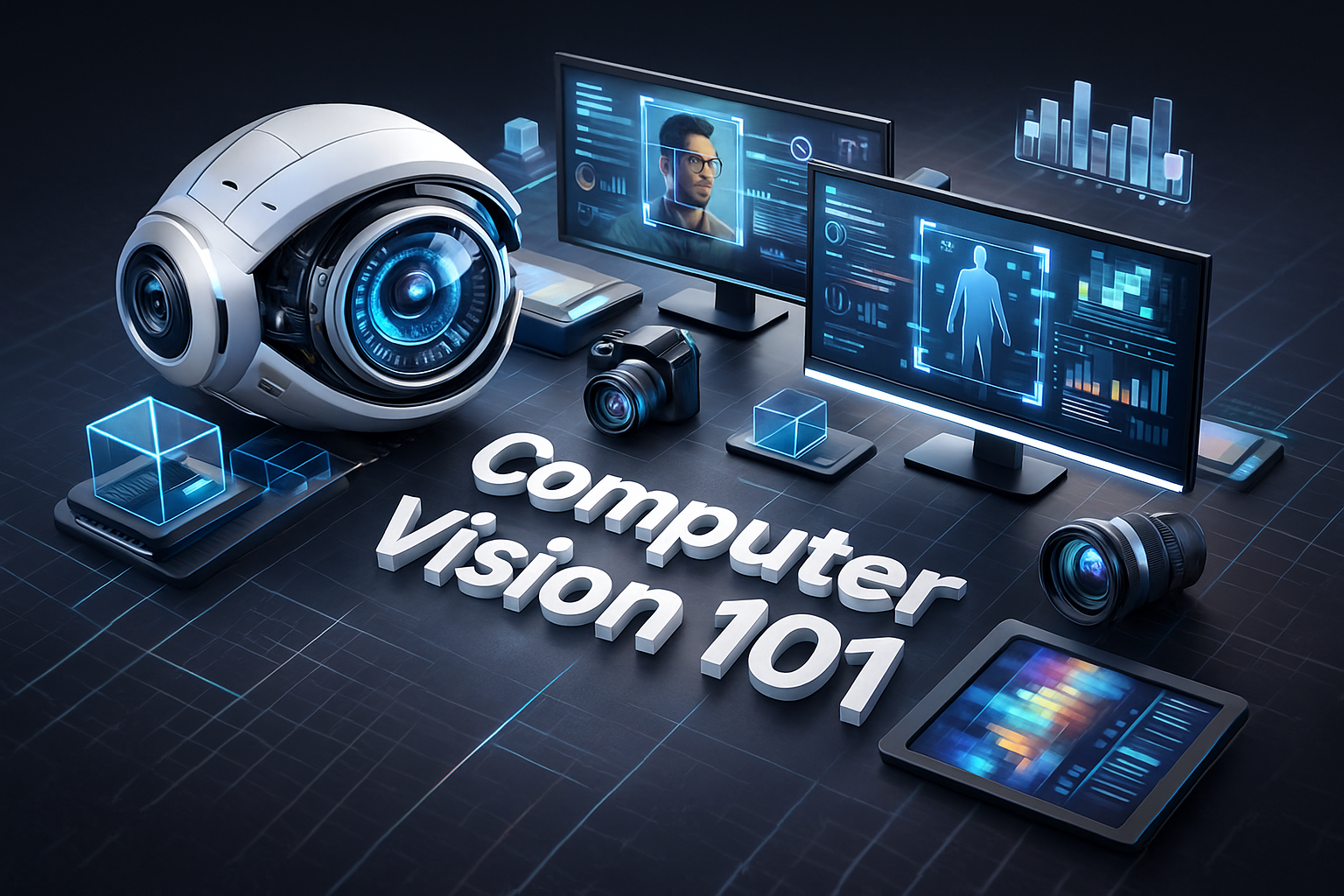
Computer Vision is a field of Artificial Intelligence that enables machines to “see” and interpret the world the way humans do. It focuses on extracting meaningful information from images and videos so that computers can understand visual data, make decisions, and perform tasks automatically. From face recognition on smartphones and self-driving car perception systems to medical imaging and industrial automation, computer vision is rapidly becoming one of the most influential technologies in the modern era. At its core, computer vision aims to close the gap between visual perception and machine understanding.
Computer vision systems rely heavily on image processing—analyzing digital images to identify patterns, edges, shapes, textures, and structures. Early computer vision methods used techniques like thresholding, filtering, histogram analysis, and edge detection to interpret visual information. While these classical methods were effective for simple tasks, they struggled with complex real-world environments. The introduction of deep learning revolutionized computer vision by allowing models to learn features directly from data. Instead of manually coding rules, deep learning systems identify patterns through thousands or millions of training examples.
A central innovation in computer vision is the Convolutional Neural Network (CNN). CNNs mimic how the human visual cortex processes information, identifying simple patterns like lines and edges at early layers and more complex patterns like faces, objects, and scenes in deeper layers. Convolutions enable neural networks to scan images efficiently, preserving spatial relationships between pixels. CNNs are now the foundation of most modern vision applications, powering everything from image classification and object detection to facial recognition and autonomous navigation. CNNs made it possible for machines to outperform humans on some visual benchmarks.
One of the most well-known tasks in computer vision is image classification, where the goal is to assign a label to an image—such as identifying whether a picture contains a cat, dog, or car. Object detection goes a step further by locating and labeling multiple objects within the same image. Models like YOLO (You Only Look Once), Faster R-CNN, and SSD (Single Shot Detector) provide bounding boxes around objects in real-time. Semantic segmentation offers even deeper understanding by classifying each pixel in an image, creating detailed masks used in medical imaging, agricultural analysis, and robotics. These tasks form the foundation of many real-world vision applications.
Computer vision also plays a crucial role in video analysis. Video understanding involves tracking objects over time, detecting actions or behaviors, and recognizing events. For example, surveillance systems use computer vision to detect unusual activities, while sports analytics platforms track player movements and generate statistics. Autonomous vehicles rely on video perception to detect pedestrians, traffic lights, road markings, and other vehicles. Advanced models combine CNNs with Recurrent Neural Networks (RNNs) or transformers to analyze sequences of frames, enabling machines to interpret dynamic scenes instead of static images.
Another important area in computer vision is facial recognition and biometrics. AI models can identify individuals, verify identities, analyze emotions, and detect facial landmarks. This technology is widely used in mobile authentication, digital onboarding, public security, and customer experience customization. However, facial recognition also raises ethical concerns, including privacy, surveillance risks, and potential biases. As the technology evolves, developers and policymakers must ensure responsible use through regulations, transparent algorithms, and fairness testing to maintain trust and safety.
Computer vision has made major contributions to healthcare as well. AI-powered imaging tools assist doctors in diagnosing diseases by analyzing X-rays, MRIs, CT scans, and ultrasounds. Models can detect tumors, heart abnormalities, fractures, and infections faster than traditional methods. These systems help reduce diagnostic errors and improve accessibility, especially in regions with limited medical specialists. Computer vision also plays a role in robotic surgery, pathology slide analysis, telemedicine, and patient monitoring. Its impact on healthcare demonstrates the life-saving potential of advanced AI vision systems.
Industrial automation is another area transformed by computer vision. In manufacturing, vision systems perform quality checks, detect defects, guide robotic arms, and ensure safety on production lines. Retail industries use vision for inventory tracking, customer movement analysis, and automated checkout systems. Agriculture relies on vision tools for crop monitoring, pest detection, and autonomous farming equipment. Even environmental science uses computer vision to track wildlife, analyze ecosystems, and monitor natural disasters. These diverse applications show the broad relevance of computer vision in the real world.
Overall, Computer Vision 101 introduces a powerful technology that enhances how machines understand and interact with their environment. From deep learning breakthroughs and CNN architectures to real-world applications like healthcare, robotics, and autonomous vehicles, computer vision holds immense potential for innovation. As research continues to advance, we can expect vision systems to become faster, more accurate, and even capable of reasoning about complex scenes. By learning computer vision fundamentals, beginners gain entry into one of the most dynamic and impactful domains in AI and machine learning.
Computer vision systems rely heavily on image processing—analyzing digital images to identify patterns, edges, shapes, textures, and structures. Early computer vision methods used techniques like thresholding, filtering, histogram analysis, and edge detection to interpret visual information. While these classical methods were effective for simple tasks, they struggled with complex real-world environments. The introduction of deep learning revolutionized computer vision by allowing models to learn features directly from data. Instead of manually coding rules, deep learning systems identify patterns through thousands or millions of training examples.
A central innovation in computer vision is the Convolutional Neural Network (CNN). CNNs mimic how the human visual cortex processes information, identifying simple patterns like lines and edges at early layers and more complex patterns like faces, objects, and scenes in deeper layers. Convolutions enable neural networks to scan images efficiently, preserving spatial relationships between pixels. CNNs are now the foundation of most modern vision applications, powering everything from image classification and object detection to facial recognition and autonomous navigation. CNNs made it possible for machines to outperform humans on some visual benchmarks.
One of the most well-known tasks in computer vision is image classification, where the goal is to assign a label to an image—such as identifying whether a picture contains a cat, dog, or car. Object detection goes a step further by locating and labeling multiple objects within the same image. Models like YOLO (You Only Look Once), Faster R-CNN, and SSD (Single Shot Detector) provide bounding boxes around objects in real-time. Semantic segmentation offers even deeper understanding by classifying each pixel in an image, creating detailed masks used in medical imaging, agricultural analysis, and robotics. These tasks form the foundation of many real-world vision applications.
Computer vision also plays a crucial role in video analysis. Video understanding involves tracking objects over time, detecting actions or behaviors, and recognizing events. For example, surveillance systems use computer vision to detect unusual activities, while sports analytics platforms track player movements and generate statistics. Autonomous vehicles rely on video perception to detect pedestrians, traffic lights, road markings, and other vehicles. Advanced models combine CNNs with Recurrent Neural Networks (RNNs) or transformers to analyze sequences of frames, enabling machines to interpret dynamic scenes instead of static images.
Another important area in computer vision is facial recognition and biometrics. AI models can identify individuals, verify identities, analyze emotions, and detect facial landmarks. This technology is widely used in mobile authentication, digital onboarding, public security, and customer experience customization. However, facial recognition also raises ethical concerns, including privacy, surveillance risks, and potential biases. As the technology evolves, developers and policymakers must ensure responsible use through regulations, transparent algorithms, and fairness testing to maintain trust and safety.
Computer vision has made major contributions to healthcare as well. AI-powered imaging tools assist doctors in diagnosing diseases by analyzing X-rays, MRIs, CT scans, and ultrasounds. Models can detect tumors, heart abnormalities, fractures, and infections faster than traditional methods. These systems help reduce diagnostic errors and improve accessibility, especially in regions with limited medical specialists. Computer vision also plays a role in robotic surgery, pathology slide analysis, telemedicine, and patient monitoring. Its impact on healthcare demonstrates the life-saving potential of advanced AI vision systems.
Industrial automation is another area transformed by computer vision. In manufacturing, vision systems perform quality checks, detect defects, guide robotic arms, and ensure safety on production lines. Retail industries use vision for inventory tracking, customer movement analysis, and automated checkout systems. Agriculture relies on vision tools for crop monitoring, pest detection, and autonomous farming equipment. Even environmental science uses computer vision to track wildlife, analyze ecosystems, and monitor natural disasters. These diverse applications show the broad relevance of computer vision in the real world.
Overall, Computer Vision 101 introduces a powerful technology that enhances how machines understand and interact with their environment. From deep learning breakthroughs and CNN architectures to real-world applications like healthcare, robotics, and autonomous vehicles, computer vision holds immense potential for innovation. As research continues to advance, we can expect vision systems to become faster, more accurate, and even capable of reasoning about complex scenes. By learning computer vision fundamentals, beginners gain entry into one of the most dynamic and impactful domains in AI and machine learning.