
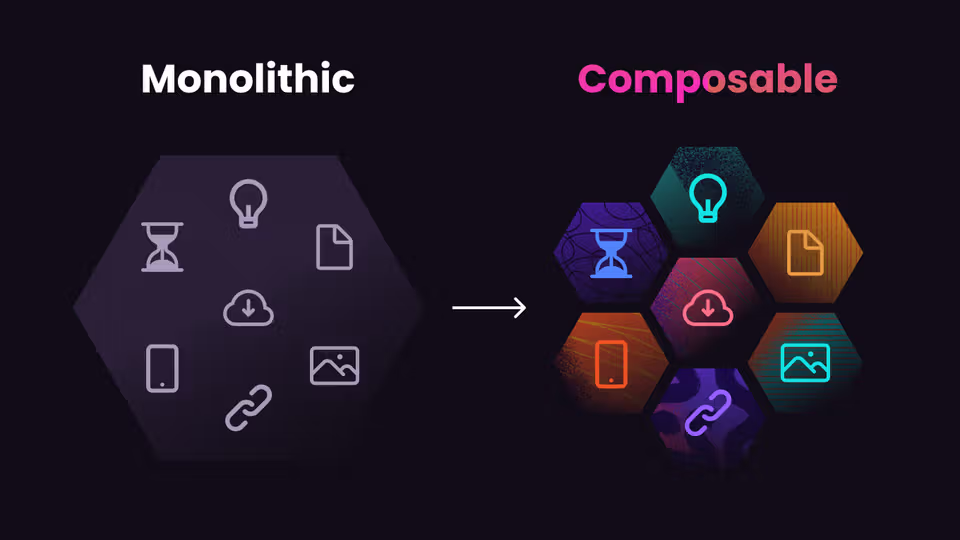
Composable Web Architecture represents a shift away from traditional monolithic web systems toward a more flexible, modular way of building digital experiences. Instead of developing a single, tightly coupled application, composable architecture breaks the system into independent, reusable components that can be assembled and reassembled based on evolving needs. This approach aligns well with modern business demands where speed, adaptability, and scalability are critical.
At the core of composable architecture is the idea of decoupling. Frontend, backend, content management, authentication, payments, analytics, and other services are treated as separate building blocks. Each component is responsible for a specific function and communicates with others through well-defined APIs. This separation allows teams to focus on individual parts without being constrained by the entire system’s structure.
A major enabler of composable systems is the API-first and headless approach. Backend services expose their capabilities through APIs, while frontend applications—built using frameworks like React, Vue, or Angular—consume these APIs independently. Headless CMS platforms further enhance this model by allowing content to be delivered to any frontend, whether it’s a website, mobile app, or IoT device.
Flexibility is one of the strongest advantages of composable web architecture. Organizations can easily swap tools or services without rebuilding the entire application. For example, a business can replace its payment gateway, search engine, or CMS with minimal disruption. This freedom prevents vendor lock-in and ensures that technology choices remain aligned with business goals over time.
Scalability is also significantly improved. Since components are decoupled, high-demand services such as product search, checkout, or user authentication can scale independently. This targeted scaling reduces infrastructure costs and improves performance during traffic spikes, making composable architecture ideal for large-scale and high-growth platforms.
From a development perspective, composable architecture boosts team productivity and collaboration. Multiple teams can work in parallel on different components using their preferred tools and technologies. This autonomy accelerates development cycles, shortens time-to-market, and enables continuous delivery without large, risky deployments.
Resilience and reliability are built into composable systems. If one service experiences failure or downtime, other components can continue functioning. This fault isolation minimizes system-wide outages and improves overall user experience. Combined with monitoring and observability tools, teams can quickly detect and resolve issues without affecting the entire platform.
Composable architecture also supports rapid innovation. Businesses can experiment with new features, integrate emerging technologies, or launch new digital channels by composing existing services in new ways. This adaptability is especially valuable in competitive markets where customer expectations and technologies evolve quickly.
In conclusion, Composable Web Architecture provides a future-ready foundation for modern web applications. By emphasizing modularity, flexibility, scalability, and resilience, it empowers both developers and businesses to build systems that grow and adapt over time. As digital ecosystems become more complex, composable architecture stands out as a strategic approach for sustainable and agile web development.
At the core of composable architecture is the idea of decoupling. Frontend, backend, content management, authentication, payments, analytics, and other services are treated as separate building blocks. Each component is responsible for a specific function and communicates with others through well-defined APIs. This separation allows teams to focus on individual parts without being constrained by the entire system’s structure.
A major enabler of composable systems is the API-first and headless approach. Backend services expose their capabilities through APIs, while frontend applications—built using frameworks like React, Vue, or Angular—consume these APIs independently. Headless CMS platforms further enhance this model by allowing content to be delivered to any frontend, whether it’s a website, mobile app, or IoT device.
Flexibility is one of the strongest advantages of composable web architecture. Organizations can easily swap tools or services without rebuilding the entire application. For example, a business can replace its payment gateway, search engine, or CMS with minimal disruption. This freedom prevents vendor lock-in and ensures that technology choices remain aligned with business goals over time.
Scalability is also significantly improved. Since components are decoupled, high-demand services such as product search, checkout, or user authentication can scale independently. This targeted scaling reduces infrastructure costs and improves performance during traffic spikes, making composable architecture ideal for large-scale and high-growth platforms.
From a development perspective, composable architecture boosts team productivity and collaboration. Multiple teams can work in parallel on different components using their preferred tools and technologies. This autonomy accelerates development cycles, shortens time-to-market, and enables continuous delivery without large, risky deployments.
Resilience and reliability are built into composable systems. If one service experiences failure or downtime, other components can continue functioning. This fault isolation minimizes system-wide outages and improves overall user experience. Combined with monitoring and observability tools, teams can quickly detect and resolve issues without affecting the entire platform.
Composable architecture also supports rapid innovation. Businesses can experiment with new features, integrate emerging technologies, or launch new digital channels by composing existing services in new ways. This adaptability is especially valuable in competitive markets where customer expectations and technologies evolve quickly.
In conclusion, Composable Web Architecture provides a future-ready foundation for modern web applications. By emphasizing modularity, flexibility, scalability, and resilience, it empowers both developers and businesses to build systems that grow and adapt over time. As digital ecosystems become more complex, composable architecture stands out as a strategic approach for sustainable and agile web development.