
An Application Programming Interface (API) is a set of rules, protocols, and tools that allow two software applications to communicate with each other. Simply put, an API acts as a messenger that takes a request from one system, delivers it to another system, and brings back the response. Every time you log in with Google, track a parcel, check weather updates, or see an online payment screen, an API is working in the background. APIs simplify development by enabling developers to reuse existing functionalities instead of building them from scratch. This makes software development faster, efficient, more secure, and more scalable.
In today’s connected world, no application works in isolation. Businesses rely on multiple services—payment gateways, authentication systems, cloud storage, mapping tools, AI models, and more. APIs enable seamless integration of these services. For example, an e-commerce application uses APIs to manage inventory, process orders, accept payments, and send notifications. Without APIs, each of these modules would have to be coded manually, significantly increasing time, effort, and risk. APIs also make digital transformation possible by connecting legacy systems to modern applications.
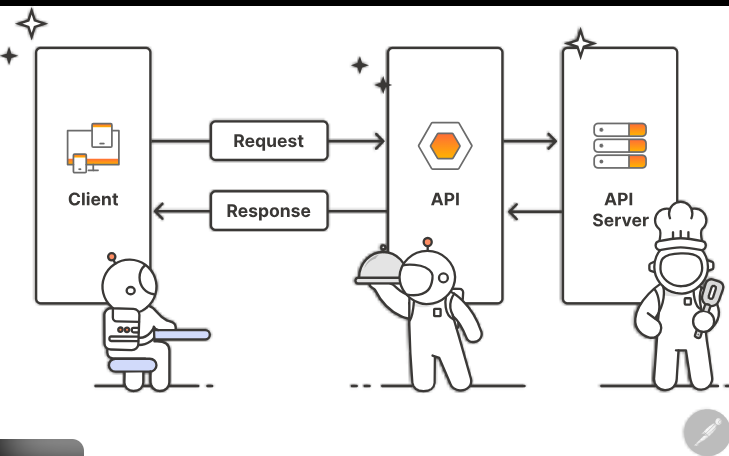
The working of an API is very similar to a restaurant system. You (the client) place an order, the waiter (API) takes your request to the chef (server), and then returns the prepared food (response). Technically, an API workflow includes:
1)Client sends a request to the API endpoint (a URL).
2)API processes the request, validates data, and checks permissions.
3)API communicates with the server or database to fetch or update required data.
4)Server sends back the response in a structured format (usually JSON).
5)Client displays the result to the user.
This cycle happens in milliseconds and is the backbone of every modern web or mobile application.
APIs come in various forms, depending on architecture and use-case. REST APIs are the most common today—they use HTTP, are lightweight, flexible, and easy to integrate. SOAP APIs are more rigid but extremely secure and are often used in banking systems. GraphQL APIs allow clients to request only the data they need, improving performance for complex applications such as social networks. Webhooks, on the other hand, push real-time updates automatically to clients, making them great for notifications. Understanding these types helps developers choose the right API based on requirements.
Every API has endpoints, which are predefined URLs that perform a specific function—like /login, /products, or /payment/status. APIs also use HTTP methods like GET (fetch data), POST (send data), PUT/PATCH (update data), and DELETE (remove data). Once a request is processed, the API responds with a status code such as 200 OK, 201 Created, 400 Bad Request, 401 Unauthorized, or 500 Server Error. These codes help developers quickly understand whether the request succeeded or failed and why, making debugging easier and integrations more reliable.
APIs must ensure that only authorized users or applications can access sensitive data. Therefore, various authentication methods are used: API keys, OAuth 2.0, JWT (JSON Web Tokens), and Bearer tokens. For example, when you log in with Google or Facebook, OAuth is what verifies your identity. APIs also implement security measures like rate limiting (preventing too many requests), input validation, IP whitelisting, HTTPS encryption, and CORS policies. These features protect systems from common cyberattacks such as data theft, injection attacks, and unauthorized access.
APIs power almost every digital service you use. Google Maps API enables apps like Zomato, Uber, and Ola to show live location tracking. Payment APIs such as Razorpay or PayPal complete secure online transactions. Weather APIs provide real-time climate updates to travel apps. Social media APIs allow apps to log in with Google, Facebook, or Instagram. AI APIs from OpenAI or Google let developers integrate chatbots, voice assistants, and smart features without building models from scratch. These examples show that APIs are not just communication tools—they are the backbone of digital innovation.
APIs help developers accelerate development, reduce manual coding, and improve overall productivity. They allow businesses to scale quickly by connecting services across platforms. APIs also enhance user experience by enabling real-time data sharing—like stock prices, delivery tracking, or payment updates. For companies, APIs help expand their ecosystem; for example, Shopify offers APIs that allow thousands of third-party developers to build apps, increasing business value. In short, APIs make applications more modular, flexible, scalable, and easier to maintain.
The future of APIs is moving toward even more automation and intelligence. With AI-powered APIs, systems can make decisions and process data autonomously. API management platforms are becoming more advanced, offering analytics, monitoring, version control, and auto-scaling capabilities. No-code and low-code platforms are also rising, allowing even non-developers to create workflows using API connectors. As businesses continue to digitize, APIs will evolve into smarter, faster, and more autonomous systems that drive the next generation of apps, websites, and AI-driven experiences.
In today’s connected world, no application works in isolation. Businesses rely on multiple services—payment gateways, authentication systems, cloud storage, mapping tools, AI models, and more. APIs enable seamless integration of these services. For example, an e-commerce application uses APIs to manage inventory, process orders, accept payments, and send notifications. Without APIs, each of these modules would have to be coded manually, significantly increasing time, effort, and risk. APIs also make digital transformation possible by connecting legacy systems to modern applications.
The working of an API is very similar to a restaurant system. You (the client) place an order, the waiter (API) takes your request to the chef (server), and then returns the prepared food (response). Technically, an API workflow includes:
1)Client sends a request to the API endpoint (a URL).
2)API processes the request, validates data, and checks permissions.
3)API communicates with the server or database to fetch or update required data.
4)Server sends back the response in a structured format (usually JSON).
5)Client displays the result to the user.
This cycle happens in milliseconds and is the backbone of every modern web or mobile application.
APIs come in various forms, depending on architecture and use-case. REST APIs are the most common today—they use HTTP, are lightweight, flexible, and easy to integrate. SOAP APIs are more rigid but extremely secure and are often used in banking systems. GraphQL APIs allow clients to request only the data they need, improving performance for complex applications such as social networks. Webhooks, on the other hand, push real-time updates automatically to clients, making them great for notifications. Understanding these types helps developers choose the right API based on requirements.
Every API has endpoints, which are predefined URLs that perform a specific function—like /login, /products, or /payment/status. APIs also use HTTP methods like GET (fetch data), POST (send data), PUT/PATCH (update data), and DELETE (remove data). Once a request is processed, the API responds with a status code such as 200 OK, 201 Created, 400 Bad Request, 401 Unauthorized, or 500 Server Error. These codes help developers quickly understand whether the request succeeded or failed and why, making debugging easier and integrations more reliable.
APIs must ensure that only authorized users or applications can access sensitive data. Therefore, various authentication methods are used: API keys, OAuth 2.0, JWT (JSON Web Tokens), and Bearer tokens. For example, when you log in with Google or Facebook, OAuth is what verifies your identity. APIs also implement security measures like rate limiting (preventing too many requests), input validation, IP whitelisting, HTTPS encryption, and CORS policies. These features protect systems from common cyberattacks such as data theft, injection attacks, and unauthorized access.
APIs power almost every digital service you use. Google Maps API enables apps like Zomato, Uber, and Ola to show live location tracking. Payment APIs such as Razorpay or PayPal complete secure online transactions. Weather APIs provide real-time climate updates to travel apps. Social media APIs allow apps to log in with Google, Facebook, or Instagram. AI APIs from OpenAI or Google let developers integrate chatbots, voice assistants, and smart features without building models from scratch. These examples show that APIs are not just communication tools—they are the backbone of digital innovation.
APIs help developers accelerate development, reduce manual coding, and improve overall productivity. They allow businesses to scale quickly by connecting services across platforms. APIs also enhance user experience by enabling real-time data sharing—like stock prices, delivery tracking, or payment updates. For companies, APIs help expand their ecosystem; for example, Shopify offers APIs that allow thousands of third-party developers to build apps, increasing business value. In short, APIs make applications more modular, flexible, scalable, and easier to maintain.
The future of APIs is moving toward even more automation and intelligence. With AI-powered APIs, systems can make decisions and process data autonomously. API management platforms are becoming more advanced, offering analytics, monitoring, version control, and auto-scaling capabilities. No-code and low-code platforms are also rising, allowing even non-developers to create workflows using API connectors. As businesses continue to digitize, APIs will evolve into smarter, faster, and more autonomous systems that drive the next generation of apps, websites, and AI-driven experiences.