
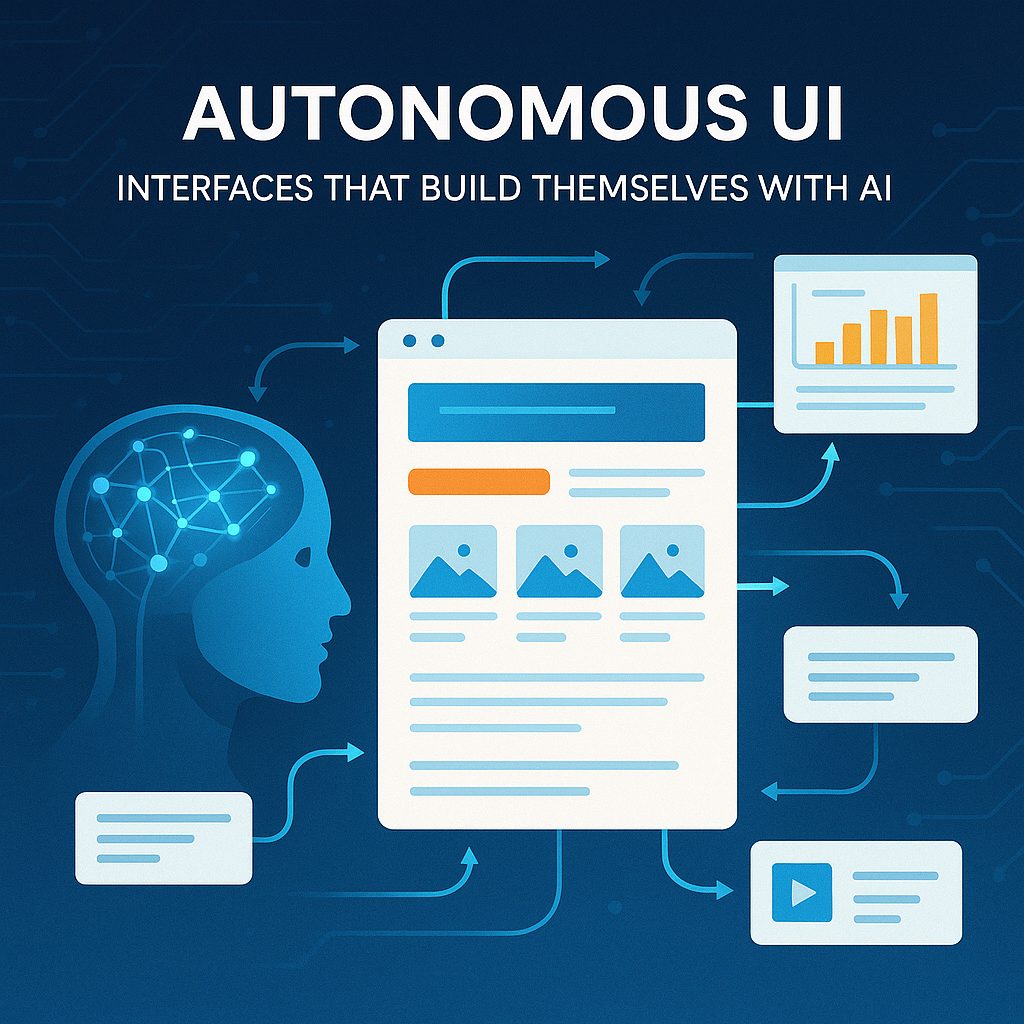
The world of web development is moving toward unprecedented automation—far beyond code suggestions and design templates. At the center of this transformation is Autonomous UI, a new paradigm where interfaces design, adapt, and update themselves using artificial intelligence. Instead of developers manually creating layouts or flows, the UI becomes a living, evolving system that responds to user behavior, environmental context, business goals, and real-time data. In this model, the interface is no longer a static asset—it becomes a continuously learning organism.
Autonomous UI refers to user interfaces that self-construct, self-optimize, and self-personalize using artificial intelligence. These interfaces observe how users interact, analyze usage patterns, run UI/UX experiments in real time, and rebuild their structure without human intervention. Unlike traditional responsive or adaptive design—where layout changes based on screen size—Autonomous UI adapts based on user intent, personality, interaction speed, accessibility needs, engagement levels, and even emotions. Using machine learning, reinforcement learning, and generative UI engines, the system updates its components in milliseconds.
At the core of Autonomous UI is a Generative UI Engine (GUIE), similar to what LLMs do for text. It includes rule-based logic, AI-driven variation generation, real-time analytics, and multi-agent collaboration. The system uses a feedback loop:
1)Observe user behavior (clicks, scrolls, attention span).
2)Analyze patterns (drop-offs, preferred actions, confusion signals).
3)Generate an updated UI based on learned models.
4)A/B test the new layout instantly.
5)Deploy the optimal version automatically.
This creates a self-healing interface capable of fixing friction points faster than human designers.
Autonomous UI isn’t a single technology—it’s a fusion of cutting-edge systems. Large Language Models (LLMs) generate layout structures; Vision Transformers evaluate UI clarity; Reinforcement Learning agents test interactive flows; and Edge Computing enables ultra-fast updates without delays. These components interact like a digital design team working 24/7, except faster and infinitely scalable. Modern frameworks such as WebAssembly, AI-driven CSS engines, and declarative UI models further accelerate the autonomy of interface generation.
The web is evolving beyond static pages and predictable layouts. Users expect experiences that feel personal, fast, and emotionally intelligent. Businesses demand interfaces that can adapt instantly to market trends. Developers want tools that eliminate repetitive UI work. Autonomous UI meets all these needs simultaneously. Instead of redesign cycles that take weeks, UI updates now happen in seconds. This drastically reduces development time, boosts conversion rates, enhances accessibility, and creates interfaces that continuously improve without human intervention.
Rather than replacing developers and designers, Autonomous UI changes their role. Developers shift toward building the underlying intelligence, APIs, and design constraints. Designers become AI supervisors, curating brand style rules, defining design ethics, and monitoring the generated variations. Instead of drawing hundreds of screens manually, they guide the AI to create consistent, usable, and beautiful patterns. The workload shifts from repetitive tasks to creative decision-making and high-level architectural thinking.
Autonomous UI is already emerging in multiple industries: e-commerce platforms generate dynamic product pages based on user purchase behavior; edtech apps adjust difficulty levels and content layout to match the learner; healthcare portals personalize accessibility modes automatically; finance dashboards rearrange charts based on real-time market conditions. Even customer support systems are adopting autonomous UI to surface the most relevant FAQs or UI flows based on user emotion signals extracted from text or voice.
With great autonomy comes great responsibility. Self-building interfaces must maintain transparency and respect user privacy. Over-personalization can create unintentional bias or filter bubbles. Security concerns also arise because autonomous systems can modify critical UI components, potentially creating attack vectors. To mitigate this, strong governance is essential: explainable AI, secured design boundaries, human override controls, and strict change-audit logs. The future of autonomous UI will depend heavily on ethical frameworks guiding how AI is allowed to manipulate user experiences.
Autonomous UI is just the beginning. In the next decade, websites and apps will transform into self-evolving digital ecosystems. They will build onboarding flows dynamically based on the user’s learning pace, create personalized dashboards from scratch, and even predict the next feature you’ll need before you ask for it. Imagine a system where the UI, backend, and logic co-evolve—where every part of your digital product continuously redesigns itself for maximum efficiency. This represents the shift toward AI-native web development, where human creativity defines the rules and AI executes billions of optimizations in real time.
Autonomous UI refers to user interfaces that self-construct, self-optimize, and self-personalize using artificial intelligence. These interfaces observe how users interact, analyze usage patterns, run UI/UX experiments in real time, and rebuild their structure without human intervention. Unlike traditional responsive or adaptive design—where layout changes based on screen size—Autonomous UI adapts based on user intent, personality, interaction speed, accessibility needs, engagement levels, and even emotions. Using machine learning, reinforcement learning, and generative UI engines, the system updates its components in milliseconds.
At the core of Autonomous UI is a Generative UI Engine (GUIE), similar to what LLMs do for text. It includes rule-based logic, AI-driven variation generation, real-time analytics, and multi-agent collaboration. The system uses a feedback loop:
1)Observe user behavior (clicks, scrolls, attention span).
2)Analyze patterns (drop-offs, preferred actions, confusion signals).
3)Generate an updated UI based on learned models.
4)A/B test the new layout instantly.
5)Deploy the optimal version automatically.
This creates a self-healing interface capable of fixing friction points faster than human designers.
Autonomous UI isn’t a single technology—it’s a fusion of cutting-edge systems. Large Language Models (LLMs) generate layout structures; Vision Transformers evaluate UI clarity; Reinforcement Learning agents test interactive flows; and Edge Computing enables ultra-fast updates without delays. These components interact like a digital design team working 24/7, except faster and infinitely scalable. Modern frameworks such as WebAssembly, AI-driven CSS engines, and declarative UI models further accelerate the autonomy of interface generation.
The web is evolving beyond static pages and predictable layouts. Users expect experiences that feel personal, fast, and emotionally intelligent. Businesses demand interfaces that can adapt instantly to market trends. Developers want tools that eliminate repetitive UI work. Autonomous UI meets all these needs simultaneously. Instead of redesign cycles that take weeks, UI updates now happen in seconds. This drastically reduces development time, boosts conversion rates, enhances accessibility, and creates interfaces that continuously improve without human intervention.
Rather than replacing developers and designers, Autonomous UI changes their role. Developers shift toward building the underlying intelligence, APIs, and design constraints. Designers become AI supervisors, curating brand style rules, defining design ethics, and monitoring the generated variations. Instead of drawing hundreds of screens manually, they guide the AI to create consistent, usable, and beautiful patterns. The workload shifts from repetitive tasks to creative decision-making and high-level architectural thinking.
Autonomous UI is already emerging in multiple industries: e-commerce platforms generate dynamic product pages based on user purchase behavior; edtech apps adjust difficulty levels and content layout to match the learner; healthcare portals personalize accessibility modes automatically; finance dashboards rearrange charts based on real-time market conditions. Even customer support systems are adopting autonomous UI to surface the most relevant FAQs or UI flows based on user emotion signals extracted from text or voice.
With great autonomy comes great responsibility. Self-building interfaces must maintain transparency and respect user privacy. Over-personalization can create unintentional bias or filter bubbles. Security concerns also arise because autonomous systems can modify critical UI components, potentially creating attack vectors. To mitigate this, strong governance is essential: explainable AI, secured design boundaries, human override controls, and strict change-audit logs. The future of autonomous UI will depend heavily on ethical frameworks guiding how AI is allowed to manipulate user experiences.
Autonomous UI is just the beginning. In the next decade, websites and apps will transform into self-evolving digital ecosystems. They will build onboarding flows dynamically based on the user’s learning pace, create personalized dashboards from scratch, and even predict the next feature you’ll need before you ask for it. Imagine a system where the UI, backend, and logic co-evolve—where every part of your digital product continuously redesigns itself for maximum efficiency. This represents the shift toward AI-native web development, where human creativity defines the rules and AI executes billions of optimizations in real time.