
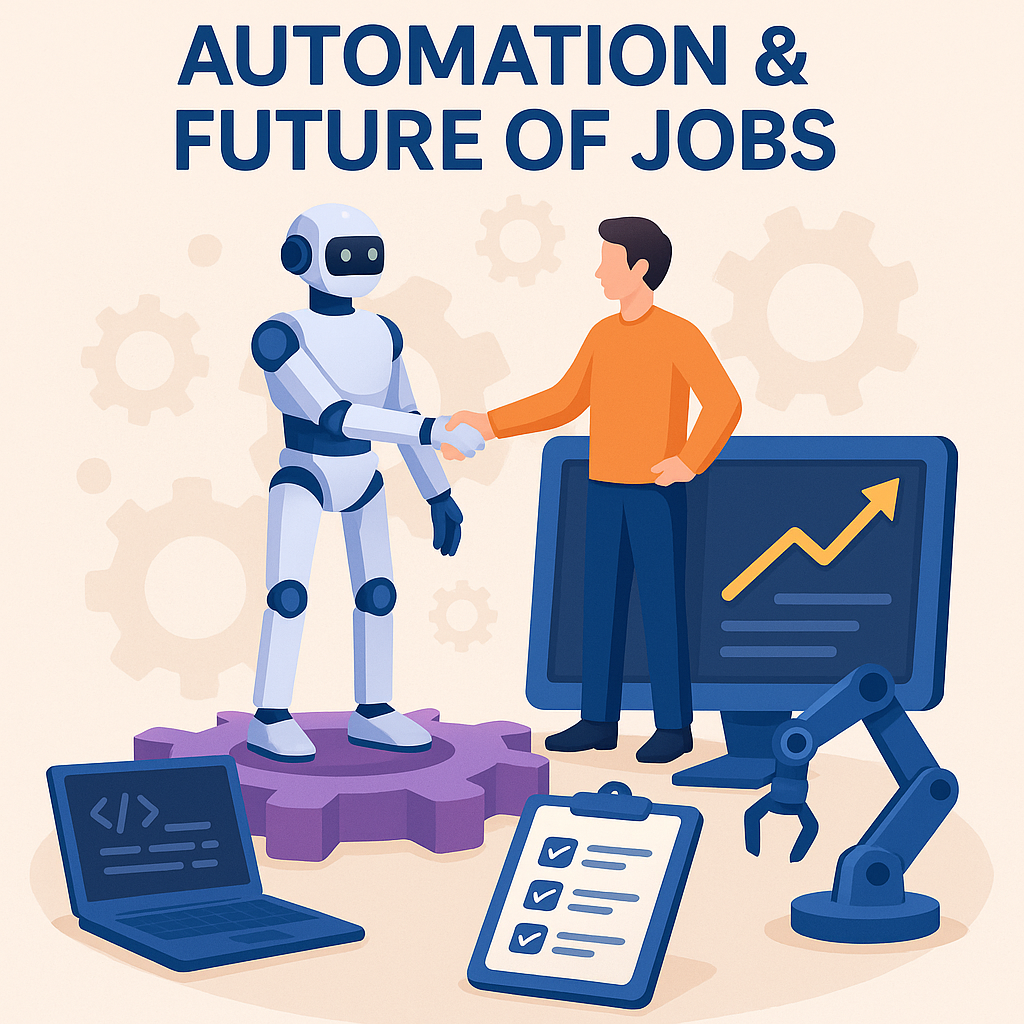
Automation has become one of the most influential forces shaping the future of global employment. From intelligent robots on factory floors to advanced AI systems performing administrative tasks, automation is transforming how industries operate. This shift is driven by rapid advancements in artificial intelligence, robotics, machine learning, and data analytics. While earlier industrial revolutions replaced manual labor with machines, today’s automation revolution enhances cognitive abilities—allowing machines to analyze, decide, and optimize. As businesses adopt automation to increase productivity and reduce operational costs, the question arises: What will be the future of jobs? Understanding this transformation is essential for workers, businesses, and policy makers to prepare for the next decade of change.
Automation today goes far beyond traditional machinery. We now have AI-powered systems capable of performing complex tasks such as diagnosing diseases, predicting customer behavior, reviewing contracts, and even generating creative content. Intelligent automation combines robotics with AI, enabling systems to learn from data and improve continuously. This has led to the rise of smart manufacturing, automated logistics, self-driving vehicles, and intelligent customer service bots. Industries like finance, healthcare, retail, and transportation are already adopting automated workflows. As companies seek higher efficiency and reduced errors, intelligent automation becomes the backbone of modern digital transformation.
Not all jobs face the same level of automation risk. Roles that involve repetitive and predictable tasks are the most vulnerable. Examples include data entry, basic accounting, tele-calling, assembly line work, and administrative operations. Manufacturing has already experienced significant automation with industrial robots replacing manual labor. In retail, self-checkout systems and automated inventory tracking reduce the need for certain staff. Even in white-collar professions, tasks like report generation, customer support, and scheduling are being automated using AI tools. This shift does not necessarily eliminate all jobs but transforms how they are performed, pushing workers to adopt new skills.
Although automation replaces certain tasks, it simultaneously creates new opportunities. Just as previous revolutions created new professions, the automation era introduces roles such as AI engineers, data analysts, robotics technicians, automation consultants, machine learning specialists, and cybersecurity experts. Jobs that require human creativity, emotional intelligence, critical thinking, and complex decision-making are gaining more importance. The demand for professionals in cloud computing, digital marketing, UI/UX design, and product management is also rising. Additionally, automation creates opportunities in fields like robot maintenance, process design, and human-machine collaboration. Rather than destroying jobs entirely, automation reshapes them.
As automation advances, reskilling becomes essential. Workers need to learn digital skills to stay relevant. Governments and companies worldwide are investing heavily in workforce training. The World Economic Forum states that more than half of workers will need significant reskilling by 2030. Skills like data literacy, digital communication, problem-solving, and adaptability are becoming core requirements across industries. Even non-technical workers must learn to work alongside automated tools and AI-driven systems. Educational institutions are gradually redesigning curriculums to include automation-driven technologies, ensuring the upcoming workforce is prepared for future challenges.
The future of jobs is not about humans replacing machines or machines replacing humans—it is about collaboration. In many industries, machines perform repetitive tasks while humans handle strategic, creative, or interpersonal responsibilities. For example, doctors use AI systems to analyze medical images but make final diagnoses based on experience and empathy. In factories, collaborative robots (cobots) work safely alongside humans to enhance efficiency. This partnership increases productivity and reduces errors while allowing workers to focus on meaningful tasks. The rise of human-machine collaboration signals a future where humans and AI complement each other’s strengths.
Automation affects countries differently based on economic development, industrial focus, and education systems. Developed nations with advanced technology ecosystems adopt automation faster, potentially leading to job restructuring or shifts in roles. Emerging economies may experience higher displacement in labor-intensive sectors but also gain new opportunities as automation drives the global demand for skilled digital workers. Remote work, digital freelancing, and gig platforms continue to grow, enabling global participation in technology-driven roles. At the same time, policymakers must address inequality, ensuring that technological progress benefits all groups rather than widening the gap.
The rapid rise of automation brings challenges such as job displacement anxiety, algorithmic bias, and workplace inequality. Ethical concerns arise when AI makes decisions affecting employment, loans, or healthcare. Economic concerns include the risk of unemployment in communities dependent on repetitive work. Policymakers must create frameworks to manage AI responsibly, ensure workforce protection, and promote inclusive growth. Companies should provide training programs and transparent AI policies. As automation reshapes society, balancing innovation with fairness becomes crucial.
Automation is not the end of human employment—it is the beginning of a new work era. Jobs will evolve, requiring workers to adopt new skills and adapt to technological change. The future belongs to individuals who embrace lifelong learning, digital skills, and creative problem-solving. Organizations that combine human intelligence with machine efficiency will lead the next wave of innovation. Governments must support education and training to prepare citizens for the demands of the automation age. By understanding these trends and adapting early, we can shape a future where humans and technology grow together.
Automation today goes far beyond traditional machinery. We now have AI-powered systems capable of performing complex tasks such as diagnosing diseases, predicting customer behavior, reviewing contracts, and even generating creative content. Intelligent automation combines robotics with AI, enabling systems to learn from data and improve continuously. This has led to the rise of smart manufacturing, automated logistics, self-driving vehicles, and intelligent customer service bots. Industries like finance, healthcare, retail, and transportation are already adopting automated workflows. As companies seek higher efficiency and reduced errors, intelligent automation becomes the backbone of modern digital transformation.
Not all jobs face the same level of automation risk. Roles that involve repetitive and predictable tasks are the most vulnerable. Examples include data entry, basic accounting, tele-calling, assembly line work, and administrative operations. Manufacturing has already experienced significant automation with industrial robots replacing manual labor. In retail, self-checkout systems and automated inventory tracking reduce the need for certain staff. Even in white-collar professions, tasks like report generation, customer support, and scheduling are being automated using AI tools. This shift does not necessarily eliminate all jobs but transforms how they are performed, pushing workers to adopt new skills.
Although automation replaces certain tasks, it simultaneously creates new opportunities. Just as previous revolutions created new professions, the automation era introduces roles such as AI engineers, data analysts, robotics technicians, automation consultants, machine learning specialists, and cybersecurity experts. Jobs that require human creativity, emotional intelligence, critical thinking, and complex decision-making are gaining more importance. The demand for professionals in cloud computing, digital marketing, UI/UX design, and product management is also rising. Additionally, automation creates opportunities in fields like robot maintenance, process design, and human-machine collaboration. Rather than destroying jobs entirely, automation reshapes them.
As automation advances, reskilling becomes essential. Workers need to learn digital skills to stay relevant. Governments and companies worldwide are investing heavily in workforce training. The World Economic Forum states that more than half of workers will need significant reskilling by 2030. Skills like data literacy, digital communication, problem-solving, and adaptability are becoming core requirements across industries. Even non-technical workers must learn to work alongside automated tools and AI-driven systems. Educational institutions are gradually redesigning curriculums to include automation-driven technologies, ensuring the upcoming workforce is prepared for future challenges.
The future of jobs is not about humans replacing machines or machines replacing humans—it is about collaboration. In many industries, machines perform repetitive tasks while humans handle strategic, creative, or interpersonal responsibilities. For example, doctors use AI systems to analyze medical images but make final diagnoses based on experience and empathy. In factories, collaborative robots (cobots) work safely alongside humans to enhance efficiency. This partnership increases productivity and reduces errors while allowing workers to focus on meaningful tasks. The rise of human-machine collaboration signals a future where humans and AI complement each other’s strengths.
Automation affects countries differently based on economic development, industrial focus, and education systems. Developed nations with advanced technology ecosystems adopt automation faster, potentially leading to job restructuring or shifts in roles. Emerging economies may experience higher displacement in labor-intensive sectors but also gain new opportunities as automation drives the global demand for skilled digital workers. Remote work, digital freelancing, and gig platforms continue to grow, enabling global participation in technology-driven roles. At the same time, policymakers must address inequality, ensuring that technological progress benefits all groups rather than widening the gap.
The rapid rise of automation brings challenges such as job displacement anxiety, algorithmic bias, and workplace inequality. Ethical concerns arise when AI makes decisions affecting employment, loans, or healthcare. Economic concerns include the risk of unemployment in communities dependent on repetitive work. Policymakers must create frameworks to manage AI responsibly, ensure workforce protection, and promote inclusive growth. Companies should provide training programs and transparent AI policies. As automation reshapes society, balancing innovation with fairness becomes crucial.
Automation is not the end of human employment—it is the beginning of a new work era. Jobs will evolve, requiring workers to adopt new skills and adapt to technological change. The future belongs to individuals who embrace lifelong learning, digital skills, and creative problem-solving. Organizations that combine human intelligence with machine efficiency will lead the next wave of innovation. Governments must support education and training to prepare citizens for the demands of the automation age. By understanding these trends and adapting early, we can shape a future where humans and technology grow together.