
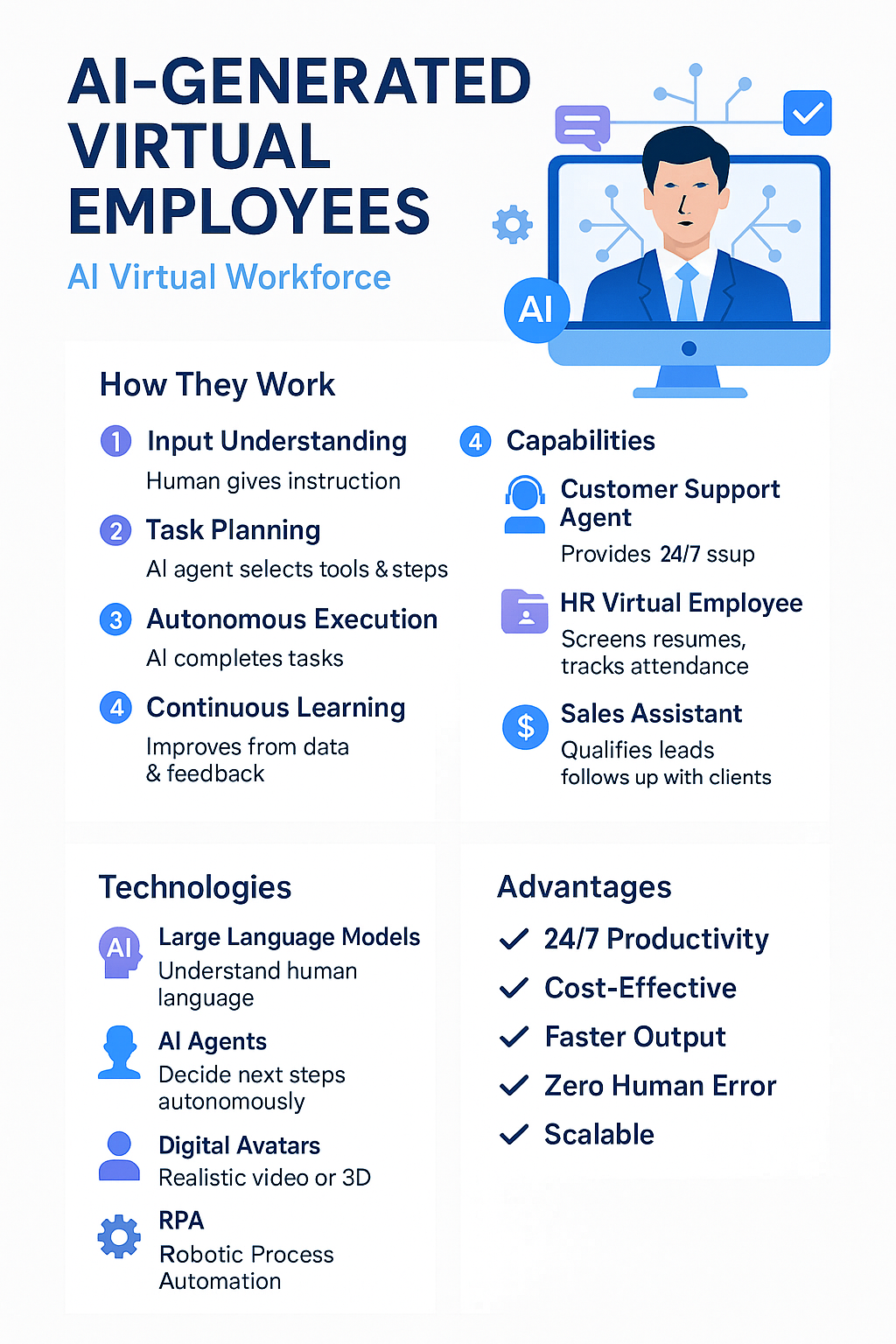
AI-Generated Virtual Employees represent one of the most disruptive transformations in the modern workplace. These digital workers are powered by advanced AI agents, large language models, automation tools, and human-like avatars that can perform tasks just like human employees—but faster, more accurately, and without interruption. Instead of only assisting humans, these AI employees can independently handle workflows such as data entry, customer support, lead follow-ups, financial reporting, HR operations, content creation, scheduling, and analytics. As businesses continue to digitize, the demand for intelligent virtual workers has skyrocketed, creating a new era where software becomes a fully functional member of the workforce.
What makes AI virtual employees unique is their ability to understand instructions, plan tasks, access internal systems, and produce results with minimal supervision. They combine natural language understanding with autonomous decision-making. For example, a sales AI employee can read emails, qualify leads, update CRM entries, schedule calls, and generate follow-up messages automatically. A finance AI employee can prepare invoices, reconcile transactions, generate reports, and analyze spending trends. These capabilities come from deep integration with APIs, databases, business apps, and enterprise workflows—allowing AI workers to operate like trained staff members with perfect memory and 24/7 availability.
A major advantage of AI-Generated Virtual Employees is scalability. Companies can create 5, 50, or even 500 AI employees instantly without worrying about recruitment, training, or overhead costs. Each virtual worker can be assigned a dedicated role—marketing assistant, HR analyst, customer support agent, or operational coordinator—and trained using internal documents, SOPs, and knowledge bases. This eliminates repetitive manual work and allows human employees to focus on creativity, strategy, leadership, and innovation. The ability to scale instantly makes AI employees extremely valuable for startups, SMEs, and enterprises experiencing rapid growth.
AI virtual employees are powered by cutting-edge technologies including natural language processing (NLP), autonomous AI agents, machine learning, robotics process automation (RPA), cloud computing, and digital avatar systems. NLP allows them to understand instructions, generate human-like responses, and comprehend business context. RPA handles repetitive rule-based tasks like form submissions, spreadsheet updates, and data transfers. Autonomous agents take decisions on what actions to perform next, enabling complex workflows without needing human intervention. When combined, these technologies transform AI employees from simple assistants into intelligent, self-driven digital workers.
One of the most impactful domains for AI employees is customer service. AI support agents respond instantly across WhatsApp, email, chat, and voice channels. They handle queries, troubleshoot issues, track orders, provide recommendations, and escalate sensitive cases to human staff. Unlike traditional chatbots, AI employees understand context, learn from interactions, maintain conversation history, and handle emotionally sensitive scenarios with tone-aware communication. Companies save significant time and cost while delivering faster, more consistent support experiences.
AI virtual employees are also transforming backend operations. In HR, they screen resumes, shortlist candidates, schedule interviews, send onboarding documents, and track attendance. In finance, they analyze statements, generate tax reports, detect anomalies, and support audits. In marketing, they create ads, write blogs, design social posts, and analyze performance metrics. In IT, they document bugs, monitor systems, and generate code documentation. Because AI employees never forget rules, never get tired, and execute tasks with precision, operational efficiency improves dramatically.
Despite the advantages, AI employees also come with challenges. They must be configured with high-quality data and proper guardrails to avoid mistakes or biased outputs. Sensitive business information must be protected through strong security, encryption, and role-based access. AI employees must align with ethical guidelines, especially when interacting with customers or handling personal data. Although they handle repetitive and analytical tasks exceptionally well, they cannot fully replace human emotional intelligence, leadership, critical judgment, or creativity. Organizations must balance AI power with human strengths to build a productive hybrid workforce.
The future of AI-Generated Virtual Employees is extremely promising. Over the next few years, AI workers will attend meetings with human-like avatars, share screens, take notes automatically, and provide insights in real time. They will collaborate with human teams across departments, becoming digital coworkers instead of just tools. We will also see AI job marketplaces where companies “hire” AI employees pre-trained in sales, finance, HR, or operations. As AI becomes more multimodal—understanding text, images, voice, documents, and workflows—virtual employees will evolve into powerful digital managers capable of overseeing entire departments with full autonomy.
Ultimately, AI-Generated Virtual Employees represent the next evolution of the modern workplace. They increase productivity, reduce operational costs, eliminate repetitive workloads, and empower human workers to focus on creativity and decision-making. Businesses that adopt AI employees early will gain a major competitive advantage in speed, accuracy, and innovation. As technology continues to evolve, the boundary between human and digital workforce will blur, creating a future where collaboration between people and AI becomes the standard across all industries.
What makes AI virtual employees unique is their ability to understand instructions, plan tasks, access internal systems, and produce results with minimal supervision. They combine natural language understanding with autonomous decision-making. For example, a sales AI employee can read emails, qualify leads, update CRM entries, schedule calls, and generate follow-up messages automatically. A finance AI employee can prepare invoices, reconcile transactions, generate reports, and analyze spending trends. These capabilities come from deep integration with APIs, databases, business apps, and enterprise workflows—allowing AI workers to operate like trained staff members with perfect memory and 24/7 availability.
A major advantage of AI-Generated Virtual Employees is scalability. Companies can create 5, 50, or even 500 AI employees instantly without worrying about recruitment, training, or overhead costs. Each virtual worker can be assigned a dedicated role—marketing assistant, HR analyst, customer support agent, or operational coordinator—and trained using internal documents, SOPs, and knowledge bases. This eliminates repetitive manual work and allows human employees to focus on creativity, strategy, leadership, and innovation. The ability to scale instantly makes AI employees extremely valuable for startups, SMEs, and enterprises experiencing rapid growth.
AI virtual employees are powered by cutting-edge technologies including natural language processing (NLP), autonomous AI agents, machine learning, robotics process automation (RPA), cloud computing, and digital avatar systems. NLP allows them to understand instructions, generate human-like responses, and comprehend business context. RPA handles repetitive rule-based tasks like form submissions, spreadsheet updates, and data transfers. Autonomous agents take decisions on what actions to perform next, enabling complex workflows without needing human intervention. When combined, these technologies transform AI employees from simple assistants into intelligent, self-driven digital workers.
One of the most impactful domains for AI employees is customer service. AI support agents respond instantly across WhatsApp, email, chat, and voice channels. They handle queries, troubleshoot issues, track orders, provide recommendations, and escalate sensitive cases to human staff. Unlike traditional chatbots, AI employees understand context, learn from interactions, maintain conversation history, and handle emotionally sensitive scenarios with tone-aware communication. Companies save significant time and cost while delivering faster, more consistent support experiences.
AI virtual employees are also transforming backend operations. In HR, they screen resumes, shortlist candidates, schedule interviews, send onboarding documents, and track attendance. In finance, they analyze statements, generate tax reports, detect anomalies, and support audits. In marketing, they create ads, write blogs, design social posts, and analyze performance metrics. In IT, they document bugs, monitor systems, and generate code documentation. Because AI employees never forget rules, never get tired, and execute tasks with precision, operational efficiency improves dramatically.
Despite the advantages, AI employees also come with challenges. They must be configured with high-quality data and proper guardrails to avoid mistakes or biased outputs. Sensitive business information must be protected through strong security, encryption, and role-based access. AI employees must align with ethical guidelines, especially when interacting with customers or handling personal data. Although they handle repetitive and analytical tasks exceptionally well, they cannot fully replace human emotional intelligence, leadership, critical judgment, or creativity. Organizations must balance AI power with human strengths to build a productive hybrid workforce.
The future of AI-Generated Virtual Employees is extremely promising. Over the next few years, AI workers will attend meetings with human-like avatars, share screens, take notes automatically, and provide insights in real time. They will collaborate with human teams across departments, becoming digital coworkers instead of just tools. We will also see AI job marketplaces where companies “hire” AI employees pre-trained in sales, finance, HR, or operations. As AI becomes more multimodal—understanding text, images, voice, documents, and workflows—virtual employees will evolve into powerful digital managers capable of overseeing entire departments with full autonomy.
Ultimately, AI-Generated Virtual Employees represent the next evolution of the modern workplace. They increase productivity, reduce operational costs, eliminate repetitive workloads, and empower human workers to focus on creativity and decision-making. Businesses that adopt AI employees early will gain a major competitive advantage in speed, accuracy, and innovation. As technology continues to evolve, the boundary between human and digital workforce will blur, creating a future where collaboration between people and AI becomes the standard across all industries.