
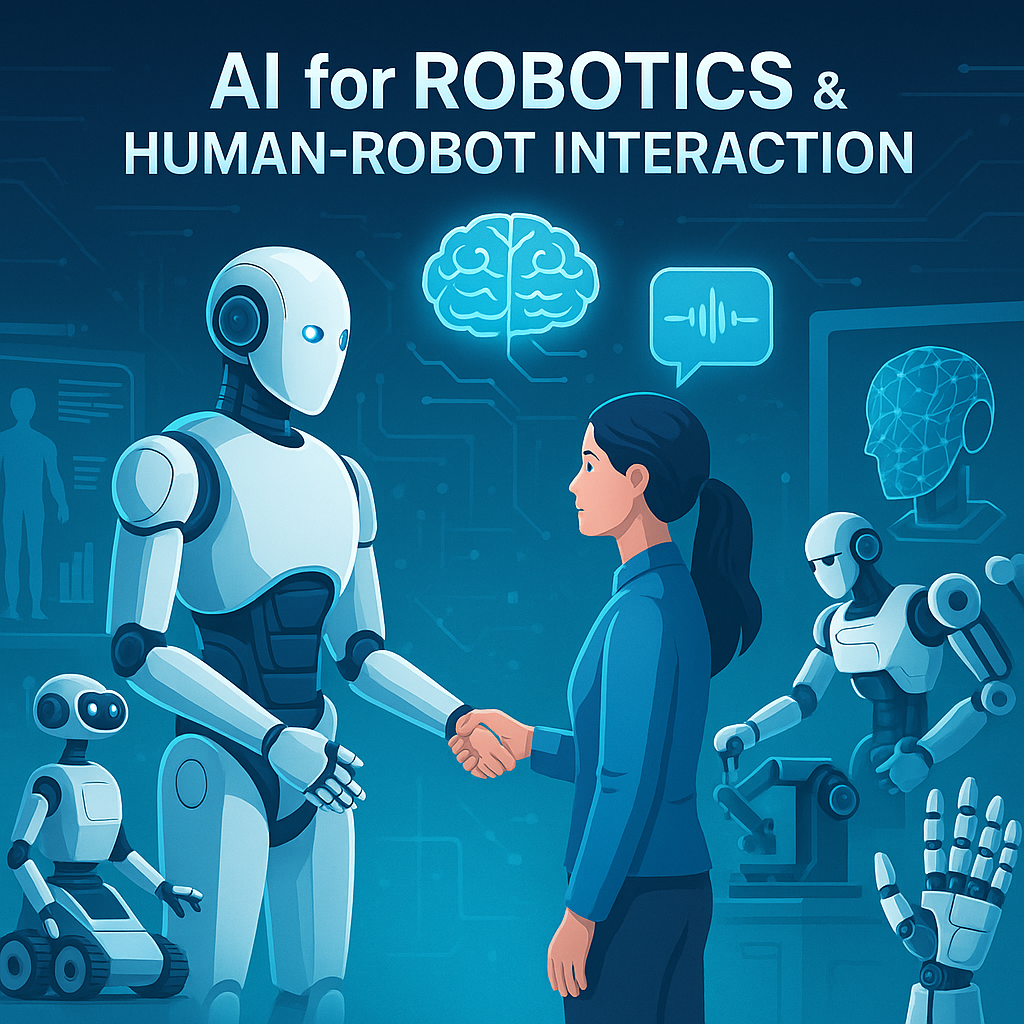
Artificial Intelligence has transformed robotics from rigid, pre-programmed machines into intelligent entities capable of perception, learning, autonomous decision-making, and natural interaction with humans. In the early decades of robotics, robots could only perform repetitive tasks inside controlled environments—such as assembling components or lifting objects on factory lines. These robots had no understanding of their surroundings, no awareness of human presence, and no ability to adapt or learn. The introduction of AI changed the foundation of robotics entirely. Deep learning, machine learning, reinforcement learning, computer vision, natural language processing, and sensor fusion have enabled robots to operate in dynamic, unpredictable, human-centered spaces. Today, AI-powered robots can understand speech, recognize faces and emotions, navigate complex environments, collaborate with people, and make real-time decisions. This advancement pushed robotics beyond industrial manufacturing into healthcare, transportation, education, defense, retail, agriculture, logistics, and home assistance. Human-Robot Interaction (HRI) has emerged as a scientific discipline focused on creating seamless, safe, intuitive interaction between humans and robots. HRI merges psychology, design, engineering, linguistics, and AI to ensure robots behave naturally, understand human intent, and collaborate effectively. As robots become more present in daily life—from delivery bots to surgical systems to personal assistants—AI is the technology that enables them to coexist with humans smoothly, meaningfully, and safely.
AI gives robots the ability to perceive the world through sensors, interpret large amounts of data, reason about their environment, and make informed decisions. Perception is the first major capability—powered by computer vision systems built on convolutional neural networks (CNNs), transformers, object detection algorithms (YOLO, Mask R-CNN), optical flow, and depth estimation. Robots see through cameras, LiDAR, radar, ultrasonic sensors, IMUs, and thermal sensors. These allow them to detect obstacles, identify objects, understand human gestures, track movement, and map environments using SLAM (Simultaneous Localization and Mapping). AI also gives robots cognitive ability through planning algorithms such as A*, RRT, Monte Carlo Tree Search, and reinforcement learning techniques. Motion planning enables robots to move arms, navigate spaces, avoid collisions, grasp objects, and coordinate complex actions. Reinforcement learning allows robots to learn tasks like walking, manipulating tools, climbing stairs, sorting items, or flying drones by trial and error. Robots remember past actions, evaluate rewards, and improve efficiency over time. Natural language processing enables robots to understand human commands, respond intelligently, carry conversations, and interpret context. Modern robots also incorporate world modeling, predictive reasoning, and probabilistic decision-making—allowing them to function autonomously in uncertain environments. The combination of perception + cognition + motion control defines the intelligence layer that differentiates modern robots from traditional machines.
AI has enabled many new classes of robots across industries, each designed for specific levels of autonomy and interaction with people. Industrial robots, once fully isolated behind safety cages, now use AI to detect humans, optimize workflows, and maintain precision. Collaborative robots (cobots) work directly alongside human workers, sharing workspace safely due to AI-driven force sensing, predictive modeling, and proactive collision avoidance. Service robots assist in retail, hospitality, banking, restaurants, and customer service—handling navigation, information delivery, and basic conversations. Healthcare robots assist surgeons, support elderly patients, deliver medicine, and handle repetitive hospital tasks. Humanoid robots like Tesla Optimus, Ameca, and Pepper use multimodal AI to mimic human expressions, understand gestures, maintain eye contact, and hold conversations. Social robots teach children, help individuals with autism, guide museum visitors, or provide companionship to the elderly. Logistics robots (in warehouses & delivery) use AI navigation to transport items efficiently. Autonomous vehicles, drones, and agricultural robots use AI-powered perception and planning to operate outdoors. Across all types, robots increasingly collaborate with humans rather than replace them—enhancing productivity, reducing risk, and enabling new forms of teamwork. The diversity of robot categories highlights how deeply AI has penetrated robotics, enabling both high-precision industrial performance and human-centered social interaction.
Human-Robot Interaction is critical when robots must coexist with people in everyday environments. HRI focuses on making interactions natural, safe, predictable, and emotionally appropriate. Robots use multiple AI-driven modalities to communicate with humans: speech recognition, natural language generation, gesture detection, facial expression analysis, and even emotional intelligence systems that detect tone, stress, or engagement. Conversational AI enables robots to understand context, maintain dialogues, and personalize interactions. Body language recognition allows robots to respond when a human approaches, reaches out, or signals intention. Eye gaze tracking helps robots maintain naturalistic communication patterns. HRI researchers also study trust—how humans perceive robot reliability and capability. For example, a robot that moves too fast or unpredictably may create fear, while one that hesitates or acts unsure may reduce user trust. AI safety systems ensure robots maintain safe distances, detect human presence, limit force, and stop instantly in emergencies. In workplaces, collaborative robots predict human intent, adjust motion accordingly, and hand over tools safely. Social robots use affective computing to express emotions using screen faces, voice tone, posture, and LED light cues—creating rapport with humans. As robots integrate into homes, hospitals, and public spaces, HRI ensures that interactions feel smooth, intuitive, and psychologically comfortable. This field combines robotics engineering with behavioral science, human psychology, and UX design to build robots that communicate like cooperative partners rather than cold machines.
AI-driven robotics and HRI are transforming industries worldwide. In healthcare, surgical robots provide precision during complex procedures, rehabilitation robots assist patients with movement exercises, and eldercare robots support aging populations by monitoring vital signs, delivering medication, or providing companionship. In manufacturing, cobots assist workers with lifting, assembling, welding, and quality inspection, while reducing injury risks. In education, robots teach STEM subjects, language learning, and interactive lessons, making classrooms more engaging. In logistics and e-commerce, robots handle automated storage, item picking, inventory scanning, and last-mile delivery. In security, AI-powered robots patrol spaces, detect anomalies, recognize faces, and alert human operators. In agriculture, robots analyze soil, harvest crops, spray pesticides precisely, and monitor plant health using AI vision. In homes, domestic robots assist with cleaning, cooking, companionship, and even mental well-being support. Hospitality robots greet customers, provide room service, or deliver food. Across all domains, robots increase efficiency, reduce operational costs, and elevate user experience. The combined power of AI + robotics + HRI helps organizations maintain high productivity while improving safety and personalization—showing how deep the impact of intelligent robotics has become on society and industry.
Despite groundbreaking advancements, AI-powered robotics faces significant challenges. Safety is the highest priority—robots must avoid harming humans physically or emotionally. Technical challenges include imperfect perception systems, unpredictable behavior in chaotic environments, limited adaptability, and difficulty understanding complex human emotions or intentions. Ethical challenges arise when robots collect personal data through cameras and microphones, raising concerns about surveillance and privacy. AI bias can lead to unequal treatment or misinterpretation of certain demographic groups. Job displacement fears exist in manufacturing, transportation, and retail as automation grows—requiring thoughtful policies, reskilling programs, and human-centered deployment strategies. Emotional dependency is another concern: social robots used by children or elderly individuals may create attachment, raising psychological and ethical questions. Autonomous weapons or military robots introduce additional global risks. Furthermore, high computational requirements, battery limitations, data labeling costs, and hardware expenses restrict widespread deployment. Addressing these challenges requires collaboration between governments, researchers, engineers, ethicists, and communities. Transparent AI systems, robust safety mechanisms, privacy-preserving design, ethical guidelines, and responsible development practices are essential for ensuring AI robotics benefits humanity without unintended harm.
The future of AI for robotics and human-robot interaction is extraordinarily promising. Advancements in embodied AI—where robots learn through physical interaction with the real world—will produce robots capable of adapting to new tasks just like humans do. General-purpose humanoid robots such as Tesla Optimus, Figure 01, and others aim to handle everyday tasks like cooking, cleaning, caregiving, and physical labor. Robots will become more social, empathetic, expressive, and conversational thanks to multimodal AI models that combine vision, language, audio, and touch understanding. Edge AI and powerful onboard processors will allow robots to understand environments without cloud dependence. Robots will collaborate with humans in factories, hospitals, offices, and homes as teammates rather than tools. Autonomous vehicles, drone fleets, warehouse robots, and delivery robots will integrate into cities and transportation systems. In education and therapy, robots will become personalized assistants. The long-term future may involve robots that possess human-level learning ability, emotional understanding, and cultural competence. As AI progresses, robots will become an integral part of human society—supporting people physically, emotionally, intellectually, and socially. The future is not about replacing humans, but augmenting human capability and improving quality of life through intelligent, interactive, and reliable machine partners.
AI gives robots the ability to perceive the world through sensors, interpret large amounts of data, reason about their environment, and make informed decisions. Perception is the first major capability—powered by computer vision systems built on convolutional neural networks (CNNs), transformers, object detection algorithms (YOLO, Mask R-CNN), optical flow, and depth estimation. Robots see through cameras, LiDAR, radar, ultrasonic sensors, IMUs, and thermal sensors. These allow them to detect obstacles, identify objects, understand human gestures, track movement, and map environments using SLAM (Simultaneous Localization and Mapping). AI also gives robots cognitive ability through planning algorithms such as A*, RRT, Monte Carlo Tree Search, and reinforcement learning techniques. Motion planning enables robots to move arms, navigate spaces, avoid collisions, grasp objects, and coordinate complex actions. Reinforcement learning allows robots to learn tasks like walking, manipulating tools, climbing stairs, sorting items, or flying drones by trial and error. Robots remember past actions, evaluate rewards, and improve efficiency over time. Natural language processing enables robots to understand human commands, respond intelligently, carry conversations, and interpret context. Modern robots also incorporate world modeling, predictive reasoning, and probabilistic decision-making—allowing them to function autonomously in uncertain environments. The combination of perception + cognition + motion control defines the intelligence layer that differentiates modern robots from traditional machines.
AI has enabled many new classes of robots across industries, each designed for specific levels of autonomy and interaction with people. Industrial robots, once fully isolated behind safety cages, now use AI to detect humans, optimize workflows, and maintain precision. Collaborative robots (cobots) work directly alongside human workers, sharing workspace safely due to AI-driven force sensing, predictive modeling, and proactive collision avoidance. Service robots assist in retail, hospitality, banking, restaurants, and customer service—handling navigation, information delivery, and basic conversations. Healthcare robots assist surgeons, support elderly patients, deliver medicine, and handle repetitive hospital tasks. Humanoid robots like Tesla Optimus, Ameca, and Pepper use multimodal AI to mimic human expressions, understand gestures, maintain eye contact, and hold conversations. Social robots teach children, help individuals with autism, guide museum visitors, or provide companionship to the elderly. Logistics robots (in warehouses & delivery) use AI navigation to transport items efficiently. Autonomous vehicles, drones, and agricultural robots use AI-powered perception and planning to operate outdoors. Across all types, robots increasingly collaborate with humans rather than replace them—enhancing productivity, reducing risk, and enabling new forms of teamwork. The diversity of robot categories highlights how deeply AI has penetrated robotics, enabling both high-precision industrial performance and human-centered social interaction.
Human-Robot Interaction is critical when robots must coexist with people in everyday environments. HRI focuses on making interactions natural, safe, predictable, and emotionally appropriate. Robots use multiple AI-driven modalities to communicate with humans: speech recognition, natural language generation, gesture detection, facial expression analysis, and even emotional intelligence systems that detect tone, stress, or engagement. Conversational AI enables robots to understand context, maintain dialogues, and personalize interactions. Body language recognition allows robots to respond when a human approaches, reaches out, or signals intention. Eye gaze tracking helps robots maintain naturalistic communication patterns. HRI researchers also study trust—how humans perceive robot reliability and capability. For example, a robot that moves too fast or unpredictably may create fear, while one that hesitates or acts unsure may reduce user trust. AI safety systems ensure robots maintain safe distances, detect human presence, limit force, and stop instantly in emergencies. In workplaces, collaborative robots predict human intent, adjust motion accordingly, and hand over tools safely. Social robots use affective computing to express emotions using screen faces, voice tone, posture, and LED light cues—creating rapport with humans. As robots integrate into homes, hospitals, and public spaces, HRI ensures that interactions feel smooth, intuitive, and psychologically comfortable. This field combines robotics engineering with behavioral science, human psychology, and UX design to build robots that communicate like cooperative partners rather than cold machines.
AI-driven robotics and HRI are transforming industries worldwide. In healthcare, surgical robots provide precision during complex procedures, rehabilitation robots assist patients with movement exercises, and eldercare robots support aging populations by monitoring vital signs, delivering medication, or providing companionship. In manufacturing, cobots assist workers with lifting, assembling, welding, and quality inspection, while reducing injury risks. In education, robots teach STEM subjects, language learning, and interactive lessons, making classrooms more engaging. In logistics and e-commerce, robots handle automated storage, item picking, inventory scanning, and last-mile delivery. In security, AI-powered robots patrol spaces, detect anomalies, recognize faces, and alert human operators. In agriculture, robots analyze soil, harvest crops, spray pesticides precisely, and monitor plant health using AI vision. In homes, domestic robots assist with cleaning, cooking, companionship, and even mental well-being support. Hospitality robots greet customers, provide room service, or deliver food. Across all domains, robots increase efficiency, reduce operational costs, and elevate user experience. The combined power of AI + robotics + HRI helps organizations maintain high productivity while improving safety and personalization—showing how deep the impact of intelligent robotics has become on society and industry.
Despite groundbreaking advancements, AI-powered robotics faces significant challenges. Safety is the highest priority—robots must avoid harming humans physically or emotionally. Technical challenges include imperfect perception systems, unpredictable behavior in chaotic environments, limited adaptability, and difficulty understanding complex human emotions or intentions. Ethical challenges arise when robots collect personal data through cameras and microphones, raising concerns about surveillance and privacy. AI bias can lead to unequal treatment or misinterpretation of certain demographic groups. Job displacement fears exist in manufacturing, transportation, and retail as automation grows—requiring thoughtful policies, reskilling programs, and human-centered deployment strategies. Emotional dependency is another concern: social robots used by children or elderly individuals may create attachment, raising psychological and ethical questions. Autonomous weapons or military robots introduce additional global risks. Furthermore, high computational requirements, battery limitations, data labeling costs, and hardware expenses restrict widespread deployment. Addressing these challenges requires collaboration between governments, researchers, engineers, ethicists, and communities. Transparent AI systems, robust safety mechanisms, privacy-preserving design, ethical guidelines, and responsible development practices are essential for ensuring AI robotics benefits humanity without unintended harm.
The future of AI for robotics and human-robot interaction is extraordinarily promising. Advancements in embodied AI—where robots learn through physical interaction with the real world—will produce robots capable of adapting to new tasks just like humans do. General-purpose humanoid robots such as Tesla Optimus, Figure 01, and others aim to handle everyday tasks like cooking, cleaning, caregiving, and physical labor. Robots will become more social, empathetic, expressive, and conversational thanks to multimodal AI models that combine vision, language, audio, and touch understanding. Edge AI and powerful onboard processors will allow robots to understand environments without cloud dependence. Robots will collaborate with humans in factories, hospitals, offices, and homes as teammates rather than tools. Autonomous vehicles, drone fleets, warehouse robots, and delivery robots will integrate into cities and transportation systems. In education and therapy, robots will become personalized assistants. The long-term future may involve robots that possess human-level learning ability, emotional understanding, and cultural competence. As AI progresses, robots will become an integral part of human society—supporting people physically, emotionally, intellectually, and socially. The future is not about replacing humans, but augmenting human capability and improving quality of life through intelligent, interactive, and reliable machine partners.